
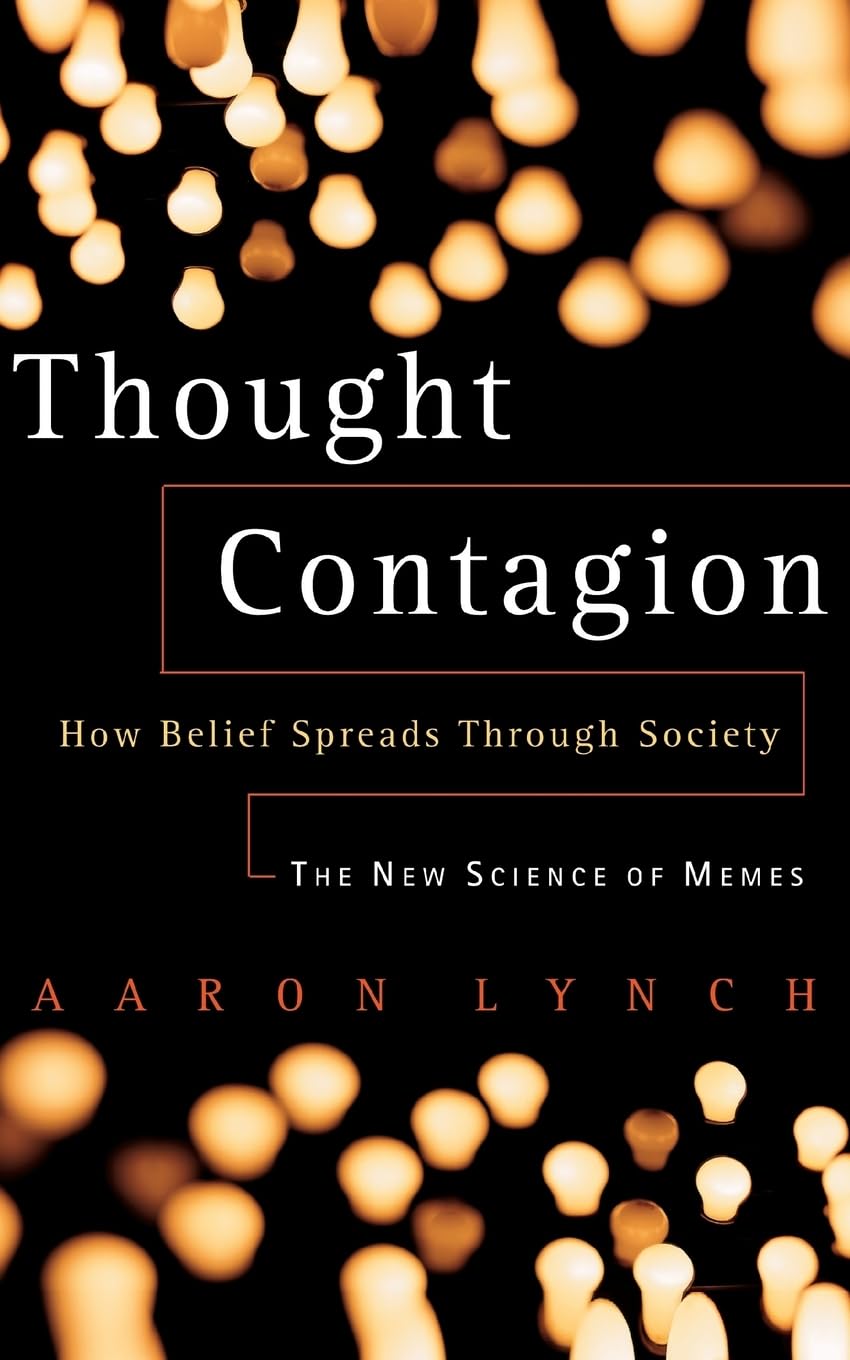
Title
Thought Contagion
Sold by Ergodebooks, an authorized reseller.
Returns accepted within 30 days | support@ergodebooks.com
Shipping Information
- Free Standard Shipping — United States only
- Processing Time: 3–5 business days
- Estimated Delivery: 6–10 business days after dispatch
- Double-boxed, fully insured & discreetly packaged
- Tracking number sent via email once dispatched
Returns & Refund
Returns accepted within 30 days of delivery.
Damaged or Defective Item
Free return shipping + replacement or full refund
Wrong Item Received
Free return shipping + replacement or full refund
Change of Mind
Return shipping at customer's expense · 25% restocking fee applies
Payment Option

Fans Of Douglas Hofstadter, Daniel Bennet, And Richard Dawkins (As Well As Science Buffs And Readers Of Wired Magazine) Will Revel In Aaron Lynch'S Groundbreaking Examination Of Memetics The New Study Of How Ideas And Beliefs Spread. What Characterizes A Meme Is Its Capacity For Displacing Rival Ideas And Beliefs In An Evolutionary Drama That Determines And Changes The Way People Think. Exactly How Do Ideas Spread, And What Are The Factors That Make Them Genuine Thought Contagions? Why, For Instance, Do Some Beliefs Spread Throughout Society, While Others Dwindle To Extinction? What Drives Those Intensely Held Beliefs That Spawn Ideological And Political Debates Such As Views On Abortion And Opinions About Sex And Sexuality? By Drawing On Examples From Everyday Life, Lynch Develops A Conceptual Basis For Understanding Memetics. Memes Evolve By Natural Selection In A Process Similar To That Of Genes In Evolutionary Biology. What Makes An Idea A Potent Meme Is How Effectively It Outpropagates Other Ideas. In Memetic Evolution, The Fittest Ideas Are Not Always The Truest Or The Most Helpful, But The Ones Best At Self Replication. Thus, Crash Diets Spread Not Because Of Lasting Benefit, But By Alternating Episodes Of Dramatic Weight Loss And Slow Regain. Each Sudden Thinning Provokes Onlookers To Ask, How Did You Do It? Thereby Manipulating Them To Experiment With The Diet And In Turn, Spread It Again. The Faster The Pounds Return, The More Often These People Enter That Disseminating Phase, All Of Which Favors Outbreaks Of The Most Pathogenic Diets. Like A Software Virus Traveling On The Internet Or A Flu Strain Passing Through A City, Thought Contagions Proliferate By Programming For Their Own Propagation. Lynch Argues That Certain Beliefs Spread Like Viruses And Evolve Like Microbes, As Mutant Strains Vie For More Adherents And More Hosts. In Its Most Revolutionary Aspect, Memetics Asks Not How People Accumulate Ideas, But How Ideas Accumulate People. Readers Of This Intriguing Theory Will Be Amazed To Discover That Many Popular Beliefs About Family, Sex, Politics, Religion, Health, And War Have Succeeded By Their Fitness As Thought Contagions.
⚠️ WARNING (California Proposition 65):
This product may contain chemicals known to the State of California to cause cancer, birth defects, or other reproductive harm.
For more information, please visit www.P65Warnings.ca.gov.
- Q: How many pages is 'Thought Contagion'? A: This book contains two hundred eight pages. It offers an in-depth exploration of memetics and how ideas spread.
- Q: What type of binding does 'Thought Contagion' have? A: This book is bound in paperback. It provides a flexible and lightweight reading experience.
- Q: Who is the author of 'Thought Contagion'? A: The author is Aaron Lynch. He examines the concept of memetics in this insightful book.
- Q: What themes does 'Thought Contagion' explore? A: It explores themes of ideas, beliefs, and their propagation within society. The book delves into the mechanics of how memes evolve.
- Q: What is the reading level of 'Thought Contagion'? A: The book is suitable for adult readers. It discusses complex ideas in social psychology and interactions.
- Q: How can I apply the concepts from 'Thought Contagion'? A: Readers can analyze their own beliefs and ideas through the lens of memetics. It encourages critical thinking about societal beliefs.
- Q: Is 'Thought Contagion' suitable for beginners in psychology? A: Yes, it is beginner-friendly. Lynch presents concepts in an accessible manner for those new to the subject.
- Q: What audience would benefit from reading 'Thought Contagion'? A: Fans of psychology, sociology, and science will benefit. It's ideal for anyone interested in how ideas spread.
- Q: How should I store 'Thought Contagion' to keep it in good condition? A: Store it in a cool, dry place away from direct sunlight. This will help preserve the integrity of the paperback.
- Q: Can I lend 'Thought Contagion' to someone? A: Yes, you can lend it. Just ensure that the book is returned in the same condition to maintain its quality.
- Q: What happens if 'Thought Contagion' arrives damaged? A: If it arrives damaged, you should contact the seller for a return or exchange. Most retailers have policies for such issues.
- Q: Is there a warranty for 'Thought Contagion'? A: Typically, there is no warranty for books. However, check with the retailer for their return policy.
- Q: How do I clean the cover of 'Thought Contagion'? A: Wipe the cover gently with a dry cloth. Avoid using water or cleaning solutions that could damage the material.
- Q: Does 'Thought Contagion' discuss contemporary beliefs? A: Yes, it examines current societal beliefs and their evolution. Lynch uses contemporary examples to illustrate his points.
- Q: What genre does 'Thought Contagion' belong to? A: It belongs to the genre of social psychology. The book combines elements of science and sociology in its analysis.