
Title
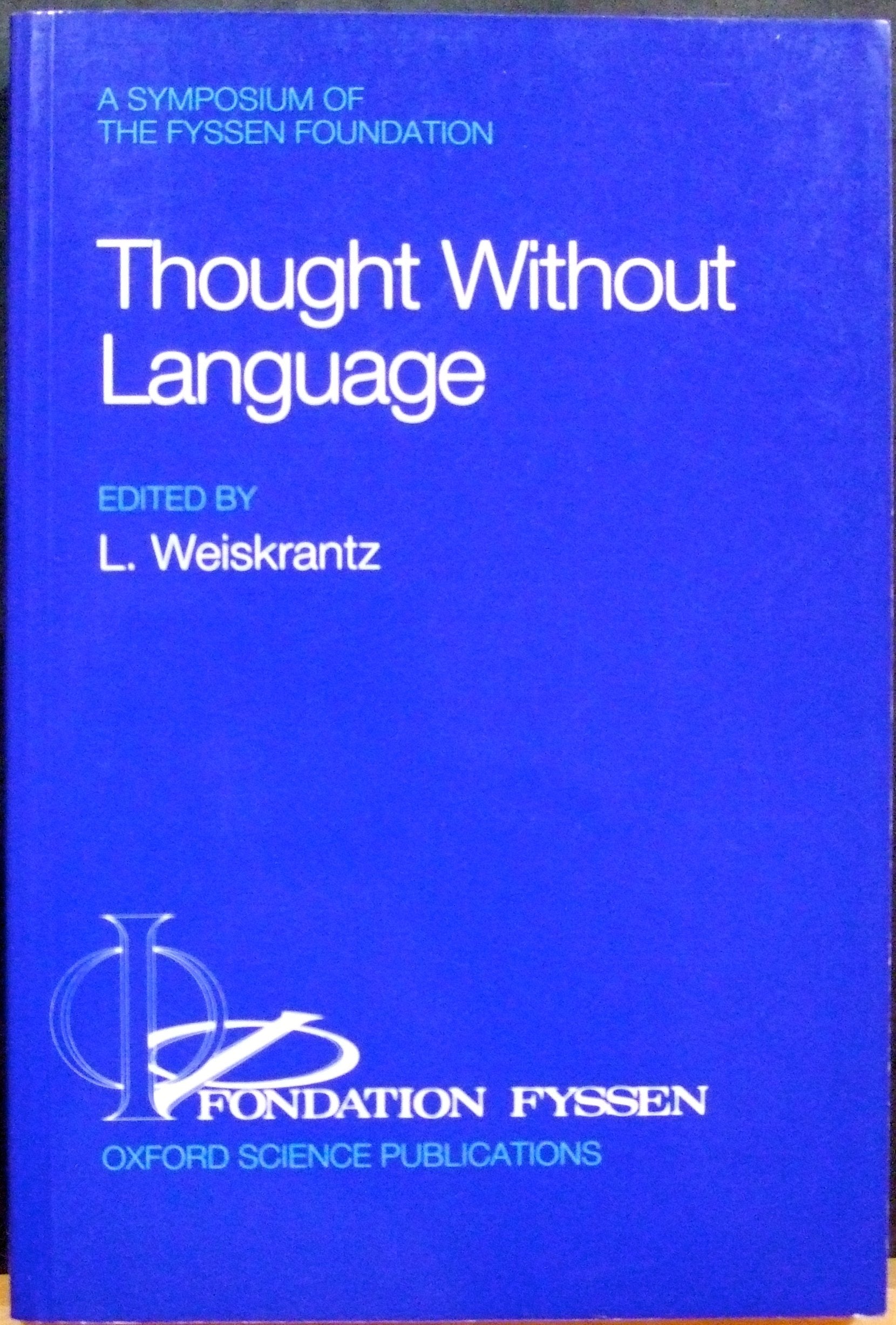
Thought Without Language (A ^AFyssen Foundation Symposium),Used
Sold by Ergodebooks, an authorized reseller.
Returns accepted within 30 days | support@ergodebooks.com
Shipping Information
- Free Standard Shipping — United States only
- Processing Time: 3–5 business days
- Estimated Delivery: 6–10 business days after dispatch
- Double-boxed, fully insured & discreetly packaged
- Tracking number sent via email once dispatched
Returns & Refund
Returns accepted within 30 days of delivery.
Damaged or Defective Item
Free return shipping + replacement or full refund
Wrong Item Received
Free return shipping + replacement or full refund
Change of Mind
Return shipping at customer's expense · 25% restocking fee applies
Payment Option

Does thought depend crucially on language, as some philosophers maintain, or can abstract reasoning and other faculties exist in the absence of language? This voume, based on a Fyssen Foundation symposium held in Versailles in April 1987, addresses this crucial question in a new way, bringing together experts on nonverbal thinking in adults, in prelinguistic infants, and in animals. The nineteen chapters, discussion and editorial comment represent an impressive body of material, shedding new light on many aspects of the problem. Topics covered include the role of the nonverbal right cerebral hemisphere in humans; the investigation of nonverbal aspects of various categories of cognition (such as abstract reasoning, spatial awareness, and pattern recognition); evidence for cognition without concious awareness; and neurological and developmental evidence. The concluding chapter is a personal account by a gifted but dyslexic mathematician of the nature of his handicap and the nonvebal reasoning that he has developed to cope with this. various
⚠️ WARNING (California Proposition 65):
This product may contain chemicals known to the State of California to cause cancer, birth defects, or other reproductive harm.
For more information, please visit www.P65Warnings.ca.gov.
- Q: How many pages does the book have? A: This book has five hundred sixty pages. It provides a comprehensive exploration of thought and language.
- Q: What is the binding type of this book? A: The binding type is paperback. This makes it lightweight and flexible for easy reading.
- Q: What are the dimensions of the book? A: The dimensions are six point twenty-six inches in length, one point sixteen inches in width, and nine point twenty-five inches in height.
- Q: Who is the author of this book? A: The author is L. Weiskrantz. He is known for his work on non-verbal thinking and cognition.
- Q: What topics does the book cover? A: The book covers topics like non-verbal thinking, cognition in infants, and neurological evidence. It explores abstract reasoning and spatial awareness.
- Q: Is this book suitable for all ages? A: Yes, the book is suitable for a broad audience, including academic readers and those interested in psychology and philosophy.
- Q: How should I read this book for best understanding? A: To grasp the concepts, read it chapter by chapter, taking time to reflect on the discussions presented.
- Q: Is this book appropriate for beginners in philosophy? A: Yes, it can be suitable for beginners. However, some sections may require more advanced understanding.
- Q: What is the main focus of the book? A: The main focus is to examine whether thought depends on language. It presents various perspectives from experts.
- Q: Can this book help with understanding cognitive development? A: Yes, it provides insights into cognitive development in pre-linguistic infants and the role of language.
- Q: How do I care for this paperback book? A: To care for the book, store it upright in a dry place and handle it gently to avoid creasing the cover.
- Q: Is there a warranty or return policy for this book? A: Typically, books do not come with a warranty, but you can return it if it arrives damaged or defective.
- Q: What if the book arrives damaged? A: If the book arrives damaged, you should contact the seller for a return or replacement.
- Q: How should I store this book? A: Store the book in a cool, dry place, preferably on a shelf to maintain its condition.
- Q: What is the unique perspective offered in this book? A: The book offers a unique perspective by addressing the cognitive abilities in the absence of language.
- Q: Does this book include discussions or commentary? A: Yes, it includes editorial comments and discussions, enriching the reader's understanding of the topics.