
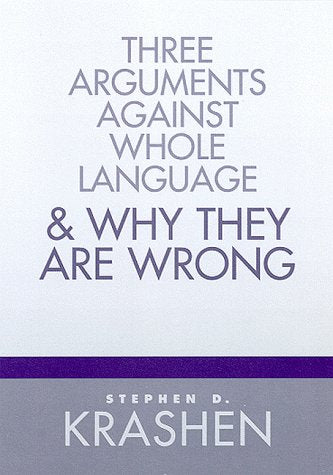
Title
Three Arguments Against Whole Language and Why They Are Wrong,Used
Sold by Ergodebooks, an authorized reseller.
Returns accepted within 30 days | support@ergodebooks.com
Shipping Information
- Free Standard Shipping — United States only
- Processing Time: 3–5 business days
- Estimated Delivery: 6–10 business days after dispatch
- Double-boxed, fully insured & discreetly packaged
- Tracking number sent via email once dispatched
Returns & Refund
Returns accepted within 30 days of delivery.
Damaged or Defective Item
Free return shipping + replacement or full refund
Wrong Item Received
Free return shipping + replacement or full refund
Change of Mind
Return shipping at customer's expense · 25% restocking fee applies
Payment Option

Stephen Krashen, one of the country's most respected authorities on language and literacy, sets the record straight about today's reading wars, offering an incisive analysis of the three major 'battle cries' of whole language critics. In a stepbystep dissection, Krashen reiterates the three arguments, then explores the most salient studies that support or refute them. CLAIM: Eye movement studies prove that readers assay text 'completely,' and therefore do not sample text to confirm predictions, as maintained by whole language advocates. In exploring the Eye Fixation Studies, which attempted to disprove the GoodmanSmith reading theory, Krashen reveals that study participants had no alternative but to examine every fine detail of the print. Further evidence is provided that supports the hypothesis that literacy development and comprehension are in fact closely related. CLAIM: Context interferes with reading. This is only true, says Krashen, if the context (e.g. pictures) is too rich, or 'overdetermining.' We also see how the results of studies supporting this claim were biased by the methodology used. CLAIM: Skillbuilding approaches to reading have been shown to produce better results than whole language. In fact, asserts Krashen, when whole language is correctly defined as providing comprehensible texts, it is a consistent winner.The author also skewers the national frenzy over early intervention and illustrates his point with a humorous scenario showing how 'prenatal phonemic awareness testing' could be the logical outgrowth of an entirely skillsbased approach! But beyond its point/counterpoint format, Three Arguments offers some real solutions, chief of which is making sure that all children have access to interesting reading material so they can finally achieve the standards of literacy they deserve.
⚠️ WARNING (California Proposition 65):
This product may contain chemicals known to the State of California to cause cancer, birth defects, or other reproductive harm.
For more information, please visit www.P65Warnings.ca.gov.