
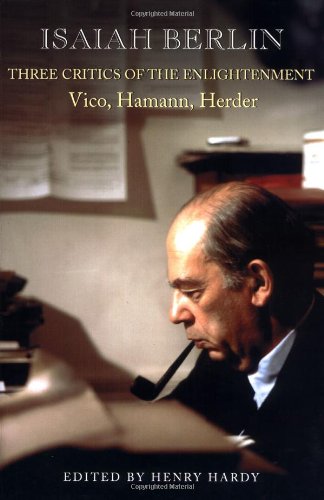
Title
Three Critics Of The Enlightenment: Vico, Hamann, Herder
Sold by Ergodebooks, an authorized reseller.
Returns accepted within 30 days | support@ergodebooks.com
Shipping Information
- Free Standard Shipping — United States only
- Processing Time: 3–5 business days
- Estimated Delivery: 6–10 business days after dispatch
- Double-boxed, fully insured & discreetly packaged
- Tracking number sent via email once dispatched
Returns & Refund
Returns accepted within 30 days of delivery.
Damaged or Defective Item
Free return shipping + replacement or full refund
Wrong Item Received
Free return shipping + replacement or full refund
Change of Mind
Return shipping at customer's expense · 25% restocking fee applies
Payment Option

Isaiah Berlin Was Deeply Admired During His Life, But His Full Contribution Was Perhaps Underestimated Because Of His Preference For The Long Essay Form. The Efforts Of Henry Hardy To Edit Berlin'S Work And Reintroduce It To A Broad, Eager Readership Have Gone Far To Remedy This. Now, Princeton Is Pleased To Return To Print, Under One Cover, Berlin'S Essays On Vico, Hamann, And Herder. These Essays On Three Relatively Uncelebrated Thinkers Are Not Marginal Ruminations, But Rather Among Berlin'S Most Important Studies In The History Of Ideas. They Are Integral To His Central Project: The Critical Recovery Of The Ideas Of The Counterenlightenment And The Explanation Of Its Appeal And Consequencesboth Positive And (Often) Tragic.Giambattista Vico Was The Anachronistic And Impoverished Neapolitan Philosopher Sometimes Credited With Founding The Human Sciences. He Opposed Enlightenment Methods As Cold And Fallacious. J. G. Hamann Was A Pious, Cranky Dilettante In A Peripheral German City. But He Was Brilliant Enough To Gain The Audience Of Kant, Goethe, And Moses Mendelssohn. In Hamann'S Chaotic And Longignored Writings, Berlin Finds The First Strong Attack On Enlightenment Rationalism And A Wholly Original Source Of The Coming Swell Of Romanticism. Johann Gottfried Herder, The Progenitor Of Populism And European Nationalism, Rejected Universalism And Rationalism But Championed Cultural Pluralism.Individually, These Fascinating Intellectual Biographies Reveal Berlin'S Own Great Intelligence, Learning, And Generosity, As Well As The Passionate Genius Of His Subjects. Together, They Constitute An Arresting Interpretation Of Romanticism'S Precursors. In Hamann'S Railings And The More Considered Writings Of Vico And Herder, Berlin Finds Critics Of The Enlightenment Worthy Of Our Careful Attention. But He Identifies Much That Is Misguided In Their Rejection Of Universal Values, Rationalism, And Science. With His Customary Emphasis On The Frightening Power Of Ideas, Berlin Traces Much Of The Next Centuries' Irrationalism And Suffering To The Historicism And Particularism They Advocated. What Berlin Has To Say About These Longdead Thinkersin Appreciation And Dissentis Remarkably Timely In A Day When Enlightenment Beliefs Are Being Challenged Not Just By Academics But By Politicians And By Powerful Nationalist And Fundamentalist Movements.The Study Of J. G. Hamann Was Originally Published Under The Title The Magus Of The North: J. G. Hamann And The Origins Of Modern Irrationalism. The Essays On Vico And Herder Were Originally Published As Vico And Herder: Two Studies In The History Of Ideas. Both Are Out Of Print.
⚠️ WARNING (California Proposition 65):
This product may contain chemicals known to the State of California to cause cancer, birth defects, or other reproductive harm.
For more information, please visit www.P65Warnings.ca.gov.
- Q: How many pages does this book have? A: This book has three hundred eighty-two pages. It provides an in-depth exploration of the ideas of Vico, Hamann, and Herder.
- Q: What is the binding type of the book? A: The book is paperback bound. This makes it lightweight and portable, suitable for casual reading.
- Q: What are the dimensions of this book? A: The dimensions of the book are six inches in length, zero point seventy-five inches in width, and nine point zero two inches in height.
- Q: Who is the author of the book? A: The author of the book is Isaiah Berlin. He is known for his significant contributions to the study of political theory and history of ideas.
- Q: What is the main subject of this book? A: The main subject of this book is the critique of Enlightenment thought. It focuses on the works of three influential thinkers: Vico, Hamann, and Herder.
- Q: How do I read this book effectively? A: To read this book effectively, consider taking notes on key arguments and historical contexts. Reflect on how the ideas relate to contemporary issues.
- Q: Is this book suitable for beginners in philosophy? A: Yes, this book is suitable for beginners in philosophy. It introduces complex ideas in an accessible manner, making it a great starting point.
- Q: What themes are explored in this book? A: The book explores themes of romanticism, cultural pluralism, and critiques of rationalism. It provides insights into the counter-Enlightenment movements.
- Q: How can I keep this book in good condition? A: To keep this book in good condition, store it upright on a shelf and avoid exposure to direct sunlight. Handle it with clean hands to prevent dirt.
- Q: Is this book appropriate for academic study? A: Yes, this book is appropriate for academic study. It provides critical insights into historical thought, making it valuable for students and scholars.
- Q: What should I do if the book arrives damaged? A: If the book arrives damaged, you should contact the seller immediately. Most retailers offer return or exchange options for damaged items.
- Q: Can I find similar books on Enlightenment critiques? A: Yes, you can find similar books on Enlightenment critiques. Look for works by contemporary philosophers or historical analyses of the period.
- Q: What is the intended audience for this book? A: The intended audience for this book includes students, scholars, and general readers interested in philosophy and history of ideas.
- Q: Does this book have any illustrations or images? A: No, this book does not contain illustrations or images. It focuses on textual analysis and critical essays.
- Q: How does this book compare to other works by Isaiah Berlin? A: This book is similar to other works by Isaiah Berlin in its depth of analysis and historical context. It focuses on lesser-known figures in Enlightenment thought.