
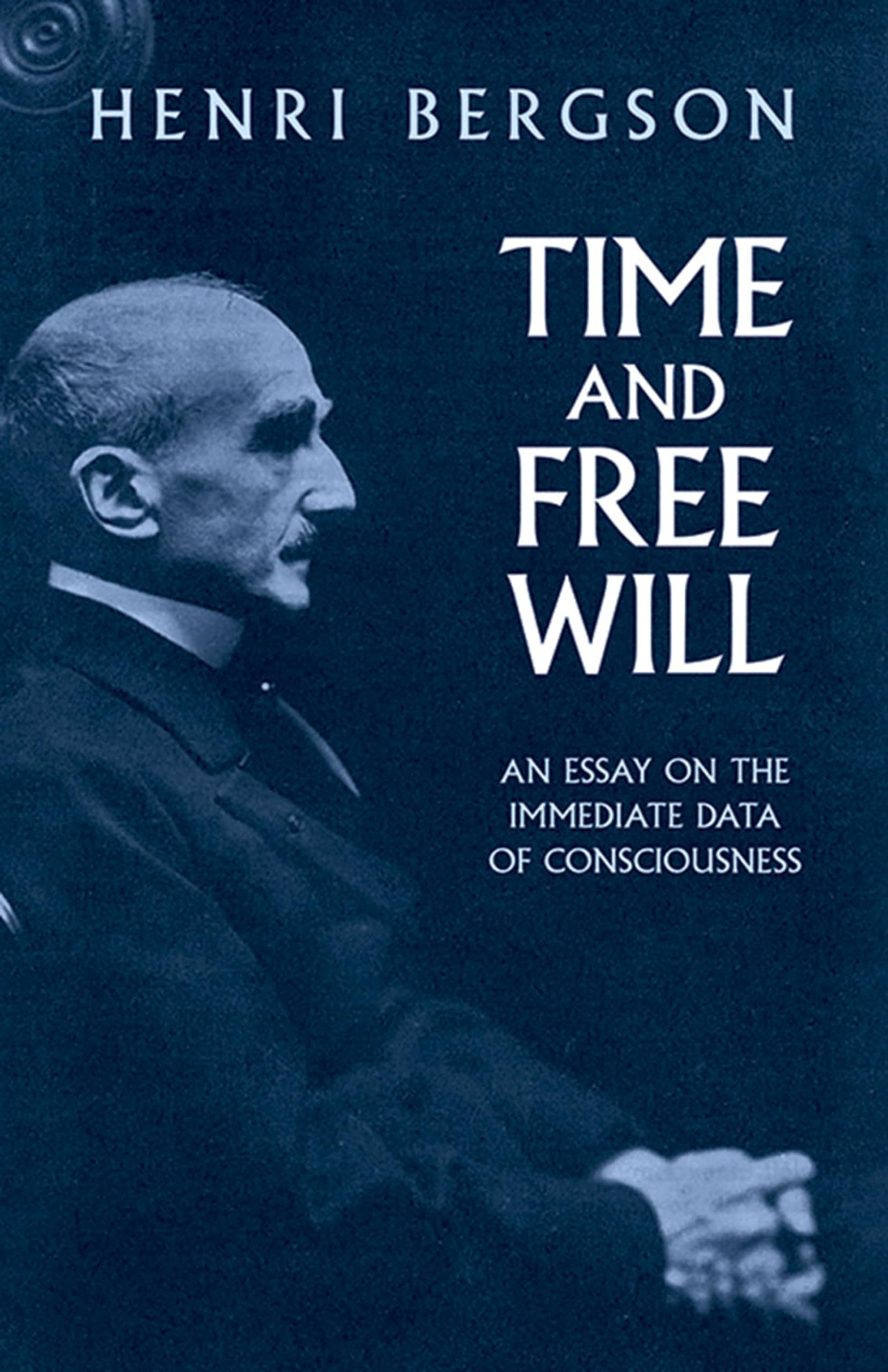
Title
Time and Free Will: An Essay on the Immediate Data of Consciousness,New
Sold by Ergodebooks, an authorized reseller.
Returns accepted within 30 days | support@ergodebooks.com
Shipping Information
- Free Standard Shipping — United States only
- Processing Time: 3–5 business days
- Estimated Delivery: 6–10 business days after dispatch
- Double-boxed, fully insured & discreetly packaged
- Tracking number sent via email once dispatched
Returns & Refund
Returns accepted within 30 days of delivery.
Damaged or Defective Item
Free return shipping + replacement or full refund
Wrong Item Received
Free return shipping + replacement or full refund
Change of Mind
Return shipping at customer's expense · 25% restocking fee applies
Payment Option

Internationally known and one of the most influential philosophers of his day (and for a time almost a cult figure in France, where his lectures drew huge crowds), Henri Bergson (185941) led a revolution in philosophical thought by rejecting traditional conceptual and abstract methods, and arguing that the intuition is deeper than the intellect. His speculations, especially about the nature of time, had a profound influence on many other philosophers, as well as on poets and novelists; they are said to have been the seed for la recherce de temps perdu by Marcel Proust (whose cousin was Bergson's wife). Though his ideas were sometimes difficult to follow, Bergson was also a fine stylist, who once declared, 'there is nothing in philosophy which could not be said in everyday language,' and who was awarded the Nobel Prize for Literature in 1927.In Time and Free Will, written as his doctoral thesis, Bergson tries to dispel the arguments against free will. These arguments, he shows, come from a confusion of different ideas of time. Physicists and mathematicians conceive of time as a measurable construct much like the spatial dimensions. But in human experience, life is perceived as a continuous and unmeasurable flow rather than as a succession of markedoff states of consciousness something that can be measured not quantitatively, but only qualitatively. And because human personalities express themselves in acts that cannot be predicted, Bergson declares free will to be an observable fact. Students and teachers of philosophy are sure to welcome this inexpensive reprint of Bergson's classic, influential essay, long a staple of college philosophy courses.
⚠️ WARNING (California Proposition 65):
This product may contain chemicals known to the State of California to cause cancer, birth defects, or other reproductive harm.
For more information, please visit www.P65Warnings.ca.gov.
- Q: What is the main theme of 'Time and Free Will' by Henri Bergson? A: The main theme of 'Time and Free Will' is the exploration of free will, which Bergson argues is an observable fact. He contrasts the measurable concept of time used in physics with the qualitative experience of time in human consciousness.
- Q: How does Bergson differentiate between types of time in his essay? A: Bergson differentiates between the measurable time of physicists, which is akin to spatial dimensions, and the lived experience of time, which he describes as a continuous flow that cannot be quantified.
- Q: What influence did Bergson's ideas have on literature and philosophy? A: Bergson's ideas significantly influenced many philosophers, poets, and novelists, notably inspiring Marcel Proust's 'À la recherche du temps perdu'.
- Q: Is 'Time and Free Will' suitable for beginners in philosophy? A: Yes, 'Time and Free Will' is considered accessible for students and teachers of philosophy, making it a suitable entry point for those new to Bergson's work.
- Q: What type of binding does this edition of 'Time and Free Will' have? A: This edition of 'Time and Free Will' is published in paperback binding.
- Q: When was 'Time and Free Will' first published? A: The essay was first published on June 7, 2001, as a reprint of Bergson's original doctoral thesis.
- Q: How many pages does 'Time and Free Will' contain? A: The book contains a total of 288 pages.
- Q: Who is the author of 'Time and Free Will'? A: The author of 'Time and Free Will' is Henri Bergson, a renowned French philosopher.
- Q: What is the condition of the book? A: The book is in new condition, ensuring it is ready for readers.
- Q: What philosophical concepts does Bergson address in this essay? A: In this essay, Bergson addresses concepts of free will, time, consciousness, and the nature of human experience.