If you have any questions, you are always welcome to contact us. We'll get back to you as soon as possible, withing 24 hours on weekdays.
Customer service
All questions about your order, return and delivery must be sent to our customer service team by e-mail at yourstore@yourdomain.com
Sale & Press
If you are interested in selling our products, need more information about our brand or wish to make a collaboration, please contact us at press@yourdomain.com
Help
If you have any questions, you are always welcome to contact us. We'll get back to you as soon as possible, withing 24 hours on weekdays.
Customer service
All questions about your order, return and delivery must be sent to our customer service team by e-mail at yourstore@yourdomain.com
Sale & Press
If you are interested in selling our products, need more information about our brand or wish to make a collaboration, please contact us at press@yourdomain.com
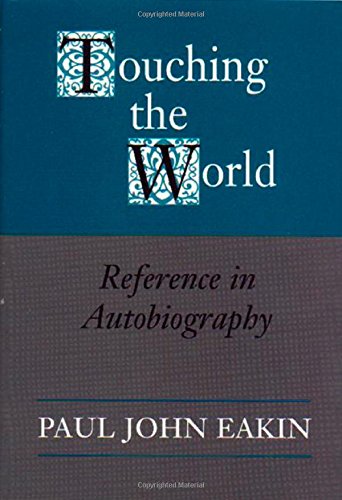
Paul John Eakin's earlier work Fictions in Autobiography is a key text in autobiography studies. In it he proposed that the self that finds expression in autobiography is in fundamental ways a kind of fictive construct, a fiction articulated in a fiction. In this new book Eakin turns his attention to what he sees as the defining assumption of autobiography: that the story of the self does refer to a world of biographical and historical fact. Here he shows that people write autobiography not in some private realm of the autonomous self but rather in strenuous engagement with the pressures that life in culture entails. In so demonstrating, he offers fresh readings of autobiographies by Roland Barthes, Nathalie Sarraute, William Maxwell, Henry James, Ronald Fraser, Richard Rodriguez, Henry Adams, Patricia Hampl, John Updike, James McConkey, and Lillian Hellman. In the introduction Eakin makes a case for reopening the file on reference in autobiography, and in the first chapter he establishes the complexity of the referential aesthetic of the genre, the intricate interplay of fact and fiction in such texts. In subsequent chapters he explores some of the major contexts of reference in autobiography: the biographical, the social and cultural, the historical, and finally, underlying all the rest, the somatic and temporal dimensions of the lived experience of identity. In his discussion of contemporary theories of the self, Eakin draws especially on cultural anthropology and developmental psychology.
⚠️ WARNING (California Proposition 65):
This product may contain chemicals known to the State of California to cause cancer,
birth defects, or other reproductive harm.
For MAP (Minimum Advertised Price) violations and Intellectual Property (IP) or Trademark concerns, please contact:
support@ergodebooks.com
⚠️ California Proposition 65 Warning: Some products sold on this website may expose you to chemicals known to the State of California to cause cancer, birth defects, or other reproductive harm. For more information, visit www.P65Warnings.ca.gov.