If you have any questions, you are always welcome to contact us. We'll get back to you as soon as possible, withing 24 hours on weekdays.
Customer service
All questions about your order, return and delivery must be sent to our customer service team by e-mail at yourstore@yourdomain.com
Sale & Press
If you are interested in selling our products, need more information about our brand or wish to make a collaboration, please contact us at press@yourdomain.com
Help
If you have any questions, you are always welcome to contact us. We'll get back to you as soon as possible, withing 24 hours on weekdays.
Customer service
All questions about your order, return and delivery must be sent to our customer service team by e-mail at yourstore@yourdomain.com
Sale & Press
If you are interested in selling our products, need more information about our brand or wish to make a collaboration, please contact us at press@yourdomain.com
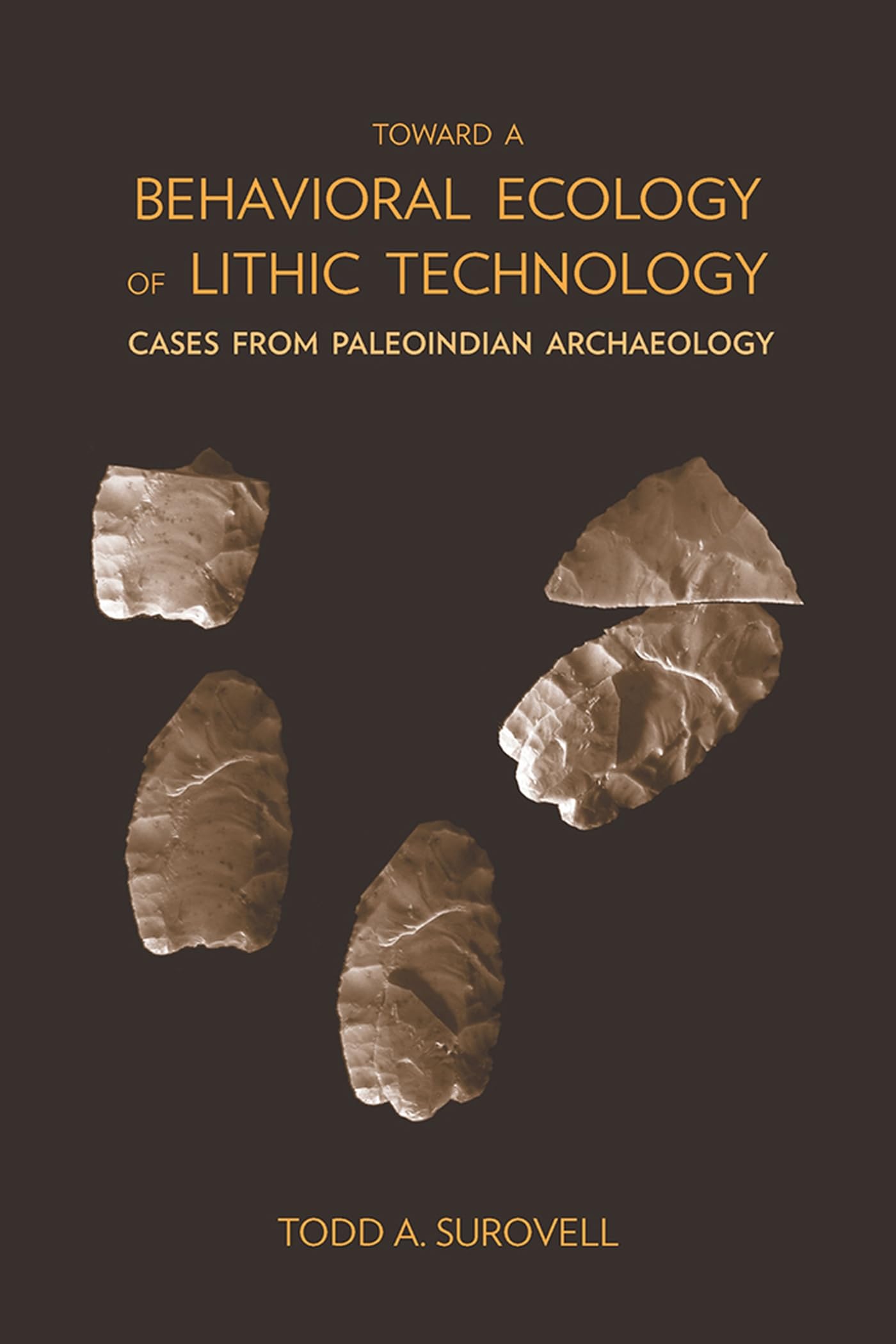
Modern humans and their hominid ancestors relied on chippedstone technology for well over two million years and colonized more than 99 percent of the Earth's habitable landmass in doing so. Yet there currently exist only a handful of informal models derived from ethnographic observation, experiments, engineering, and 'common sense' to explain variability in archaeological lithic assemblages.Because the fundamental processes of making, using, and discarding stone tools are, at root, exercises in problem solving, Todd Surovell asks what conditions favor certain technological solutions. Whether asking if a biface should be made thick or thin or if a flake should be saved or discarded, Surovell seeks answers that extend beyond a casebycase analysis. One avenue for addressing these questions theoretically is formal mathematical modeling.Here Surovell constructs a series of models designed to link environmental variability to human decision making as it pertains to lithic technology. To test the models, Surovell uses data from the analysis of more than 40,000 artifacts from five Rocky Mountain and Northern Plains Folsom and Goshen complex archaeological sites dating to the Younger Dryas stadial (ca. 12,60011,500 years BP). The primary result is the production of powerful new analytical tools useful to the interpretation of archaeological assemblages.Surovell's goal is to promote modeling and explore the general issues governing technological decisions. In this light, his models can be applied to any context in which stone tools are made and used.
⚠️ WARNING (California Proposition 65):
This product may contain chemicals known to the State of California to cause cancer,
birth defects, or other reproductive harm.
For MAP (Minimum Advertised Price) violations and Intellectual Property (IP) or Trademark concerns, please contact:
support@ergodebooks.com
⚠️ California Proposition 65 Warning: Some products sold on this website may expose you to chemicals known to the State of California to cause cancer, birth defects, or other reproductive harm. For more information, visit www.P65Warnings.ca.gov.