If you have any questions, you are always welcome to contact us. We'll get back to you as soon as possible, withing 24 hours on weekdays.
Customer service
All questions about your order, return and delivery must be sent to our customer service team by e-mail at yourstore@yourdomain.com
Sale & Press
If you are interested in selling our products, need more information about our brand or wish to make a collaboration, please contact us at press@yourdomain.com
Help
If you have any questions, you are always welcome to contact us. We'll get back to you as soon as possible, withing 24 hours on weekdays.
Customer service
All questions about your order, return and delivery must be sent to our customer service team by e-mail at yourstore@yourdomain.com
Sale & Press
If you are interested in selling our products, need more information about our brand or wish to make a collaboration, please contact us at press@yourdomain.com
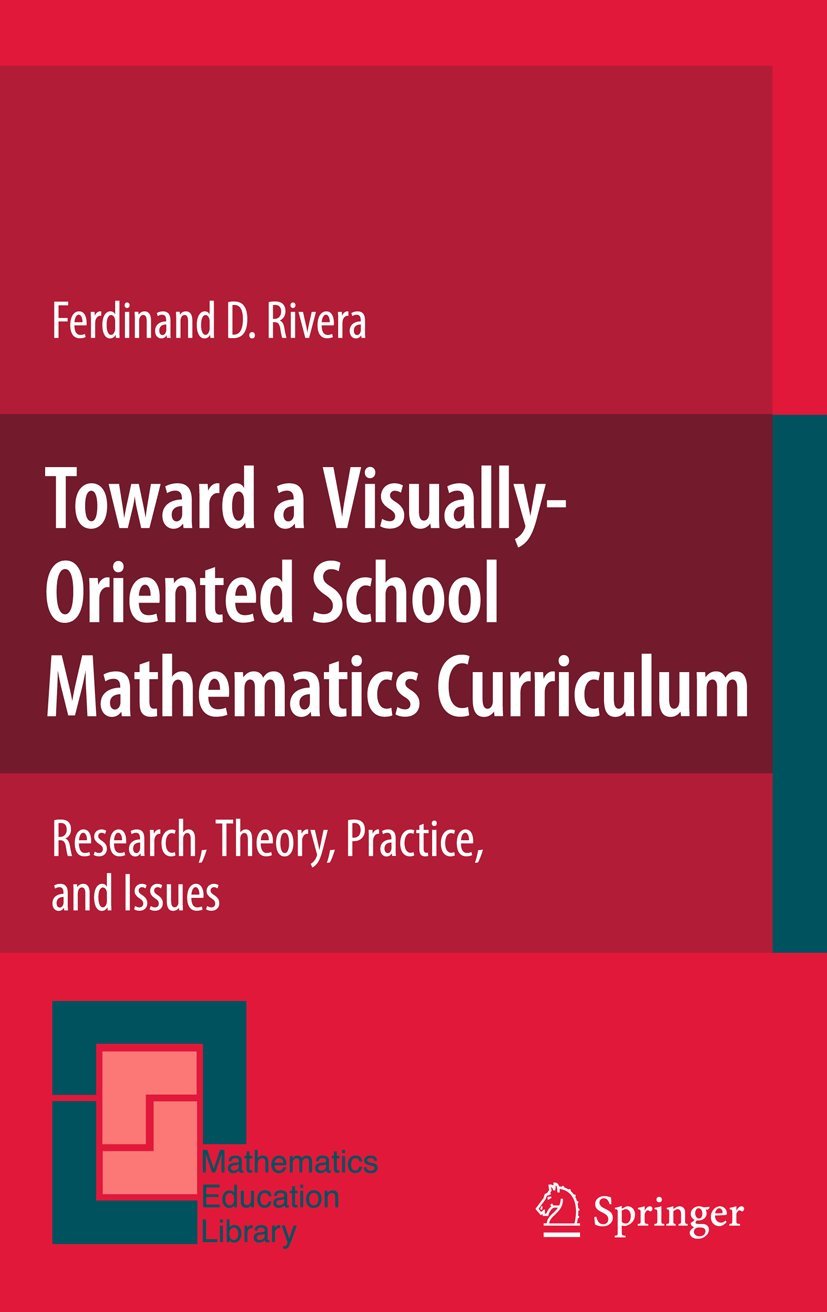
What does it mean to have a visual representation of a mathematical object, concept, or process? What visualization strategies support growth in mathematical thinking, reasoning, generalization, and knowledge? Is mathematical seeing culturefree? How can information drawn from studies in blind subjects help us understand the significance of a multimodal approach to learning mathematics? Toward a VisuallyOriented School Mathematics Curriculum explores a unified theory of visualization in school mathematical learning via the notion of progressive modeling. Based on the authors longitudinal research investigations in elementary and middle school classrooms, the book provides a compelling empirical account of ways in which instruction can effectively orchestrate the transition from personallyconstructed visuals, both externallydrawn and internallyderived, into more structured visual representations within the context of a socioculturally grounded mathematical activity. Both for teachers and researchers, a discussion of this topic is relevant in the history of the present. The ubiquity of technological tools and virtual spaces for learning and doing mathematics has aroused interest among concerned stakeholders about the role of mathematics in these contexts. The book begins with a prolegomenon on the authors reflections on past and present visual studies in mathematics education. In the remaining seven chapters, visualization is pursued in terms of its role in bringing about progressions in mathematical symbolization, abduction, pattern generalization, and diagrammatization. Toward a VisuallyOriented School Mathematics Curriculum views issues surrounding visualization through the eyes of a classroom teacherresearcher; it draws on findings within and outside of mathematics education that help practitioners and scholars gain a better understanding of what it means to pleasurably experience the symmetric visual/symbolic reversal phenomenon that is, seeing the visual in the symbolic and the symbolic in the visual.'
⚠️ WARNING (California Proposition 65):
This product may contain chemicals known to the State of California to cause cancer,
birth defects, or other reproductive harm.
For MAP (Minimum Advertised Price) violations and Intellectual Property (IP) or Trademark concerns, please contact:
support@ergodebooks.com
⚠️ California Proposition 65 Warning: Some products sold on this website may expose you to chemicals known to the State of California to cause cancer, birth defects, or other reproductive harm. For more information, visit www.P65Warnings.ca.gov.