
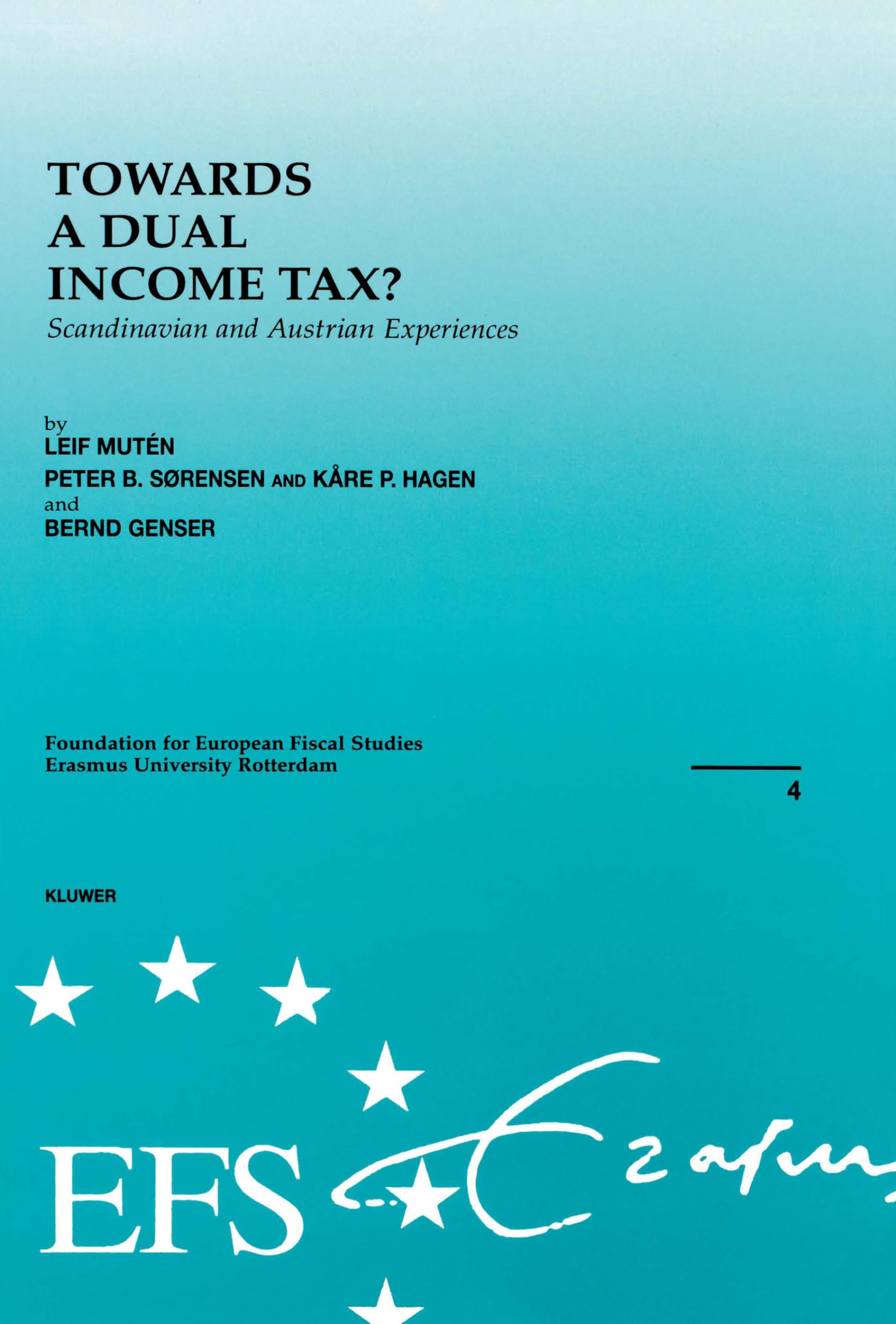
Title
Towards A Dual Income Tax?:Scandinavian And Austrian Experiences
Sold by Ergodebooks, an authorized reseller.
Returns accepted within 30 days | support@ergodebooks.com
Shipping Information
- Free Standard Shipping — United States only
- Processing Time: 3–5 business days
- Estimated Delivery: 6–10 business days after dispatch
- Double-boxed, fully insured & discreetly packaged
- Tracking number sent via email once dispatched
Returns & Refund
Returns accepted within 30 days of delivery.
Damaged or Defective Item
Free return shipping + replacement or full refund
Wrong Item Received
Free return shipping + replacement or full refund
Change of Mind
Return shipping at customer's expense · 25% restocking fee applies
Payment Option

In A World Of Growing Capital Mobility And Financial Innovation, Countries Find It Increasingly Difficult Properly To Reach Capital Income Under Their Global Income Taxes. As A Result, Capital Income Is Taxed Lightly Or Not At All. This Violates Commonly Accepted Equity And Neutrality Criteria.In Trying To Remedy The Situation, The Scandinavian Countries And Finland Have Introduced A Dual Income Tax Under Which The Tax Treatment Of Capital Income Is Separated From The Tax Treatment Of Labor Income. While Labor Income Continues To Be Taxed At High Progressive Rates, Capital Income Is Subject To A Low, Uniform Rate Of Tax. Austria Has Also Taken Steps Towards A Dual Income Tax, By Introducing (Among Other Measures) A Final, Flat Sourcewithholding Tax On Interest.To Examine These Developments, The Foundation For European Fiscal Studies Of Erasmus University Rotterdam Organized A Seminar In May 1995 To Discuss The Papers On Various Aspects Of The Dual Income Tax Presented By Leif Mutandeacute;N (Stockholm School Of Economics), Kandaring;Re P. Hagen (Norwegian School Of Economics And Business Administration), Peter B. Sorensen (Economic Policy Research Unit, Copenhagen) And Bernd Genser (University Of Konstanz).While The Dual Income Tax Has Resulted In The More Effective Taxation Of Capital Income, It Has Also Led To Problems In Dealing Adequately With The Separation Of Capital And Labor Income Accruing In Proprietorships And Closed Companies. Nonetheless, The Dual Income Tax Seems To Provide More Equal Treatment And Neutrality Than The Socalled Global Income Tax.This Brochure Is The Fourth In A New Series Initiated By The Foundation For European Fiscal Studies.
⚠️ WARNING (California Proposition 65):
This product may contain chemicals known to the State of California to cause cancer, birth defects, or other reproductive harm.
For more information, please visit www.P65Warnings.ca.gov.
- Q: What is the main focus of 'Towards a Dual Income Tax?: Scandinavian and Austrian Experiences'? A: The book explores the implementation of dual income tax systems in Scandinavian countries and Austria, addressing the challenges of taxing capital income in light of global financial mobility.
- Q: Who is the author of this book? A: The book is authored by Leif Mutben, a noted expert in public finance.
- Q: What are the key features discussed in the book? A: Key features include the separation of capital and labor income taxation, high progressive rates on labor income, and a low uniform tax rate on capital income.
- Q: When was this book published? A: The book was published on July 9, 1996.
- Q: How many pages does the book contain? A: The book contains 96 pages.
- Q: What is the condition of the book? A: The book is in new condition.
- Q: What is the binding type of this book? A: The book is available in paperback binding.
- Q: Is this book suitable for someone new to public finance? A: Yes, this book provides a comprehensive overview of dual income tax systems, making it suitable for readers new to public finance.
- Q: What category does this book fall under? A: The book falls under the category of Public Finance.
- Q: Does the book address the practical challenges of dual income tax systems? A: Yes, the book discusses the challenges of applying dual income tax systems, especially concerning proprietorships and closed companies.