
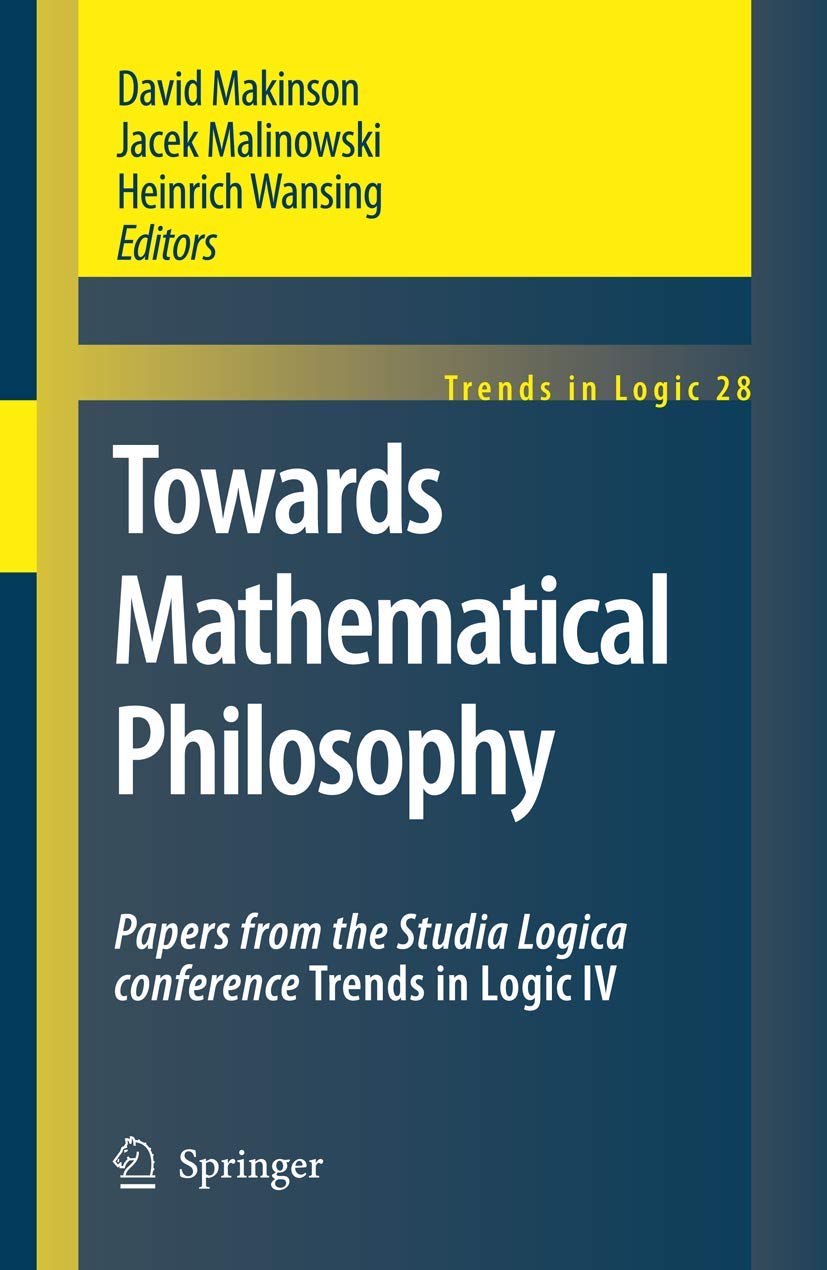
Title
Towards Mathematical Philosophy: Papers from the Studia Logica conference Trends in Logic IV (Trends in Logic, 28),Used
Sold by Ergodebooks, an authorized reseller.
Returns accepted within 30 days | support@ergodebooks.com
Shipping Information
- Free Standard Shipping — United States only
- Processing Time: 3–5 business days
- Estimated Delivery: 6–10 business days after dispatch
- Double-boxed, fully insured & discreetly packaged
- Tracking number sent via email once dispatched
Returns & Refund
Returns accepted within 30 days of delivery.
Damaged or Defective Item
Free return shipping + replacement or full refund
Wrong Item Received
Free return shipping + replacement or full refund
Change of Mind
Return shipping at customer's expense · 25% restocking fee applies
Payment Option

area and in applications to linguistics, formal epistemology, and the study of norms. The second contains papers on nonclassical and manyvalued logics, with an eye on applications in computer science and through it to engineering. The third concerns the logic of belief management,whichis likewise closely connected with recent work in computer science but also links directly with epistemology, the philosophy of science, the study of legal and other normative systems, and cognitive science. The grouping is of course rough, for there are contributions to the volume that lie astride a boundary; at least one of them is relevant, from a very abstract perspective, to all three areas. We say a few words about each of the individual chapters, to relate them to each other and the general outlook of the volume. Modal Logics The ?rst bundle of papers in this volume contains contribution to modal logic. Three of them examine general problems that arise for all kinds of modal logics. The ?rst paper is essentially semantical in its approach, the second prooftheoretic, the third semantical again: Commutativity of quanti?ers in varyingdomain Kripke models,by R. Goldblatt and I. Hodkinson, investigates the possibility of com tation (i.e. reversing the order) for quanti?ers in ?rstorder modal logics interpreted over relational models with varying domains. The authors study a possibleworlds style structural model theory that does not v idate commutation, but satis?es all the axioms originally presented by Kripke for his familiar semantics for ?rstorder modal logic.
⚠️ WARNING (California Proposition 65):
This product may contain chemicals known to the State of California to cause cancer, birth defects, or other reproductive harm.
For more information, please visit www.P65Warnings.ca.gov.