If you have any questions, you are always welcome to contact us. We'll get back to you as soon as possible, withing 24 hours on weekdays.
Customer service
All questions about your order, return and delivery must be sent to our customer service team by e-mail at yourstore@yourdomain.com
Sale & Press
If you are interested in selling our products, need more information about our brand or wish to make a collaboration, please contact us at press@yourdomain.com
Help
If you have any questions, you are always welcome to contact us. We'll get back to you as soon as possible, withing 24 hours on weekdays.
Customer service
All questions about your order, return and delivery must be sent to our customer service team by e-mail at yourstore@yourdomain.com
Sale & Press
If you are interested in selling our products, need more information about our brand or wish to make a collaboration, please contact us at press@yourdomain.com
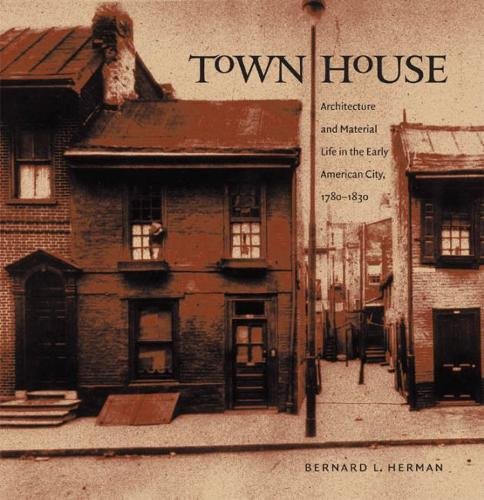
In this abundantly illustrated volume, Bernard Herman provides a history of urban dwellings and the people who built and lived in them in early America. In the eighteenth century, cities were constant objects of idealization, often viewed as the outward manifestations of an organized, civil society. As the physical objects that composed the largest portion of urban settings, town houses contained and signified different aspects of city life, argues Herman.Taking a material culture approach, Herman examines urban domestic buildings from Charleston, South Carolina, to Portsmouth, New Hampshire, as well as those in English cities and towns, to better understand why people built the houses they did and how their homes informed everyday city life. Working with buildings and documentary sources as diverse as court cases and recipes, Herman interprets town houses as lived experience. Chapters consider an array of domestic spaces, including the merchant family's house, the servant's quarter, and the widow's dower. Herman demonstrates that city houses served as sites of power as well as complex and often conflicted artifacts mapping the everyday negotiations of social identity and the display of sociability.
⚠️ WARNING (California Proposition 65):
This product may contain chemicals known to the State of California to cause cancer,
birth defects, or other reproductive harm.
For MAP (Minimum Advertised Price) violations and Intellectual Property (IP) or Trademark concerns, please contact:
support@ergodebooks.com
⚠️ California Proposition 65 Warning: Some products sold on this website may expose you to chemicals known to the State of California to cause cancer, birth defects, or other reproductive harm. For more information, visit www.P65Warnings.ca.gov.