
Title
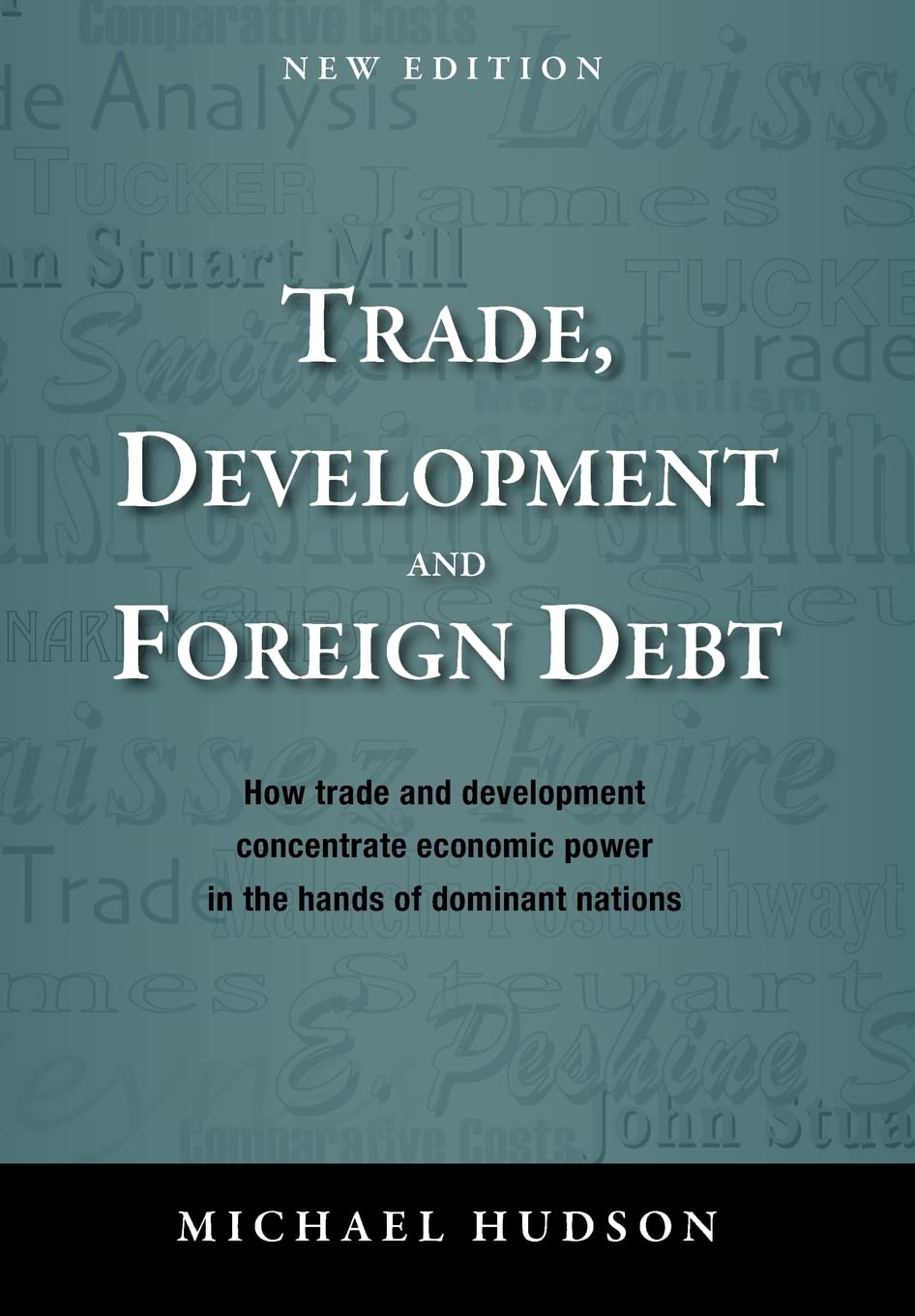
Trade, Development and Foreign Debt,Used
Sold by Ergodebooks, an authorized reseller.
Returns accepted within 30 days | support@ergodebooks.com
Shipping Information
- Free Standard Shipping — United States only
- Processing Time: 3–5 business days
- Estimated Delivery: 6–10 business days after dispatch
- Double-boxed, fully insured & discreetly packaged
- Tracking number sent via email once dispatched
Returns & Refund
Returns accepted within 30 days of delivery.
Damaged or Defective Item
Free return shipping + replacement or full refund
Wrong Item Received
Free return shipping + replacement or full refund
Change of Mind
Return shipping at customer's expense · 25% restocking fee applies
Payment Option

In this survey of international economic thought, Michael Hudson rewrites the history of trade, development and debt theorizing. He shows that mainstream freetrade surveys are censorial in excluding the protectionist logic that has guided the trade policy of Europe and the United States, especially by leaving out discussion of the transfer problem and payment of international debts. He points out that most economists throughout history have focused as much on war financing as on trade and development. Freetrade ideology and IMFstyle financial austerity under today's rules, rather than benefiting all parties and maximizing welfare, leave 'client' nations severely indebted. By excluding dynamics that used to be central to trade theory such as emigration and technology transfer, today's global production and financial policies tend to concentrate economic and political power in the hands of dominant nations. Prof. Michael Hudson (Economics Department, University of Missouri, Kansas City) is a frequent contributor to The Financial Times, Counterpunch, and Global Research.
⚠️ WARNING (California Proposition 65):
This product may contain chemicals known to the State of California to cause cancer, birth defects, or other reproductive harm.
For more information, please visit www.P65Warnings.ca.gov.
- Q: What is the main topic of 'Trade, Development and Foreign Debt'? A: The book surveys international economic thought, focusing on trade, development, and debt theorizing, highlighting the protectionist logic often excluded in mainstream free-trade discussions.
- Q: Who is the author of the book? A: The author is Michael Hudson, who is a professor in the Economics Department at the University of Missouri, Kansas City.
- Q: What is the condition of the book? A: The book is listed as a used book in good condition.
- Q: How many pages does the book have? A: The book contains 440 pages.
- Q: What is the binding type of this book? A: This book is available in paperback binding.
- Q: When was 'Trade, Development and Foreign Debt' published? A: The book was published on September 23, 2009.
- Q: What are some key themes discussed in the book? A: Key themes include the impact of free-trade ideology, the transfer problem in international debts, and the focus on war financing in historical economic thought.
- Q: Is this book suitable for academic study? A: Yes, the book provides in-depth analysis and perspectives that are valuable for academic study in economics and international relations.
- Q: Can this book help in understanding current economic policies? A: Yes, it critiques contemporary global production and financial policies, making it relevant for understanding current economic dynamics.
- Q: What genre does this book fall under? A: The book falls under the genre of Company Profiles and economic theory.