
Title
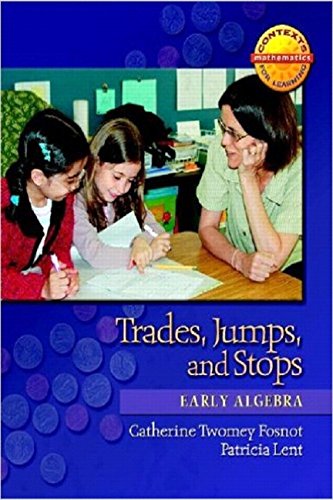
Trades, Jumps, and Stops: Early Algebra (Contexts for Learning Mathematics, Grades K3: Investigating Number Sense, Addition, an,Used
Sold by Ergodebooks, an authorized reseller.
Returns accepted within 30 days | support@ergodebooks.com
Shipping Information
- Free Standard Shipping — United States only
- Processing Time: 3–5 business days
- Estimated Delivery: 6–10 business days after dispatch
- Double-boxed, fully insured & discreetly packaged
- Tracking number sent via email once dispatched
Returns & Refund
Returns accepted within 30 days of delivery.
Damaged or Defective Item
Free return shipping + replacement or full refund
Wrong Item Received
Free return shipping + replacement or full refund
Change of Mind
Return shipping at customer's expense · 25% restocking fee applies
Payment Option

Trades, Jumps, and Stops: Early Algebra is one of eight units in the Contexts for Learning Mathematics Investigating Number Sense, Addition, and Subtraction (K3) The story The Masloppy Family Goes to New York City sets the stage in this unit for a series of investigations to develop several big ideas and strategies important in the algebra strand. Sevenyearold Nicholas Masloppy (fondly known as the Organizer) and his brother and sisters are all waiting for the very special night when the familys big piggy bank will be opened. The family has been saving for a long time and now the bank is full. They are hoping to have enough money to go to New York City, where they will ride the subway to the Empire State Building, take a boat ride around the city, and visit the American Museum of Natural History. When the bank is opened, Nicholass task is to organize the money into three equivalent piles for the three excursions. The piggy bank context is developed in the story and then used in the unit as an important model for exchange and equivalence. The coins in the bank cannot be distributed into three piles evenly because not all of the coins are in multiples of three. Children need to redistribute and exchange coins in order to make three equivalent amounts. As the unit progresses, the piggy bank context is used to introduce and analyze equations and to develop strategies for simplifying them, such as using the associative and commutative properties, canceling, and substituting. Variables are introduced with the additional context of foreign coins of unknown denominations. As the unit progresses, the context of subway stops at which numbers of passengers board and detrain is used to explore net change and functions. Equivalent expressions are generated as ways to describe the changes and children work to develop convincing proofs that they have found all the possible ways. Several minilessons for algebra are also included in the unit. These are structured initially as a game of twenty questions to determine the denominations of hidden coins totaling 50 cents and later as strings of related problems. Initially the focus of the minilessons is on equivalent trades and writing mathematical statements using the relational signs , , and =. As the unit progresses, the minilessons support the development of an understanding of the commutative and associative properties of addition, and of strategies for simplifying equations and solving for unknowns (focusing on strategies such as canceling, substituting using equivalence, and undoing.) To learn more visit http://www.contextsforlearning.com
⚠️ WARNING (California Proposition 65):
This product may contain chemicals known to the State of California to cause cancer, birth defects, or other reproductive harm.
For more information, please visit www.P65Warnings.ca.gov.