
Title
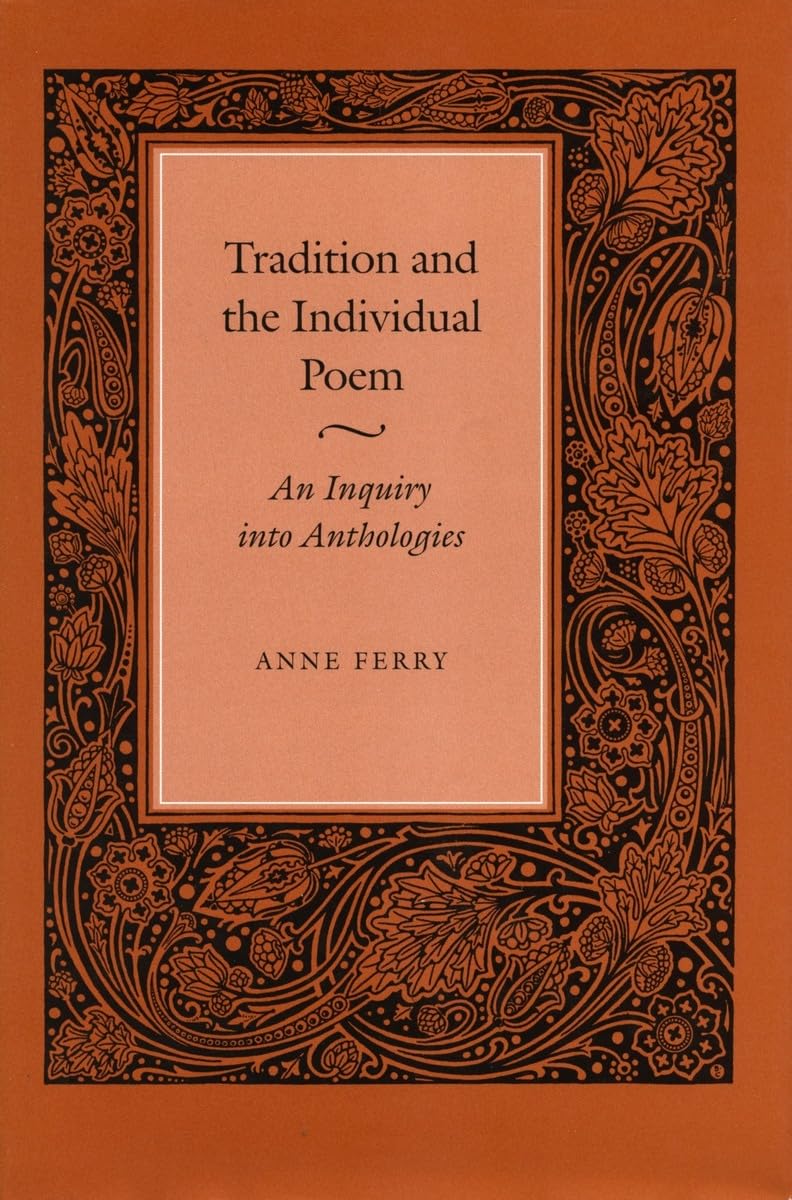
Tradition and the Individual Poem: An Inquiry into Anthologies,New
Sold by Ergodebooks, an authorized reseller.
Returns accepted within 30 days | support@ergodebooks.com
Shipping Information
- Free Standard Shipping — United States only
- Processing Time: 3–5 business days
- Estimated Delivery: 6–10 business days after dispatch
- Double-boxed, fully insured & discreetly packaged
- Tracking number sent via email once dispatched
Returns & Refund
Returns accepted within 30 days of delivery.
Damaged or Defective Item
Free return shipping + replacement or full refund
Wrong Item Received
Free return shipping + replacement or full refund
Change of Mind
Return shipping at customer's expense · 25% restocking fee applies
Payment Option

Anthologies have been a powerful force in poetry and criticism in English ever since the earliest extant book of this kind was published in the sixteenth century. A theoretical, historical, and critical inquiry, Anne Ferry's book looks in detail at the assumptions anthologies are predicated on, how they are put together, the treatment of the poems in them, and the effects their presentations have on their readers' experiences of the poems.In an anthology the work of many poets is selected and arranged by someone whose aim is to make, out of the writings of others, a book of which the anthologist is the author. Part I explains the classifying terms and defining dimensionsconceptual, spatial, temporalthat make the anthology a unique kind of book. It also explores and illustrates the ways that the presence of the anthologistin arranging, annotating, titling, and revising the poemsdirects how they are read. As examples, Ferry focuses on the three most historically influential of anthologies: Richard Tottel's Songes and Sonettes, Thomas Percy's Reliques of Ancient English Poetry, and Francis Palgrave's The Golden Treasury.Part II asks how the poems most frequently included in anthologies get there: by what cultural situations, literary circumstances, and internal features. Examples include a group of Renaissance pastoral lyrics, three public poems of 1770, 1867, and 1955, and Elizabeth Bishop's narrativedescriptive poem 'The Fish.' Part III describes how poets themselves, as readers and compilers of anthologies, have used them, and how anthologies have contributed to the making of poems and the making of their reception. A Coda shows how T. S. Eliot wove certain of his writings into an imaginary anthology that figures his conception of tradition and the individual talent.
⚠️ WARNING (California Proposition 65):
This product may contain chemicals known to the State of California to cause cancer, birth defects, or other reproductive harm.
For more information, please visit www.P65Warnings.ca.gov.