
Title
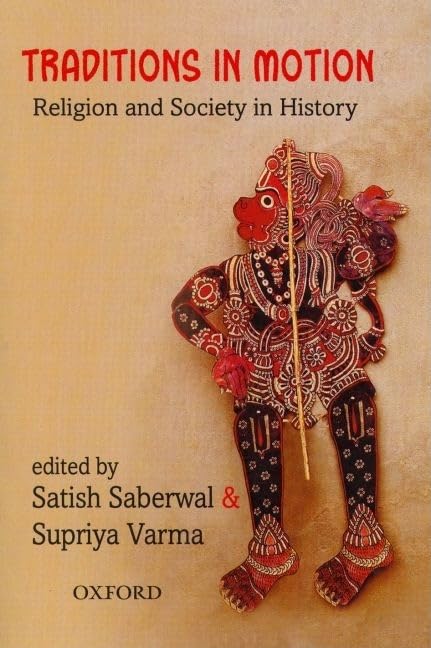
Traditions in Motion: Religion and Society in History,Used
Sold by Ergodebooks, an authorized reseller.
Returns accepted within 30 days | support@ergodebooks.com
Shipping Information
- Free Standard Shipping — United States only
- Processing Time: 3–5 business days
- Estimated Delivery: 6–10 business days after dispatch
- Double-boxed, fully insured & discreetly packaged
- Tracking number sent via email once dispatched
Returns & Refund
Returns accepted within 30 days of delivery.
Damaged or Defective Item
Free return shipping + replacement or full refund
Wrong Item Received
Free return shipping + replacement or full refund
Change of Mind
Return shipping at customer's expense · 25% restocking fee applies
Payment Option

This collection of 13 original essays demonstrates traditions in motion through the historical period in South Asia. The essays look at these traditions from the point of view of scholars outside, as well as believers within the tradition. A wide range of religious traditions Buddhism,Christianity, Sikhism, and several strands of Islamic and Hindu traditions are discussed in this rich collection. An insightful introduction by Satish Saberwal and Supriya Verma defines tradition and places the essays in the proper context. The volume begins with a look at the archaeological tradition by Jaya Menon and Supriya Verma. Kumkum Roy goes on to look at the rich textual tradition, focusing on theArthasastra, Manusmriti and Kamasutra, and Uma Chakravarti and Anindita Mukhopadhyaya discuss the epics. Madhu Trivedi elaborates on the popular Iranian musical tradition of the marsiya in India between the 16th and 18th centuries. Greg Alles essay moves into the realm of the religious traditio nsas he looks at popular Buddhism. R. Champakalakshmi carries the discussion forward with a look at the evolution of the Tamil Saiva tradition from the 6th to the 14th centuries. Anita Raina Thapan looks at the religious beliefs of Sindhi Hindus over the historical period. Ajay Dandekar and AnanyaVajpeyi explore issues around the search for political legitimacy in medieval southwestern Maharashtra. Satish Saberwal poses a wider enquiry of why the south Asian subcontinent came to be partitioned in 1947, with the focus on the interactions between two religious traditions. Finally, Errol D Limaand Rudolf Heredia present the point of view of those who exist within a tradition.
⚠️ WARNING (California Proposition 65):
This product may contain chemicals known to the State of California to cause cancer, birth defects, or other reproductive harm.
For more information, please visit www.P65Warnings.ca.gov.