
Title
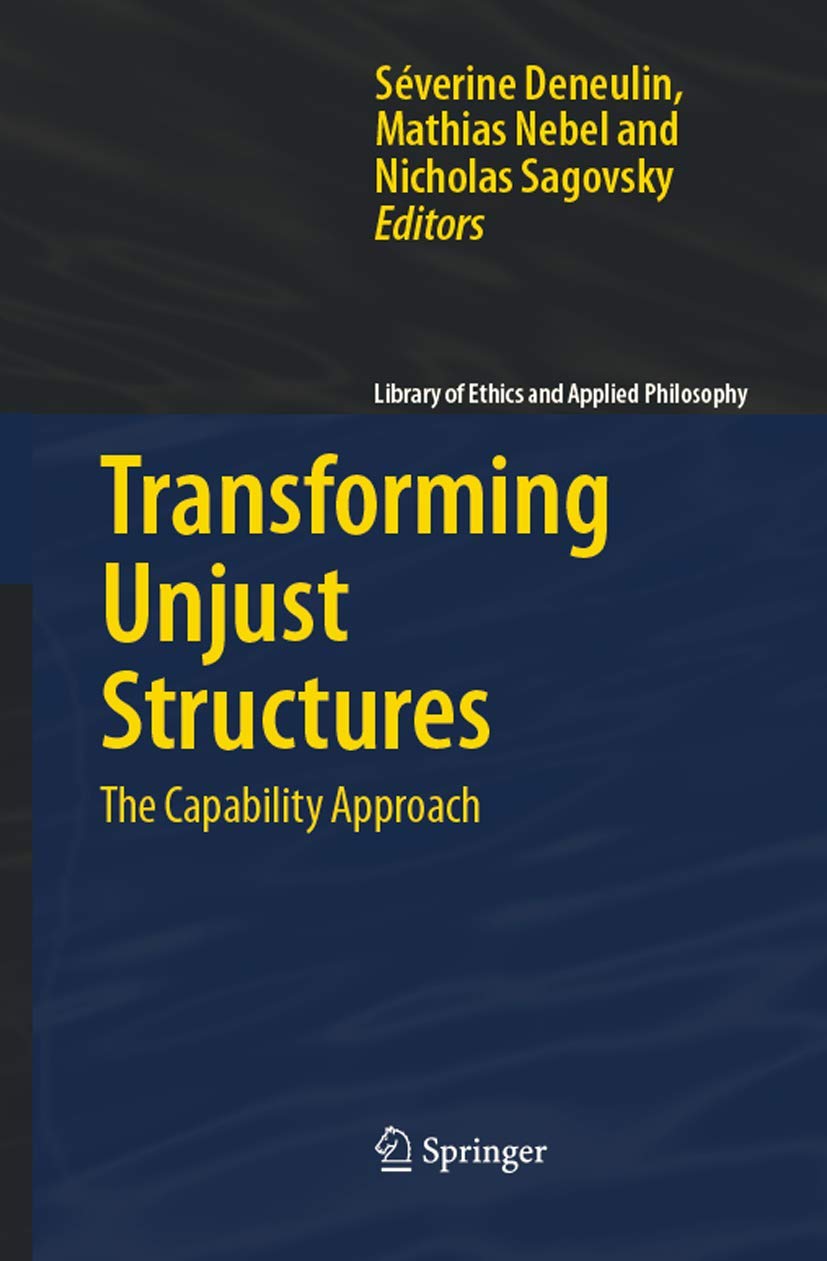
Transforming Unjust Structures: The Capability Approach (Library of Ethics and Applied Philosophy, 19),Used
Sold by Ergodebooks, an authorized reseller.
Returns accepted within 30 days | support@ergodebooks.com
Shipping Information
- Free Standard Shipping — United States only
- Processing Time: 3–5 business days
- Estimated Delivery: 6–10 business days after dispatch
- Double-boxed, fully insured & discreetly packaged
- Tracking number sent via email once dispatched
Returns & Refund
Returns accepted within 30 days of delivery.
Damaged or Defective Item
Free return shipping + replacement or full refund
Wrong Item Received
Free return shipping + replacement or full refund
Change of Mind
Return shipping at customer's expense · 25% restocking fee applies
Payment Option

SVERINE DENEULIN, MATHIAS NEBEL AND NICHOLAS SAGOVSKY TRANSFORMING UNJUST STRUCTURES The Capability Approach THE CAPABILITY APPROACH Structural injustice has traditionally been the concern of two major academic disciplines: economics and philosophy. The dominant model of economics has long been that of neoclassical economics. For neoclassical economists, human we being is to be assessed by the availability of disposable income or according to goods consumed; it is measured by the levels of utility achieved in the consumption of commodities. Social order is fashioned by the ways consumers maximise their 1 wellbeing and enterprises maximise their profits. A core assumption is that all 2 commodities are commensurable: they can all be measured according to a single 3 numerical covering value, which is their price. Within this neoclassical paradigm, justice is achieved when the utility level of someone cannot be increased without 4 another person seeing his or her utility level decrease. The dominant paradigm of neoclassical economics was strongly challenged when development and welfare economist Amartya Sen received the Nobel Prize for Economics in 1998. His work offered an alternative to the neoclassical evaluation of human wellbeing in the utility/commodity space. The underlining philosophical intuition behind Sens work is that the standard of living lies in the living and not in the consumption of commodities. In searching for an alternative measure of human wellbeing, Sen devised his capability approach.
⚠️ WARNING (California Proposition 65):
This product may contain chemicals known to the State of California to cause cancer, birth defects, or other reproductive harm.
For more information, please visit www.P65Warnings.ca.gov.