If you have any questions, you are always welcome to contact us. We'll get back to you as soon as possible, withing 24 hours on weekdays.
Customer service
All questions about your order, return and delivery must be sent to our customer service team by e-mail at yourstore@yourdomain.com
Sale & Press
If you are interested in selling our products, need more information about our brand or wish to make a collaboration, please contact us at press@yourdomain.com
Help
If you have any questions, you are always welcome to contact us. We'll get back to you as soon as possible, withing 24 hours on weekdays.
Customer service
All questions about your order, return and delivery must be sent to our customer service team by e-mail at yourstore@yourdomain.com
Sale & Press
If you are interested in selling our products, need more information about our brand or wish to make a collaboration, please contact us at press@yourdomain.com
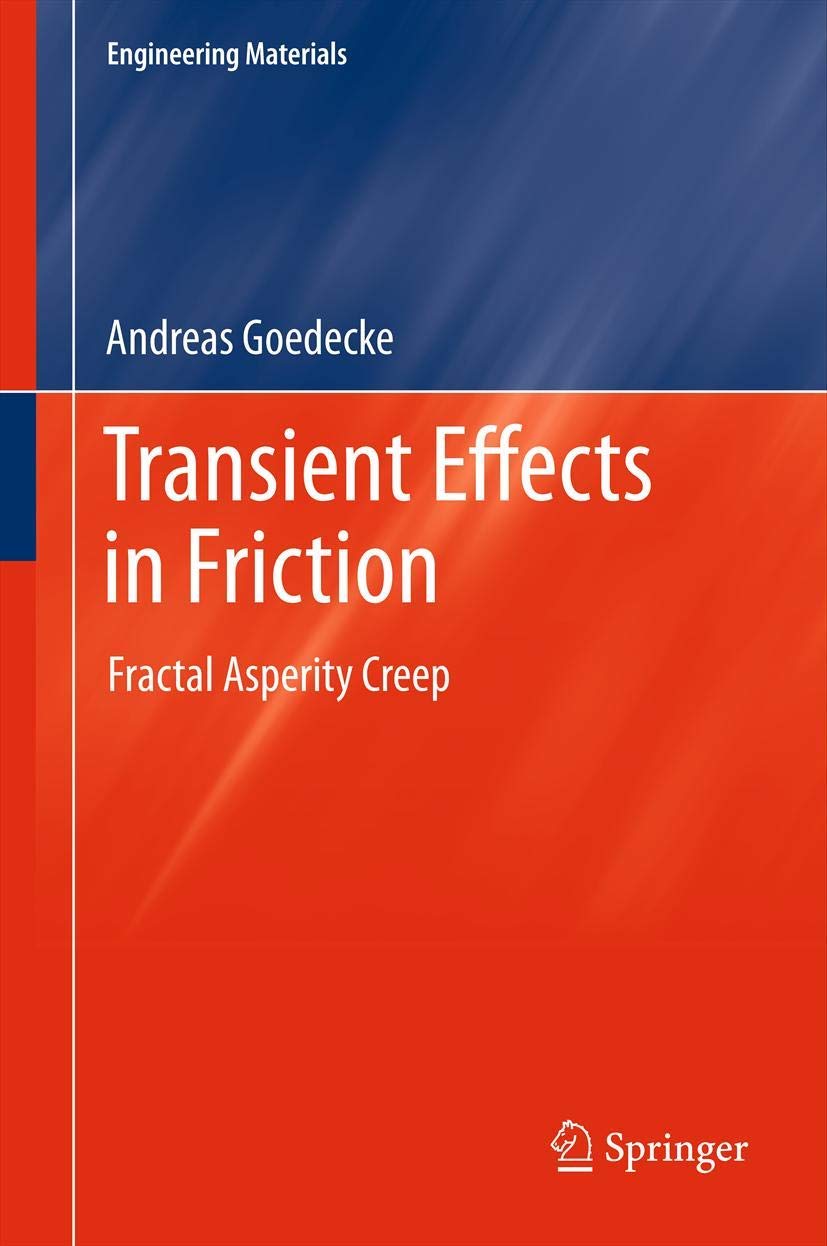
Transient friction effects determine the behavior of a wide class of mechatronic systems. Classic examples are squealing brakes, stiction in robotic arms, or stickslip in linear drives. To properly design and understand mechatronic systems of this type, good quantitative models of transient friction effects are of primary interest. The theory developed in this book approaches this problem bottomup, by deriving the behavior of macroscopic friction surfaces from the microscopic surface physics. The model is based on two assumptions: First, rough surfaces are inherently fractal, exhibiting roughness on a wide range of scales. Second, transient friction effects are caused by creep enlargement of the real area of contact between two bodies. This work demonstrates the results of extensive Finite Element analyses of the creep behavior of surface asperities, and proposes a generalized multiscale area iteration for calculating the timedependent real contact between two bodies. The toolset is then demonstrated both for the reproduction of a variety of experimental results on transient friction as well as for system simulations of two example systems.
⚠️ WARNING (California Proposition 65):
This product may contain chemicals known to the State of California to cause cancer,
birth defects, or other reproductive harm.
For MAP (Minimum Advertised Price) violations and Intellectual Property (IP) or Trademark concerns, please contact:
support@ergodebooks.com
⚠️ California Proposition 65 Warning: Some products sold on this website may expose you to chemicals known to the State of California to cause cancer, birth defects, or other reproductive harm. For more information, visit www.P65Warnings.ca.gov.