If you have any questions, you are always welcome to contact us. We'll get back to you as soon as possible, withing 24 hours on weekdays.
Customer service
All questions about your order, return and delivery must be sent to our customer service team by e-mail at yourstore@yourdomain.com
Sale & Press
If you are interested in selling our products, need more information about our brand or wish to make a collaboration, please contact us at press@yourdomain.com
Help
If you have any questions, you are always welcome to contact us. We'll get back to you as soon as possible, withing 24 hours on weekdays.
Customer service
All questions about your order, return and delivery must be sent to our customer service team by e-mail at yourstore@yourdomain.com
Sale & Press
If you are interested in selling our products, need more information about our brand or wish to make a collaboration, please contact us at press@yourdomain.com
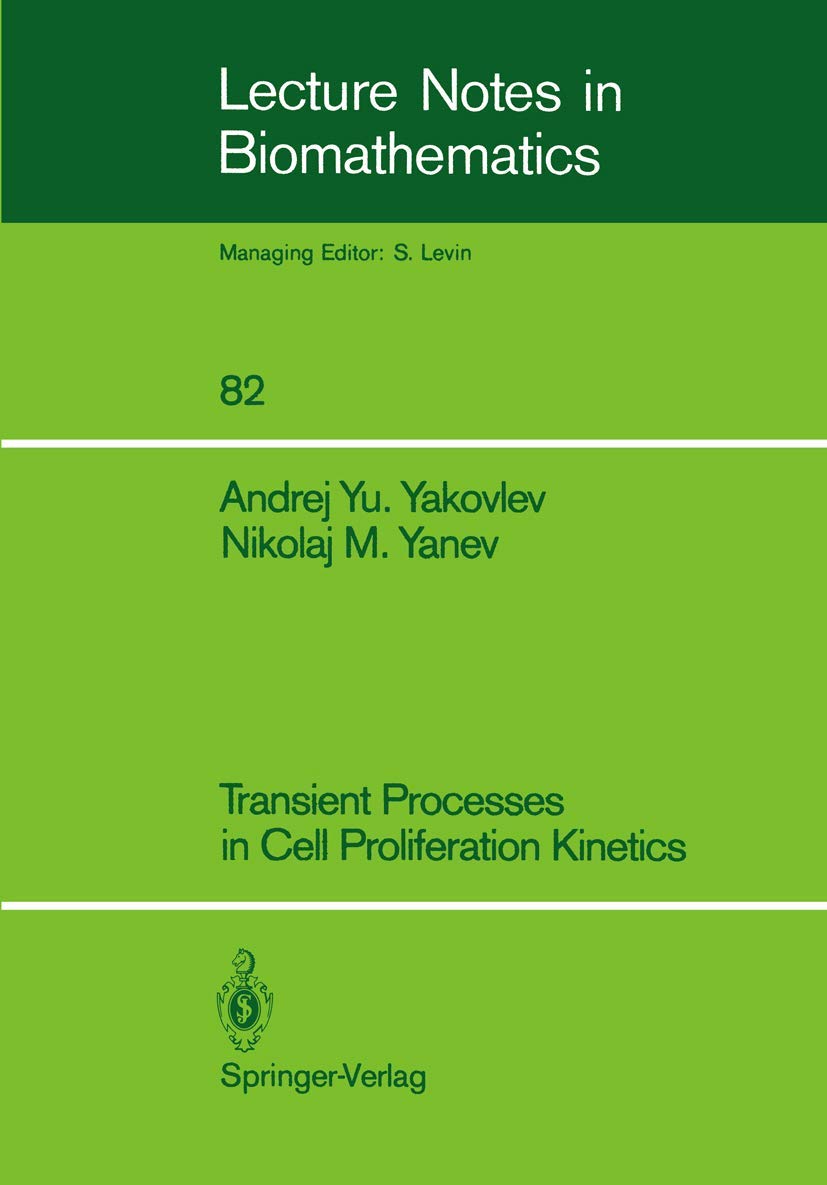
A mathematician who has taken the romantic decision to devote himself to biology will doubtlessly look upon cell kinetics as the most simple and natural field of application for his knowledge and skills. Indeed, the thesaurus he is to master is not so complicated as, say, in molecular biology, the structural elements of the system, i. e. ceils, have been segregated by Nature itself, simple considerations of balance may be used for deducing basic equations, and numerous analogies in other areas of science also superficial add to one's confidence. Generally speaking, this number of impression is correct, as evidenced by the very great theoretical studies on population kinetics, unmatched in other branches of mathematical biology. This, however, does not mean that mathematical theory of cell systems has traversed in its development a pathway free of difficulties or errors. The seeming ease of formalizing the phenomena of cell kinetics not infrequently led to the appearance of mathematical models lacking in adequacy or effectiveness from the viewpoint of applications. As in any other domain of science, mathematical theory of cell systems has its own intrinsic logic of development which, however, depends in large measure on the progress in experimental biology. Thus, during a fairly long period running into decades activities in that sphere were centered on devising its own specific approaches necessitated by new objectives in the experimental in vivo and in vitro investigation of cell population kinetics in different tissues.
⚠️ WARNING (California Proposition 65):
This product may contain chemicals known to the State of California to cause cancer,
birth defects, or other reproductive harm.
For MAP (Minimum Advertised Price) violations and Intellectual Property (IP) or Trademark concerns, please contact:
support@ergodebooks.com
⚠️ California Proposition 65 Warning: Some products sold on this website may expose you to chemicals known to the State of California to cause cancer, birth defects, or other reproductive harm. For more information, visit www.P65Warnings.ca.gov.