If you have any questions, you are always welcome to contact us. We'll get back to you as soon as possible, withing 24 hours on weekdays.
Customer service
All questions about your order, return and delivery must be sent to our customer service team by e-mail at yourstore@yourdomain.com
Sale & Press
If you are interested in selling our products, need more information about our brand or wish to make a collaboration, please contact us at press@yourdomain.com
Help
If you have any questions, you are always welcome to contact us. We'll get back to you as soon as possible, withing 24 hours on weekdays.
Customer service
All questions about your order, return and delivery must be sent to our customer service team by e-mail at yourstore@yourdomain.com
Sale & Press
If you are interested in selling our products, need more information about our brand or wish to make a collaboration, please contact us at press@yourdomain.com
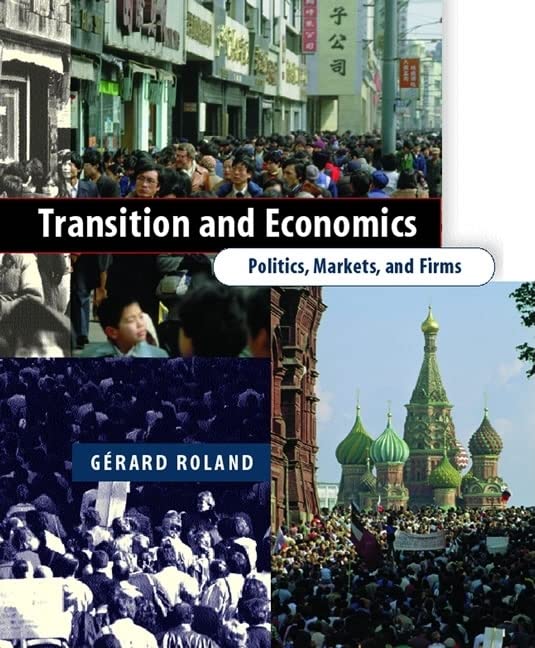
The transition from socialism to capitalism in former socialist economies is one of the main economic events of the twentieth century. Not only does it affect the lives of approximately 1.65 billion people, but it is contributing to a shift in emphasis in economics from standard price and monetary theory to contracting and its institutional environment. Economic research in transition shows not only that institutions matter but also how their evolution toward higher efficiency depends on initial conditions and on sustained political support.Unlike early policy literature on transition economics, which focused on the socalled Washington consensus, this book provides an overview of current research, analyzing issues raised by transition for which economic theorists and policy makers had no ready answers. It shows how research on transition contributes to our understanding of capitalism as an economic system and of the dynamics of largescale institutional change.The book is divided into three parts. The first part looks at how largescale reforms are decided dynamically through the political process. The second part looks at the general equilibrium and macroeconomic effects of liberalization in economies without preexisting markets. The third part looks at the economic behavior of firms in the transition from state to private ownership and compares the effects of privatization, restructuring, and financial reform. Although focused on transition economics, the discussions are relevant to topics in political economics, development, public economics, corporate finance, and micro and macroeconomics.
⚠️ WARNING (California Proposition 65):
This product may contain chemicals known to the State of California to cause cancer,
birth defects, or other reproductive harm.
For MAP (Minimum Advertised Price) violations and Intellectual Property (IP) or Trademark concerns, please contact:
support@ergodebooks.com
⚠️ California Proposition 65 Warning: Some products sold on this website may expose you to chemicals known to the State of California to cause cancer, birth defects, or other reproductive harm. For more information, visit www.P65Warnings.ca.gov.