If you have any questions, you are always welcome to contact us. We'll get back to you as soon as possible, withing 24 hours on weekdays.
Customer service
All questions about your order, return and delivery must be sent to our customer service team by e-mail at yourstore@yourdomain.com
Sale & Press
If you are interested in selling our products, need more information about our brand or wish to make a collaboration, please contact us at press@yourdomain.com
Help
If you have any questions, you are always welcome to contact us. We'll get back to you as soon as possible, withing 24 hours on weekdays.
Customer service
All questions about your order, return and delivery must be sent to our customer service team by e-mail at yourstore@yourdomain.com
Sale & Press
If you are interested in selling our products, need more information about our brand or wish to make a collaboration, please contact us at press@yourdomain.com
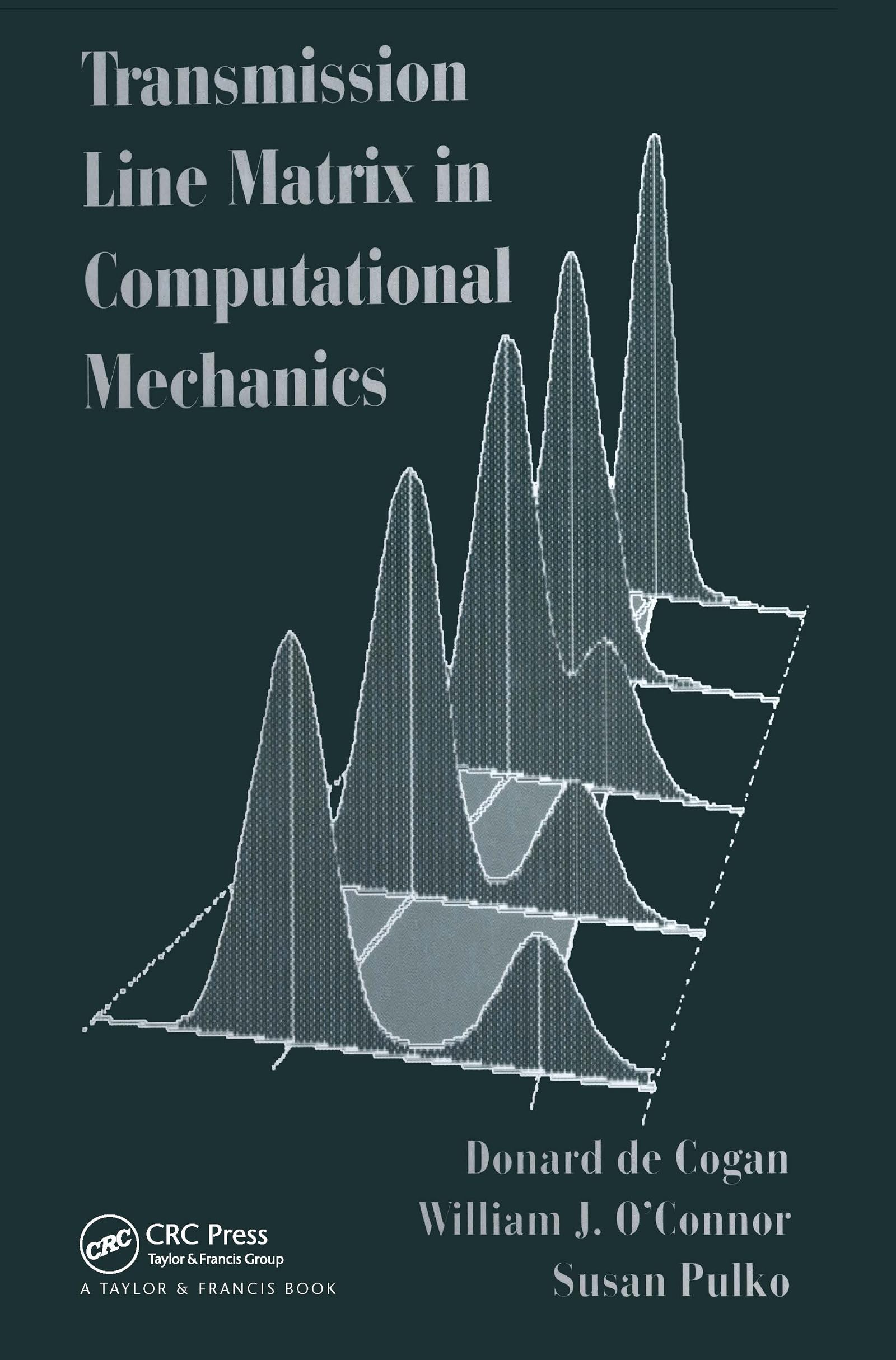
The finite element method reigns as the dominant technique for modeling mechanical systems. Originally developed to model electromagnetic systems, the Transmission Line Matrix (TLM) method proves to match, and in some cases exceed, the effectiveness of finite elements for modeling several types of physical systems. Transmission Line Matrix in Computational Mechanics provides a tutorial approach to applying TLM for modeling mechanical and other physical systems.Transmission Line Matrix in Computational Mechanics begins with the history of TLM, an introduction to the theory using mechanical engineering concepts, and the electromagnetic basics of TLM. The authors then demonstrate the theory for use in acoustic propagation, along with examples of MATLAB code. The remainder of the book explores the application of TLM to problems in mechanics, specifically heat and mass transfer, elastic solids, simple deformation models, hydraulic systems, and computational fluid dynamics. A discussion of stateoftheart techniques concludes the book, offering a look at the current research undertaken by the authors and other leading experts to overcome the limitations of TLM in applying the method to diverse types of systems.This valuable reference introduces students, engineers, and researchers to a powerful, accurate, and stable alternative to finite elements, providing case studies and examples to reinforce the concepts and illustrate the applications.
⚠️ WARNING (California Proposition 65):
This product may contain chemicals known to the State of California to cause cancer,
birth defects, or other reproductive harm.
For MAP (Minimum Advertised Price) violations and Intellectual Property (IP) or Trademark concerns, please contact:
support@ergodebooks.com
⚠️ California Proposition 65 Warning: Some products sold on this website may expose you to chemicals known to the State of California to cause cancer, birth defects, or other reproductive harm. For more information, visit www.P65Warnings.ca.gov.