If you have any questions, you are always welcome to contact us. We'll get back to you as soon as possible, withing 24 hours on weekdays.
Customer service
All questions about your order, return and delivery must be sent to our customer service team by e-mail at yourstore@yourdomain.com
Sale & Press
If you are interested in selling our products, need more information about our brand or wish to make a collaboration, please contact us at press@yourdomain.com
Help
If you have any questions, you are always welcome to contact us. We'll get back to you as soon as possible, withing 24 hours on weekdays.
Customer service
All questions about your order, return and delivery must be sent to our customer service team by e-mail at yourstore@yourdomain.com
Sale & Press
If you are interested in selling our products, need more information about our brand or wish to make a collaboration, please contact us at press@yourdomain.com
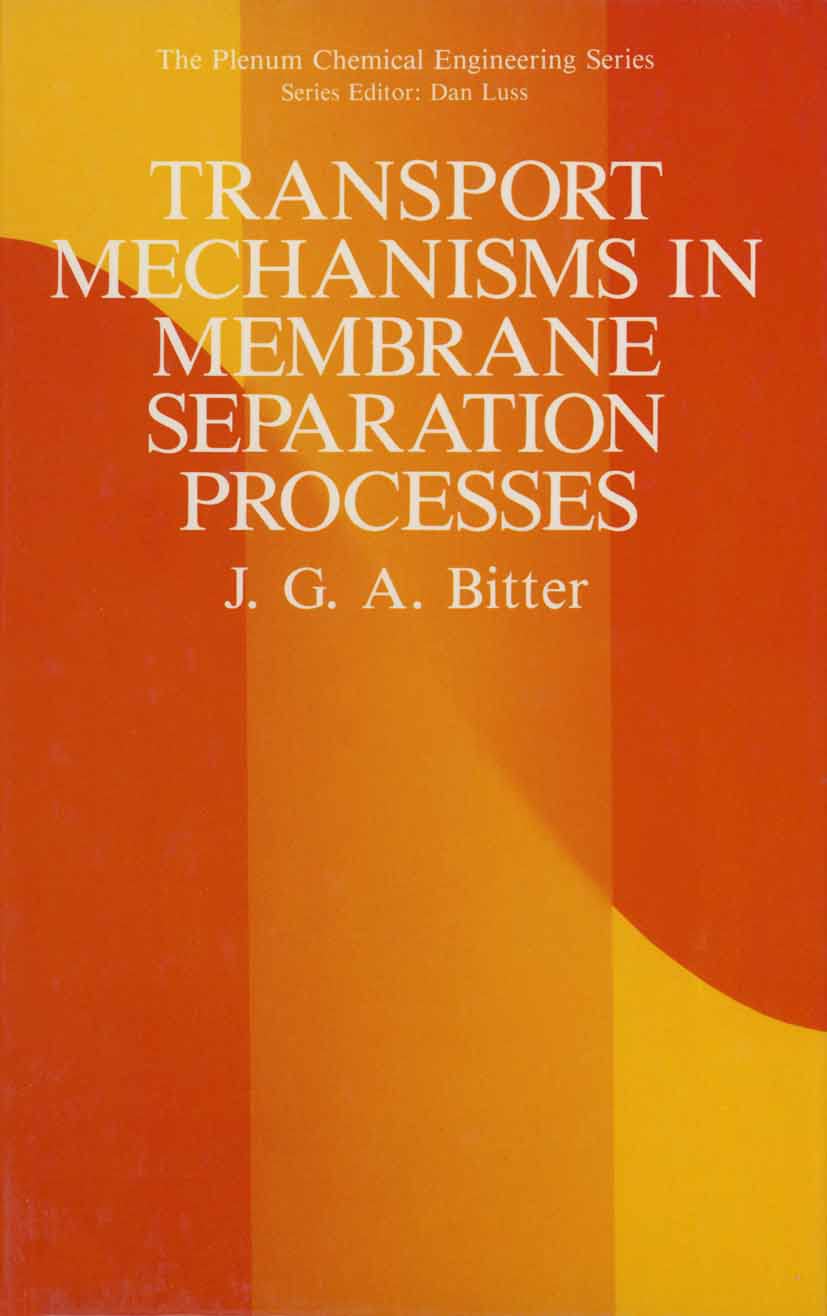
The present book contains a comparison of existing theoretical models developed in order to describe membrane separation processes. In general, the permeation equations resulting from these models give inaccurate predictions of the mutual effects of the permeants involved, due to the simplifications adopted in their derivation. It is concluded that an optimum description of transport phenomena in tight (diffusiontype) membranes is achieved with the "solutiondiffusion" model. According to this model each component of a fluid mixture to be separated dissolves in the membrane and passes through by diffusion in response to its gradient in the chemical potential. A modified FloryHuggins equation has been derived to calculate the solubility of the permeants in the membrane material. Contrary to the original FloryHuggins equation, the modified equation accounts for the large effect on solubility of crystallinity and elastic strain of the polymer chains by swelling. The equilibrium sorption of liquids computed with this equation was found to be in good agreement with experimental results. Also, the sorption of gases in both rubbery and glassy polymers could be described quan titatively with the modified FloryHuggins equation without any need of the arbitrary Langmuir term, as required in the conventional "dualmode" sorption model. Furthermore, fewer parameters are required than with the at least identical accuracy.
⚠️ WARNING (California Proposition 65):
This product may contain chemicals known to the State of California to cause cancer,
birth defects, or other reproductive harm.
For MAP (Minimum Advertised Price) violations and Intellectual Property (IP) or Trademark concerns, please contact:
support@ergodebooks.com
⚠️ California Proposition 65 Warning: Some products sold on this website may expose you to chemicals known to the State of California to cause cancer, birth defects, or other reproductive harm. For more information, visit www.P65Warnings.ca.gov.