
Title
Treatise on Law: The Complete Text,Used
Sold by Ergodebooks, an authorized reseller.
Returns accepted within 30 days | support@ergodebooks.com
Shipping Information
- Free Standard Shipping — United States only
- Processing Time: 3–5 business days
- Estimated Delivery: 6–10 business days after dispatch
- Double-boxed, fully insured & discreetly packaged
- Tracking number sent via email once dispatched
Returns & Refund
Returns accepted within 30 days of delivery.
Damaged or Defective Item
Free return shipping + replacement or full refund
Wrong Item Received
Free return shipping + replacement or full refund
Change of Mind
Return shipping at customer's expense · 25% restocking fee applies
Payment Option

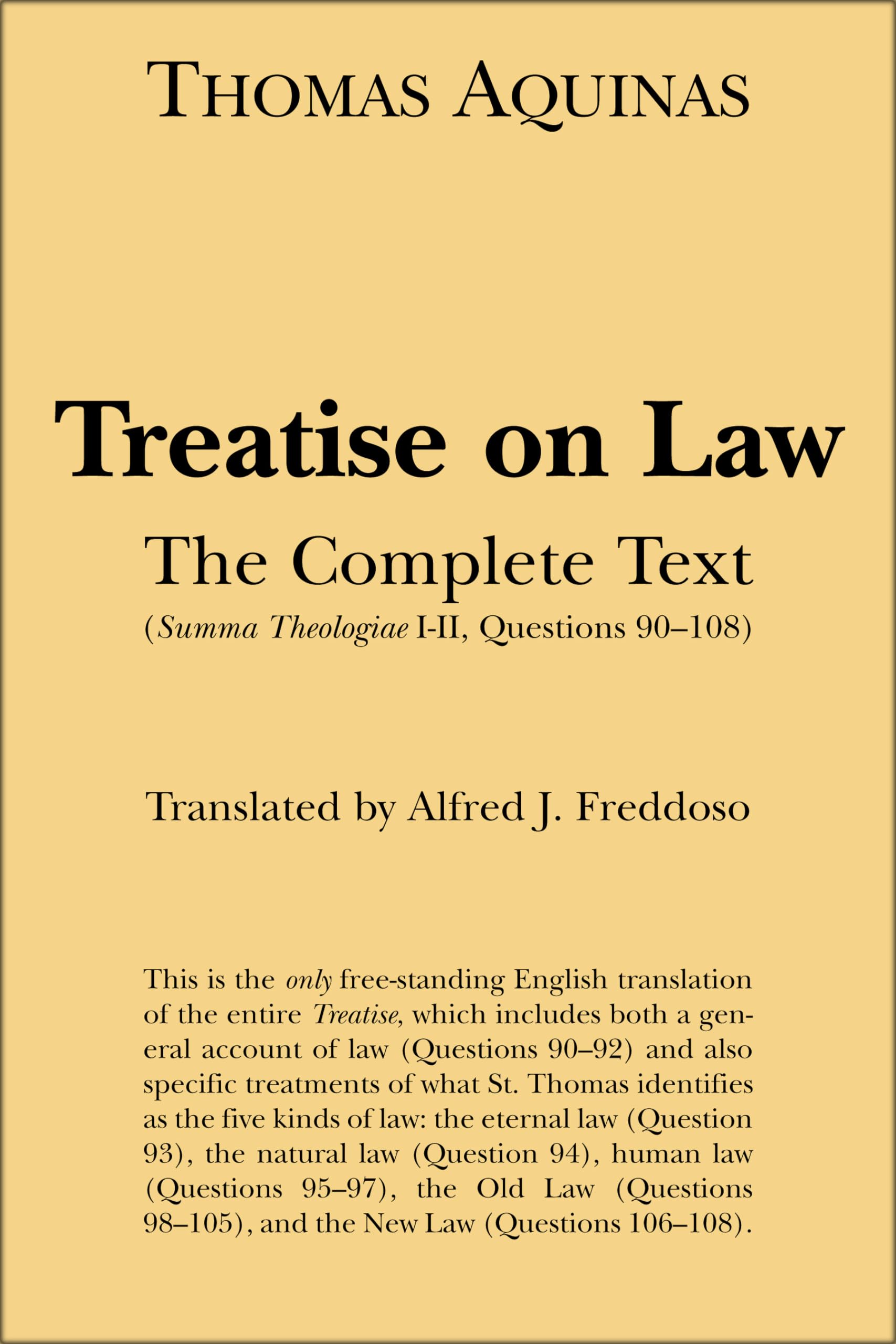
This is a new English translation of St. Thomas Aquinass Treatise on Law, found in Questions 90108 of the First Part of the Second Part of the Summa Theologiae. In fact, it is the only freestanding English translation of the entire Treatise, which includes both a general account of law (Questions 9092) and also specific treatments of what St. Thomas identifies as the five kinds of law: the eternal law (Question 93), the natural law (Question 94), human law (Questions 9597), the Old Law (Questions 98105), and the New Law (Questions 106108). All other extant editions of Treatise on Law stop with the human law, and are thus approximately onethird the size of the full Treatise.St. Thomass account of law is firmly embedded within a general moral theory that begins with a rich conception of human flourishing, i.e., the good for human beings (Questions 15). This good consists, first and foremost, in our ultimate and intimate union with the Persons of the Blessed Trinity a union that in our present state we can grasp intellectively and pursue affectively only with Gods supernatural assistance. It is within this framework that we order our loves and pursue the more proximate goals they open up to us as human beings in this life. Given the appropriate goals, the next question is how we can get from where we are, in the grips of the consequences of Original Sin, to where we want to be. The answer is: by means of (a) human actions that are good, i.e., rightly ordered toward our ultimate end and (b) the habits that these actions either engender or flow from. In analyzing human actions (Questions 621) and their relation to the passions (Questions 2248), St. Thomas gives a general account of what he calls the intrinsic principles of human actions and their associated habits both virtues (Questions 4970) and vices (Questions 7189). It is only then that he turns to what he calls the extrinsic principles of good human actions, viz., law (Questions 90108) and grace (Questions 109114).According to St. Thomas, law, far from supplanting virtue as a basic principle of action, serves as an independent principle of action that complements virtue and is itself capable of being factored into practical deliberation. The reason is that all of Godsprecepts, prohibitions, and punishments are aimed at promoting the good of the whole universe and, more particularly, the good for human beings, both individually and within the various forms of social life. Because of this, law serves as both a restraint on bad actions and a spur to good action, i.e., a restraint on actions that take us away from virtue and genuine human flourishing and a spur to actions that promote virtue and flourishing.There are many benefits of having the whole treatise rather than just the first few questions, as has been the standard practice in previous editions of the Treatise on Law. To mention just a few of these benefits, the question on the moral precepts of the Old Law (question 100) helps to illuminate in many different ways the earlier questions on natural law and human law (questions 9497). Again, the questions on the ceremonial and judicial precepts of the Old Law (questions 101105) demonstrate in depth the symbiotic relationship that St. Thomas takes to obtain between the Old Testament and the New Testament. The questions on the New Law provide an introduction to the Christian way of life that will be described in incomparable detail in the Second Part of the Second Part, the bulk of which is structured around the treatment of the three theological virtues and the four cardinal virtues.
⚠️ WARNING (California Proposition 65):
This product may contain chemicals known to the State of California to cause cancer, birth defects, or other reproductive harm.
For more information, please visit www.P65Warnings.ca.gov.
- Q: How many pages does 'Treatise on Law: The Complete Text' have? A: This book has three hundred four pages. It provides a comprehensive examination of St. Thomas Aquinas's thoughts on law.
- Q: What are the dimensions of this book? A: The book measures six inches in length, nine inches in height, and zero point nine one inches in width. These dimensions make it easy to handle and read.
- Q: What type of binding does this book have? A: This book is paperback bound. The paperback format is lightweight and flexible, making it convenient for reading.
- Q: How should I read or study this book? A: You can read this book at your own pace, focusing on each question as it delves into various aspects of law. It is suitable for both casual readers and those studying jurisprudence.
- Q: Is this book suitable for beginners in law? A: Yes, this book is suitable for beginners. It presents complex ideas in an accessible manner, making it easier for new learners to understand Aquinas's legal philosophy.
- Q: How do I store this book to keep it in good condition? A: Store this book in a cool, dry place away from direct sunlight. Keeping it upright on a shelf will help maintain its shape and condition.
- Q: Can I clean the cover of this book? A: Yes, you can clean the cover with a soft, dry cloth. Avoid using any liquids that may damage the cover or pages.
- Q: What if the book arrives damaged? A: If the book arrives damaged, you should contact the seller for a return or exchange. Most sellers have policies in place for such situations.
- Q: Is there a warranty for this book? A: Books typically do not come with a warranty. However, check with the seller for any specific return policies or guarantees.
- Q: How does this book compare to other translations of Aquinas's work? A: This book is unique as it is the only complete English translation of Aquinas's Treatise on Law. Other editions often stop short, missing vital sections.
- Q: Does this book focus on any specific type of law? A: Yes, the book covers various types of law, including eternal law, natural law, human law, Old Law, and New Law. It provides a thorough exploration of each.
- Q: What is the main theme of 'Treatise on Law: The Complete Text'? A: The main theme is the relationship between law and virtue as discussed by St. Thomas Aquinas. It emphasizes how law serves to promote human flourishing.
- Q: Is this book appropriate for academic study? A: Yes, this book is appropriate for academic study. It is a significant text for understanding legal philosophy and moral theory.
- Q: Who is the author of this book? A: The author of this book is St. Thomas Aquinas. He is a renowned philosopher and theologian known for his influential works on law and ethics.
- Q: What is the publisher of this book? A: The publisher of this book is St. Augustines Press. They specialize in works related to philosophy and theology.