
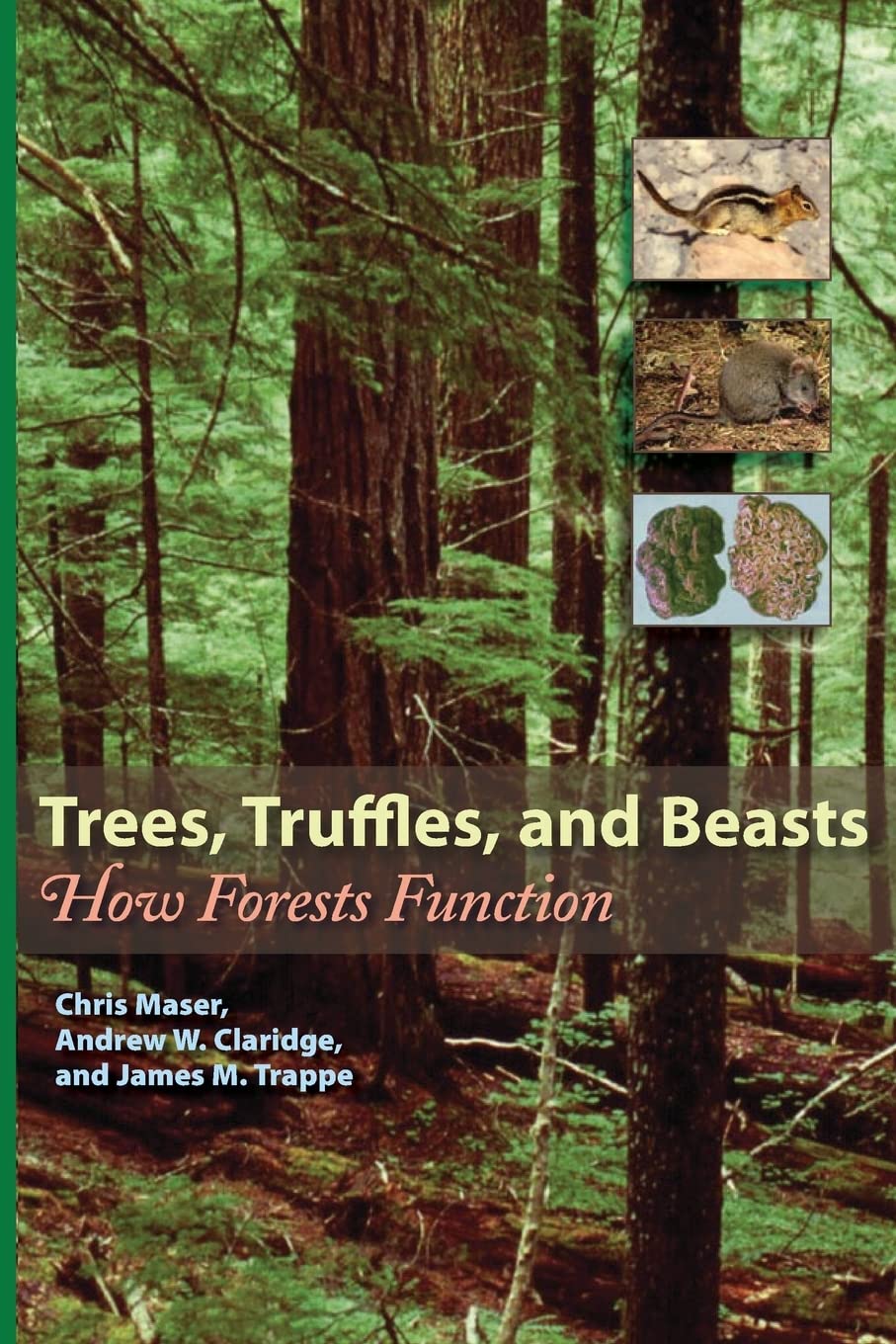
Title
Trees, Truffles, And Beasts: How Forests Function
Sold by Ergodebooks, an authorized reseller.
Returns accepted within 30 days | support@ergodebooks.com
Shipping Information
- Free Standard Shipping — United States only
- Processing Time: 3–5 business days
- Estimated Delivery: 6–10 business days after dispatch
- Double-boxed, fully insured & discreetly packaged
- Tracking number sent via email once dispatched
Returns & Refund
Returns accepted within 30 days of delivery.
Damaged or Defective Item
Free return shipping + replacement or full refund
Wrong Item Received
Free return shipping + replacement or full refund
Change of Mind
Return shipping at customer's expense · 25% restocking fee applies
Payment Option

In Today'S World Of Specialization, People Are Attempting To Protect The Earth'S Fragile State By Swapping Limousines For Hybrids And Pesticidelaced Foods For Organic Produce. At Other Times, Environmental Awareness Is Translated Into Public Relations Gimmicks Or Trendy Commodities. Moreover, Simplistic Policies, Like Singlespecies Protection Or Planting Ten Trees For Every Tree Cut Down, Are Touted As Bureaucratic Or Industrial Panaceas.Because Today'S Decisions Are Tomorrow'S Consequences, Every Small Effort Makes A Difference, But A Broader Understanding Of Our Environmental Problems Is Necessary To The Development Of Sustainable Ecosystem Policies. In Trees, Truffles, And Beasts, Chris Maser, Andrew W. Claridge, And James M. Trappe Make A Compelling Case That We Must First Understand The Complexity And Interdependency Of Species And Habitats From The Microscopic Level To The Gigantic. Comparing Forests In The Pacific Northwestern United States And Southeastern Mainland Of Australia, The Authors Show How Easily Observable Species, Trees And Mammals Are Part Of A Complicated Infrastructure That Includes Fungi, Lichens, And Organisms Invisible To The Naked Eye, Such As Microbes.Eminently Readable, This Important Book Shows That Forests Are Far More Complicated Than Most Of Us Might Think, Which Means Simplistic Policies Will Not Save Them. Understanding The Biophysical Intricacies Of Our Lifesupport Systems Just Might.
⚠️ WARNING (California Proposition 65):
This product may contain chemicals known to the State of California to cause cancer, birth defects, or other reproductive harm.
For more information, please visit www.P65Warnings.ca.gov.
- Q: How many pages does the book have? A: The book has two hundred eighty pages. This length provides a comprehensive exploration of forest ecosystems.
- Q: What are the dimensions of the book? A: The book measures six inches in length, zero point eight inches in width, and nine point twenty-five inches in height. These dimensions make it a convenient read.
- Q: What is the binding type of this book? A: The book is available in paperback binding. This makes it lightweight and easy to handle.
- Q: Who are the authors of this book? A: The authors are Mr. Chris Maser, Andrew W. Claridge, and James M. Trappe. They are recognized for their expertise in forest ecology.
- Q: What category does this book fall under? A: The book falls under the Biology category. It focuses on ecological and environmental themes.
- Q: What is the main theme of the book? A: The main theme is the complexity of forest ecosystems. It emphasizes the interdependencies between species and their habitats.
- Q: Is this book suitable for beginners in ecology? A: Yes, the book is suitable for beginners. Its readable style makes complex ecological concepts accessible to a general audience.
- Q: What kind of reader would benefit from this book? A: Readers interested in environmental science and ecology would benefit greatly. The book provides valuable insights into forest management and sustainability.
- Q: Can this book be used in an academic setting? A: Yes, this book can be used in academic settings. It is a useful resource for students studying biology and environmental science.
- Q: How should I store this book? A: Store the book in a cool, dry place. Avoid exposure to direct sunlight to prevent fading and deterioration.
- Q: What if the book gets damaged? A: If the book gets damaged, you should assess the damage first. Minor tears can be repaired with tape, while major damage may require replacement.
- Q: Are there any specific care instructions for this book? A: No specific care instructions are required, but handle it gently. Avoid placing heavy objects on top of it.
- Q: What if I want to return the book? A: You can return the book according to the retailer's return policy. Check their guidelines for specific instructions on returns.
- Q: Is this book appropriate for children? A: Yes, the book is appropriate for older children. However, it may be more suitable for teens and adults due to its complex themes.
- Q: What kind of illustrations are included in the book? A: The book includes forty-two color illustrations and sixty-seven black-and-white illustrations. These visual aids enhance understanding of the content.
- Q: Does the book discuss any specific forest locations? A: Yes, the book compares forests in the Pacific Northwestern United States and Southeastern mainland of Australia. This regional focus enriches the discussion.