
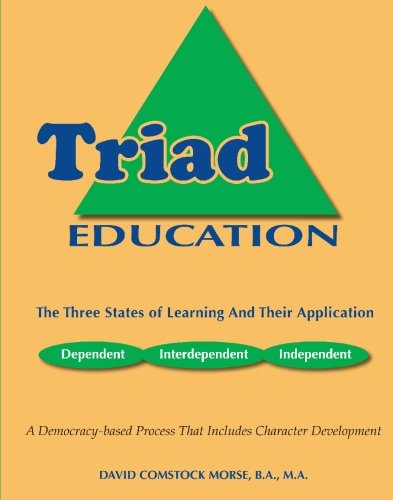
Title
Triad Education: The Three States of Learning And Their Application,Used
Sold by Ergodebooks, an authorized reseller.
Returns accepted within 30 days | support@ergodebooks.com
Shipping Information
- Free Standard Shipping — United States only
- Processing Time: 3–5 business days
- Estimated Delivery: 6–10 business days after dispatch
- Double-boxed, fully insured & discreetly packaged
- Tracking number sent via email once dispatched
Returns & Refund
Returns accepted within 30 days of delivery.
Damaged or Defective Item
Free return shipping + replacement or full refund
Wrong Item Received
Free return shipping + replacement or full refund
Change of Mind
Return shipping at customer's expense · 25% restocking fee applies
Payment Option

Product DescriptionA democracy based process that combines Dependent, Interdependent and Independent teaching, along with verbal and nonverbal learning while building character and selfconfidence. This education experience is structured to enable each student to release their constructive learning potential. The process uses the resources of teachers, teacherstudent mutual interaction, and each student to affect the productivity of learning. In brief, the key to implementing a quality process is the method used for evaluating verbal and nonverbal learning: Between student progress grading terms, teachers direct students to complete a selfevaluating form. Elementary teachers use each students selfevaluating responses as a guide for teacherstudent mutual interactive evaluating conferences. Secondary teachers respond by writing their helpful comments on each students selfevaluating form. If there is a need for verbal interaction, arrangements are made for a teacherstudent conference.About the AuthorDavid C. Morse is a member of Phi Delta Kappa, the California Teachers Association and the National Education Association. He received his Bachelor and Master? degrees from the California State University, Sacramento. He was a High School Teacher, Counselor and Dean. He was also a Summer Session Professor at the University of California, Davis; University of Hawaii and California State University, Sacramento. He spoke at National and California School Board Conferences; California State Counseling and Guidance Association; California School Administrator? Conferences, National Symposium on Violence, University of Nevada; the annual Professors of Curriculum Conference and conducted workshops at the University of Santa Barbara. Also, was one of six Counselors in the nation to serve two years as a member of the National American College Test Advisory Board (ACT) representing the Western States, Alaska and Hawaii. He, also, conducted many Triad Education teacher workshops.
⚠️ WARNING (California Proposition 65):
This product may contain chemicals known to the State of California to cause cancer, birth defects, or other reproductive harm.
For more information, please visit www.P65Warnings.ca.gov.
- Q: What is the page count of this book? A: This book contains one hundred forty-two pages. It provides a comprehensive approach to learning through various teaching states.
- Q: What is the binding type of the book? A: The binding type is paperback. This makes it lightweight and easy to handle for readers.
- Q: What are the dimensions of the book? A: The dimensions are eight point two seven inches in length, zero point three two inches in width, and ten point five one inches in height.
- Q: How do I apply the learning methods described in the book? A: You can apply the methods by integrating dependent, interdependent, and independent teaching techniques in your classroom. The book outlines structured processes for fostering student engagement.
- Q: Is this book suitable for all age groups? A: Yes, this book is suitable for educators and learners of various age groups. It offers insights applicable to both elementary and secondary education.
- Q: How does the book address self-evaluation? A: The book emphasizes self-evaluation through guided forms provided to students. Teachers use these forms for interactive evaluations to enhance student progress.
- Q: What should I do to maintain the book's condition? A: To maintain the book's condition, store it in a cool, dry place and avoid exposure to direct sunlight. This will help prevent wear and tear.
- Q: Can this book be used in teacher training programs? A: Yes, this book is ideal for teacher training programs. It provides valuable methodologies for effective teaching and learning strategies.
- Q: Is there a warranty or return policy for the book? A: Generally, books have a return policy that allows returns within a specified period if they are in new condition. Check with the retailer for specific details.
- Q: What if the book arrives damaged? A: If the book arrives damaged, you should contact the seller immediately for a return or replacement. Most sellers have policies in place for such issues.
- Q: What unique teaching methods does the book cover? A: The book covers unique teaching methods that blend verbal and non-verbal learning. It encourages a democracy-based approach to education.
- Q: Who is the author of the book? A: The author is David C. Morse. He has extensive experience in education and has contributed to numerous educational forums.
- Q: Does the book include examples of lesson plans? A: Yes, the book includes examples and guidelines for lesson plans that incorporate the three states of learning. These can be adapted for various educational settings.
- Q: Are there any specific educational philosophies discussed? A: Yes, the book discusses educational philosophies that promote character building and self-confidence among students through interactive learning.
- Q: Is this book recommended for new teachers? A: Yes, this book is highly recommended for new teachers. It provides foundational strategies for effective teaching and student engagement.