If you have any questions, you are always welcome to contact us. We'll get back to you as soon as possible, withing 24 hours on weekdays.
Customer service
All questions about your order, return and delivery must be sent to our customer service team by e-mail at yourstore@yourdomain.com
Sale & Press
If you are interested in selling our products, need more information about our brand or wish to make a collaboration, please contact us at press@yourdomain.com
Help
If you have any questions, you are always welcome to contact us. We'll get back to you as soon as possible, withing 24 hours on weekdays.
Customer service
All questions about your order, return and delivery must be sent to our customer service team by e-mail at yourstore@yourdomain.com
Sale & Press
If you are interested in selling our products, need more information about our brand or wish to make a collaboration, please contact us at press@yourdomain.com
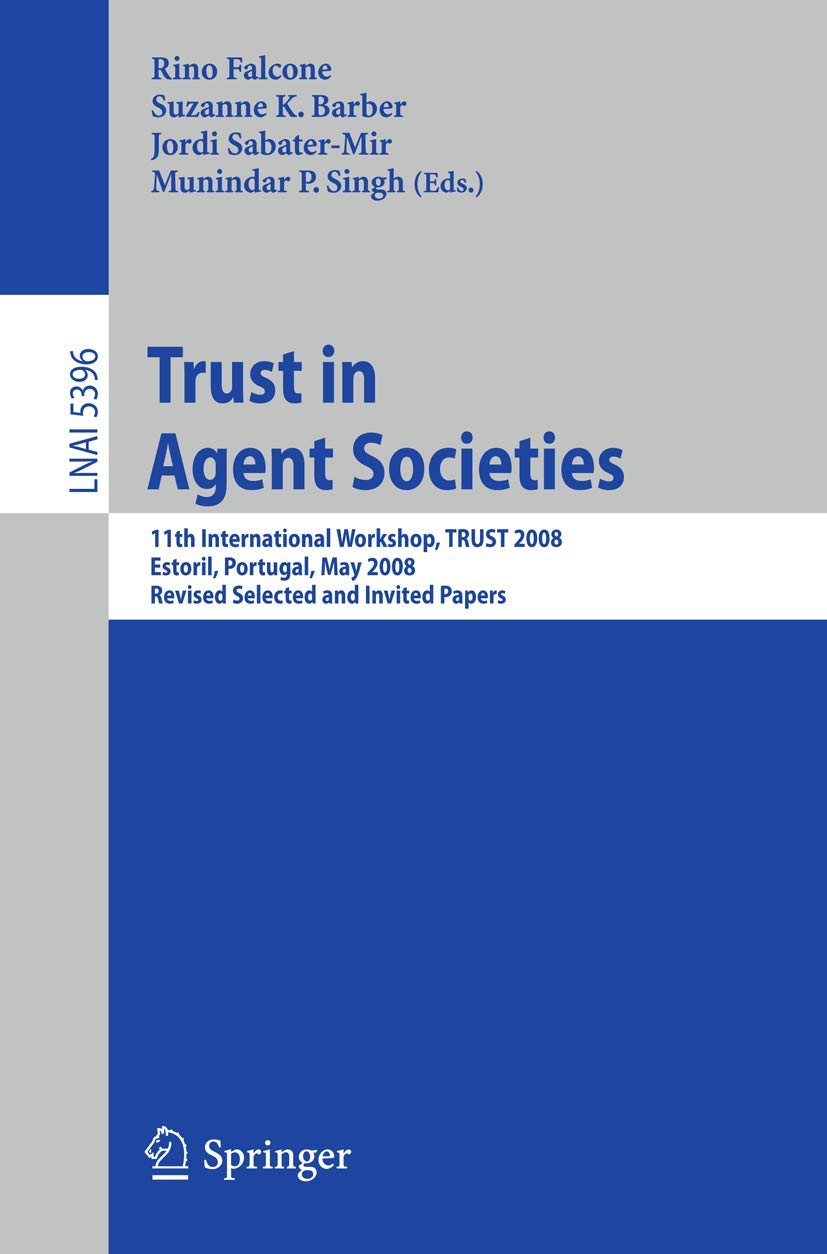
This special issue is the result of the selection and resubmission of advanced and revised versions of papers from the workshop on "Trust in Agent Societies" (11th edition), held in Estoril (Portugal) on May 10, 2008 as part of the Autonomous Agents and MultiAgent Systems 2008 Conference (AAMAS 2008), and organized by Rino Falcone, Suzanne Barber, Jordi SabaterMir, and Munindar Singh. The aim of the workshop was to bring together researchers from different fields (artificial intelligence, multiagent systems, cognitive science, game theory, and social and organizational sciences) that could contribute to a better understanding of trust and reputation in agent societies. The workshop scope included theoretical results as well their applications in humancomputer interaction and electronic commerce. It was constituted by a main session integrated with two others: the first on the formal models of trust, and the second on reputation models. In this volume we present papers from the three workshop sessions: the main s sion with papers on theoretical and applicative aspects of trust (from a engineering, cognitive, computational, sociological point of view); the formal model session with works in the field of applied logic and applied mathematics; the reputation models session with papers that specifically address models of reputation systems, theo driven and empirically backedup guidelines for designing reputation technologies, and analysis and discussion of existing reputation systems.
⚠️ WARNING (California Proposition 65):
This product may contain chemicals known to the State of California to cause cancer,
birth defects, or other reproductive harm.
For MAP (Minimum Advertised Price) violations and Intellectual Property (IP) or Trademark concerns, please contact:
support@ergodebooks.com
⚠️ California Proposition 65 Warning: Some products sold on this website may expose you to chemicals known to the State of California to cause cancer, birth defects, or other reproductive harm. For more information, visit www.P65Warnings.ca.gov.