
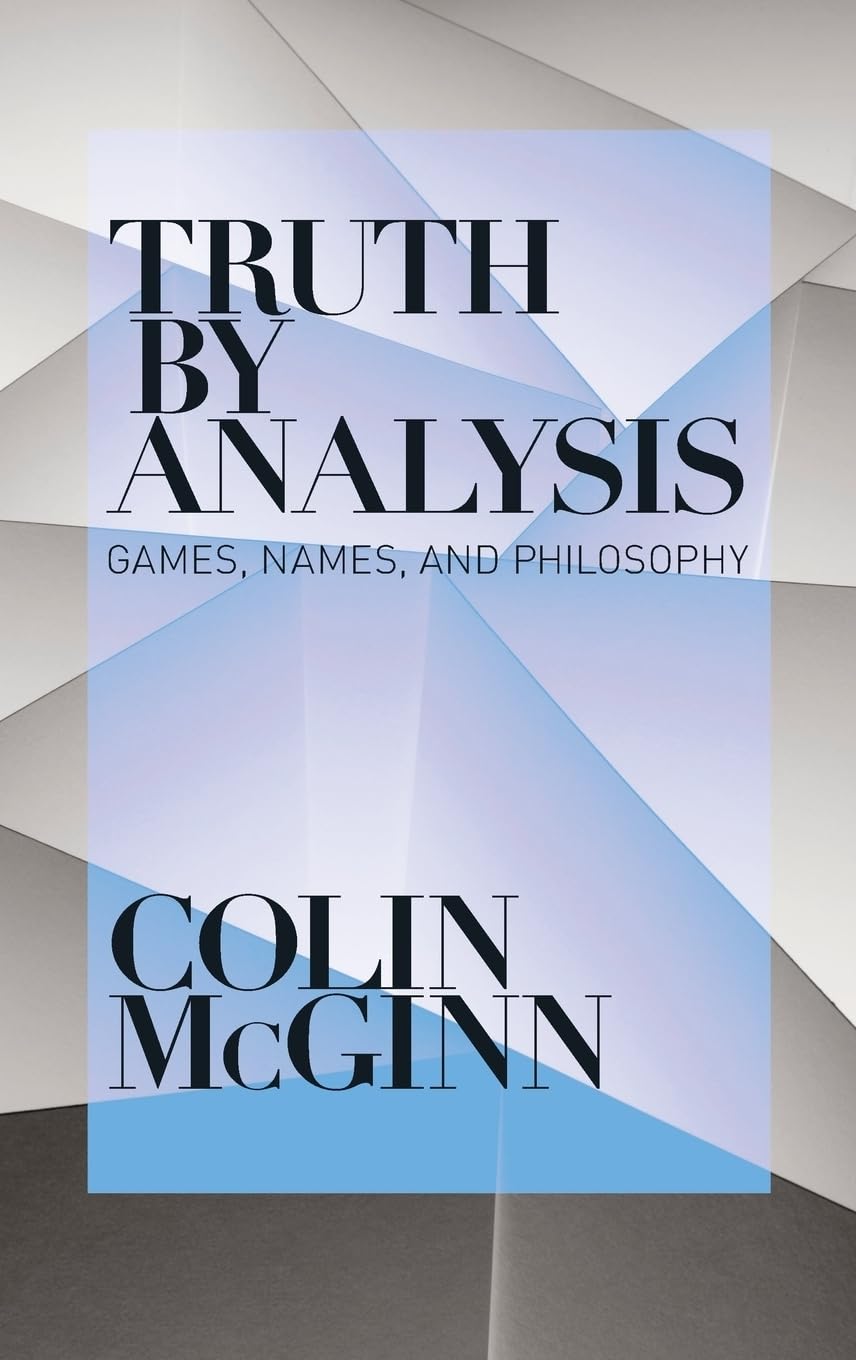
Title
Truth by Analysis: Games, Names, and Philosophy,Used
Sold by Ergodebooks, an authorized reseller.
Returns accepted within 30 days | support@ergodebooks.com
Shipping Information
- Free Standard Shipping — United States only
- Processing Time: 3–5 business days
- Estimated Delivery: 6–10 business days after dispatch
- Double-boxed, fully insured & discreetly packaged
- Tracking number sent via email once dispatched
Returns & Refund
Returns accepted within 30 days of delivery.
Damaged or Defective Item
Free return shipping + replacement or full refund
Wrong Item Received
Free return shipping + replacement or full refund
Change of Mind
Return shipping at customer's expense · 25% restocking fee applies
Payment Option

What kind of subject is philosophy? Colin McGinn takes up this perennial question, defending the view that philosophy consists of conceptual analysis, construed broadly. Conceptual analysis is understood to involve the search for de re essences, but McGinn takes up various challenges to this metaphilosophy: that some concepts are merely family resemblance concepts with no definition in terms of necessary and sufficient conditions ("game", "language"); that it is impossible to provide sufficient conditions for some philosophically important concepts without circularity ("knowledge", "intentional action"); that there exists an unsolved paradox of analysis; that there is no welldefined analyticsynthetic distinction; that names have no definition; and that conceptual analysis is not properly naturalistic. Ultimately, McGinn finds none of these objections convincing: analysis emerges as both possible and fruitful.At the same time, he rejects the idea of the "linguistic turn", arguing that analysis is not directed to language as such, but at reality. Going on to distinguish several types of analysis, with an emphasis on classical decompositional analysis, he shows different philosophical traditions to be engaged in conceptual analysis when properly understood. Philosophical activity has the kind of value possessed by play, McGinn claims, which differs from the kind of value possessed by scientific activity. The book concludes with an analytic discussion of the prospects for traditional ontology and the nature of instantiation.McGinn's study of the nature of philosophy shows us how philosophy can maintain its connection to the past while looking forward to a bright future.
⚠️ WARNING (California Proposition 65):
This product may contain chemicals known to the State of California to cause cancer, birth defects, or other reproductive harm.
For more information, please visit www.P65Warnings.ca.gov.