
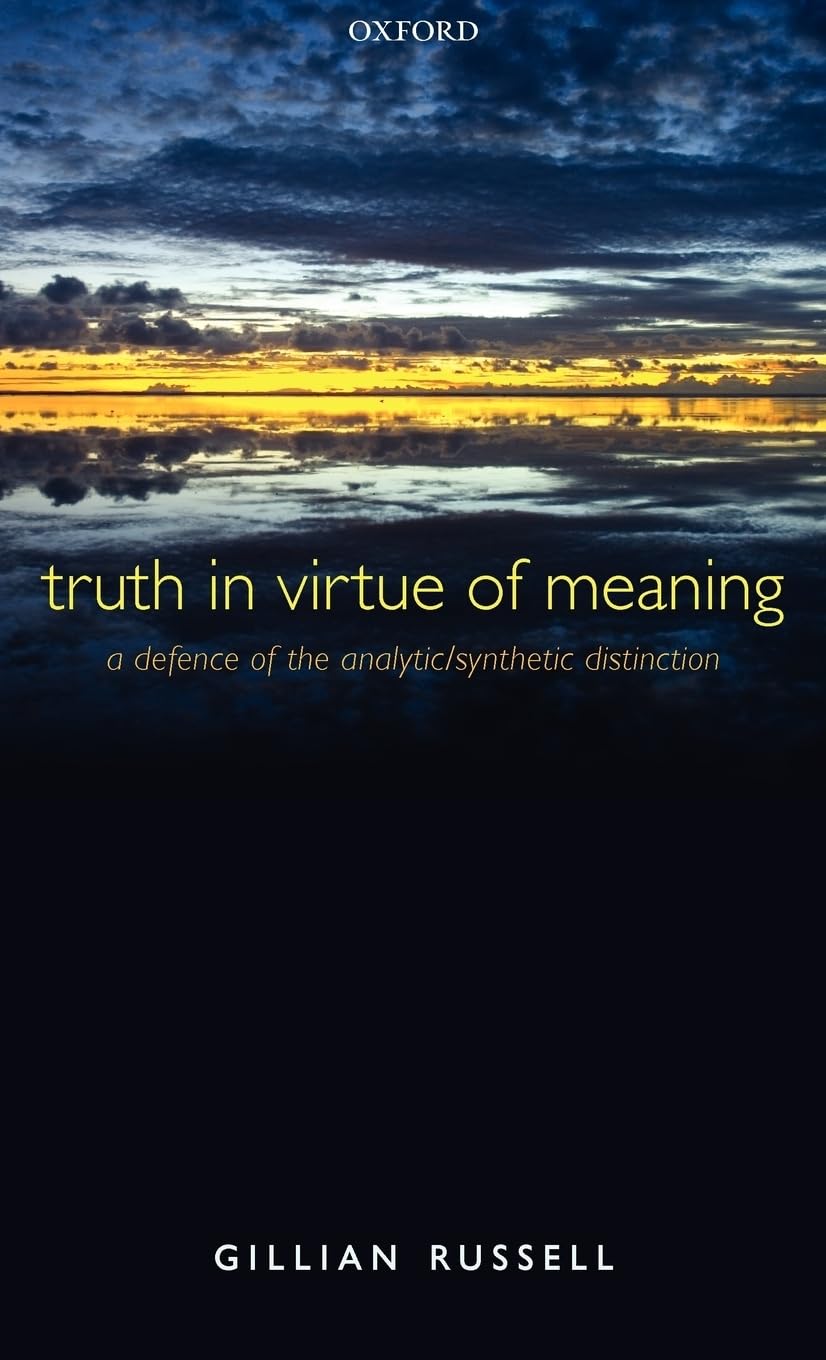
Title
Truth in Virtue of Meaning: A Defence of the Analytic/Synthetic Distinction,Used
Sold by Ergodebooks, an authorized reseller.
Returns accepted within 30 days | support@ergodebooks.com
Shipping Information
- Free Standard Shipping — United States only
- Processing Time: 3–5 business days
- Estimated Delivery: 6–10 business days after dispatch
- Double-boxed, fully insured & discreetly packaged
- Tracking number sent via email once dispatched
Returns & Refund
Returns accepted within 30 days of delivery.
Damaged or Defective Item
Free return shipping + replacement or full refund
Wrong Item Received
Free return shipping + replacement or full refund
Change of Mind
Return shipping at customer's expense · 25% restocking fee applies
Payment Option

The analytic/synthetic distinction looks simple. It is a distinction between two different kinds of sentence. Synthetic sentences are true in part because of the way the world is, and in part because of what they mean. Analytic sentenceslike all bachelors are unmarried and triangles have three sidesare different. They are true in virtue of meaning, so no matter what the world is like, as long as the sentence means what it does, it will be true.This distinction seems powerful because analytic sentences seem to be knowable in a special way. One can know that all bachelors are unmarried, for example, just by thinking about what it means. But many twentiethcentury philosophers, with Quine in the lead, argued that there were no analytic sentences, that the idea of analyticity didn't even make sense, and that the analytic/synthetic distinction was therefore an illusion. Others couldn't see how there could fail to be a distinction, however ingenious the arguments of Quine and his supporters.But since the heyday of the debate, things have changed in the philosophy of language. Tools have been refined, confusions cleared up, and most significantly, many philosophers now accept a view of languagesemantic externalismon which it is possible to see how the distinction could fail. One might be tempted to think that ultimately the distinction has fallen for reasons other than those proposed in the original debate.In Truth in Virtue of Meaning, Gillian Russell argues that it hasn't. Using the tools of contemporary philosophy of language, she outlines a view of analytic sentences which is compatible with semantic externalism and defends that view against the old Quinean arguments. She then goes on to draw out the surprising epistemological consequences of her approach.
⚠️ WARNING (California Proposition 65):
This product may contain chemicals known to the State of California to cause cancer, birth defects, or other reproductive harm.
For more information, please visit www.P65Warnings.ca.gov.