
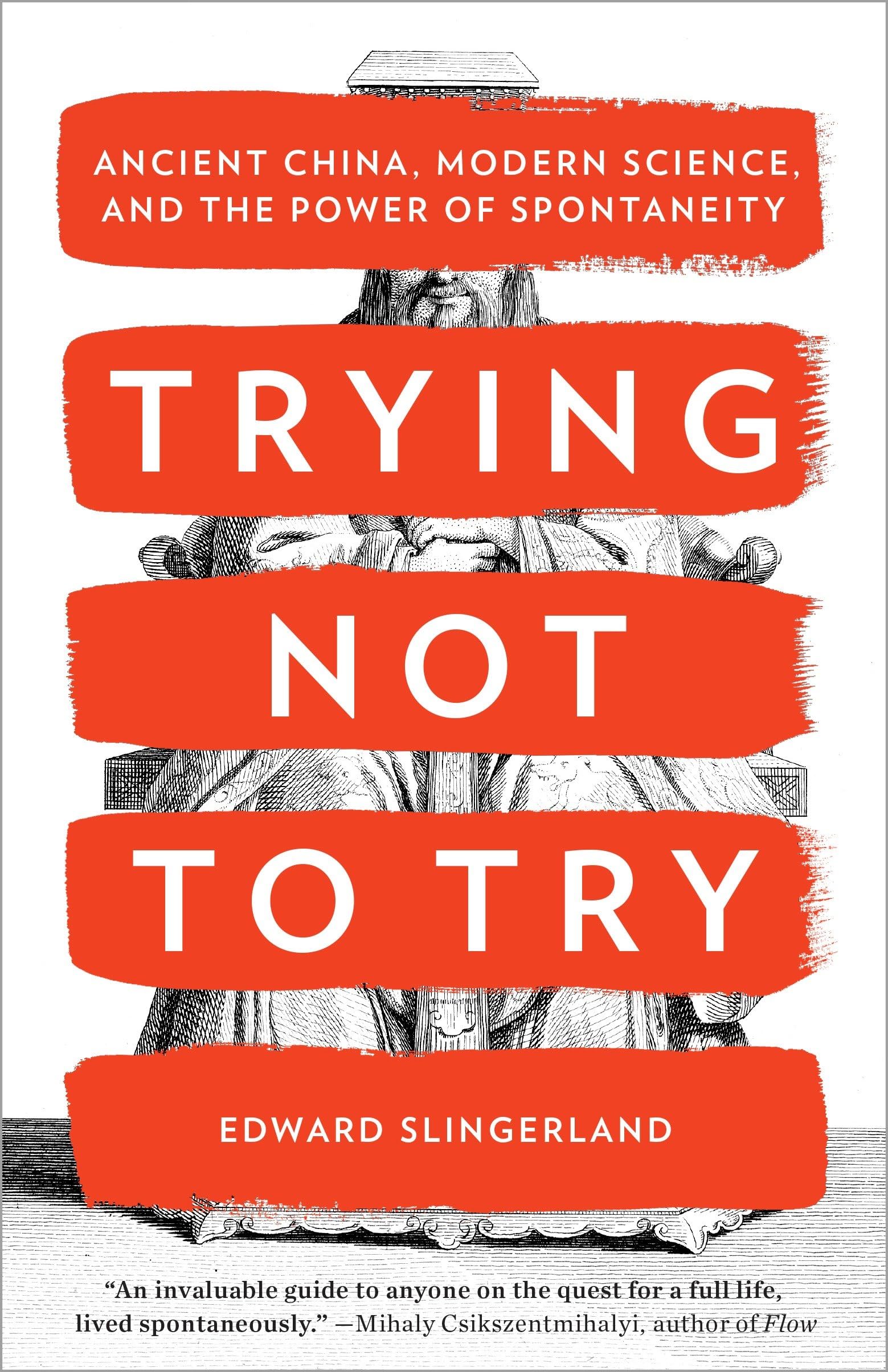
Title
Trying Not to Try: Ancient China, Modern Science, and the Power of Spontaneity,Used
Sold by Ergodebooks, an authorized reseller.
Returns accepted within 30 days | support@ergodebooks.com
Shipping Information
- Free Standard Shipping — United States only
- Processing Time: 3–5 business days
- Estimated Delivery: 6–10 business days after dispatch
- Double-boxed, fully insured & discreetly packaged
- Tracking number sent via email once dispatched
Returns & Refund
Returns accepted within 30 days of delivery.
Damaged or Defective Item
Free return shipping + replacement or full refund
Wrong Item Received
Free return shipping + replacement or full refund
Change of Mind
Return shipping at customer's expense · 25% restocking fee applies
Payment Option

A deeply original exploration of the power of spontaneityan ancient Chinese ideal that cognitive scientists are only now beginning to understandand why it is so essential to our wellbeingWhy is it always hard to fall asleep the night before an important meeting? Or be charming and relaxed on a first date? What is it about a politician who seems wooden or a comedian whose jokes fall flat or an athlete who chokes? In all of these cases, striving seems to backfire.In Trying Not To Try, Edward Slingerland explains why we find spontaneity so elusive, and shows how early Chinese thought points the way to happier, more authentic lives. Weve long been told that the way to achieve our goals is through careful reasoning and conscious effort. But recent research suggests that many aspects of a satisfying life, like happiness and spontaneity, are best pursued indirectly. The early Chinese philosophers knew this, and they wrote extensively about an effortless way of being in the world, which they called wuwei (oooway). They believed it was the source of all success in life, and they developed various strategies for getting it and hanging on to it.With clarity and wit, Slingerland introduces us to these thinkers and the marvelous characters in their texts, from the butcher whose blade glides effortlessly through an ox to the wood carver who sees his sculpture simply emerge from a solid block. Slingerland uncovers a direct line from wuwei to the Force in Star Wars, explains why wuwei is more powerful than flow, and tells us what it all means for getting a date. He also shows how new research reveals whats happening in the brain when were in a state of wuweiwhy it makes us happy and effective and trustworthy, and how it might have even made civilization possible.Through stories of mythical creatures and drunken cart riders, jazz musicians and Japanese motorcycle gangs, Slingerland effortlessly blends Eastern thought and cuttingedge science to show us how we can live more fulfilling lives. Trying Not To Try is mindexpanding and deeply pleasurable, the perfect antidote to our striving modern culture.
⚠️ WARNING (California Proposition 65):
This product may contain chemicals known to the State of California to cause cancer, birth defects, or other reproductive harm.
For more information, please visit www.P65Warnings.ca.gov.
- Q: What is the page count of this book? A: This book contains three hundred four pages. It is a paperback edition published by Crown.
- Q: What are the dimensions of 'Trying Not to Try'? A: The dimensions are five point two inches in length, zero point seven one inches in width, and seven point nine two inches in height.
- Q: Who is the author of this book? A: The author of 'Trying Not to Try' is Edward Slingerland. He explores themes of spontaneity and well-being in this work.
- Q: How should I read 'Trying Not to Try'? A: You can read this book at your own pace, as it is suitable for a general audience. It is particularly engaging for those interested in philosophy and psychology.
- Q: Is this book appropriate for beginners in philosophy? A: Yes, this book is appropriate for beginners. Slingerland presents complex ideas in an accessible and engaging manner.
- Q: What is the genre of 'Trying Not to Try'? A: The genre of this book is categorized under Interpersonal Relations. It blends philosophy with insights from cognitive science.
- Q: How do I care for this paperback book? A: To care for this paperback book, keep it away from moisture and direct sunlight. Store it in a cool, dry place to prevent damage.
- Q: Can this book be easily damaged? A: Yes, as a paperback, it can be more susceptible to wear and tear. Using a bookmark instead of folding pages can help maintain its condition.
- Q: Is this book safe for young readers? A: Yes, this book is safe for young readers. However, it is recommended for older teens and adults due to its complex themes.
- Q: What age group is this book suitable for? A: This book is suitable for readers aged sixteen and older. Its themes may resonate more with adults and older teens.
- Q: How does 'Trying Not to Try' compare to other self-help books? A: This book differs from typical self-help books by focusing on spontaneity rather than effort. It combines Eastern philosophy with modern science.
- Q: Is 'Trying Not to Try' based on scientific research? A: Yes, the book is based on recent cognitive science research. Slingerland integrates these findings with ancient Chinese philosophy.
- Q: What if I receive a damaged copy of the book? A: If you receive a damaged copy, you should contact the retailer for a return or exchange. Most retailers offer a satisfaction guarantee.
- Q: What is the return policy for this book? A: Return policies vary by retailer, but many allow returns within thirty days if the book is in original condition.
- Q: How do I handle my book if it gets wet? A: If your book gets wet, dry it gently by laying it flat. Avoid using heat sources, as they can warp the pages.