
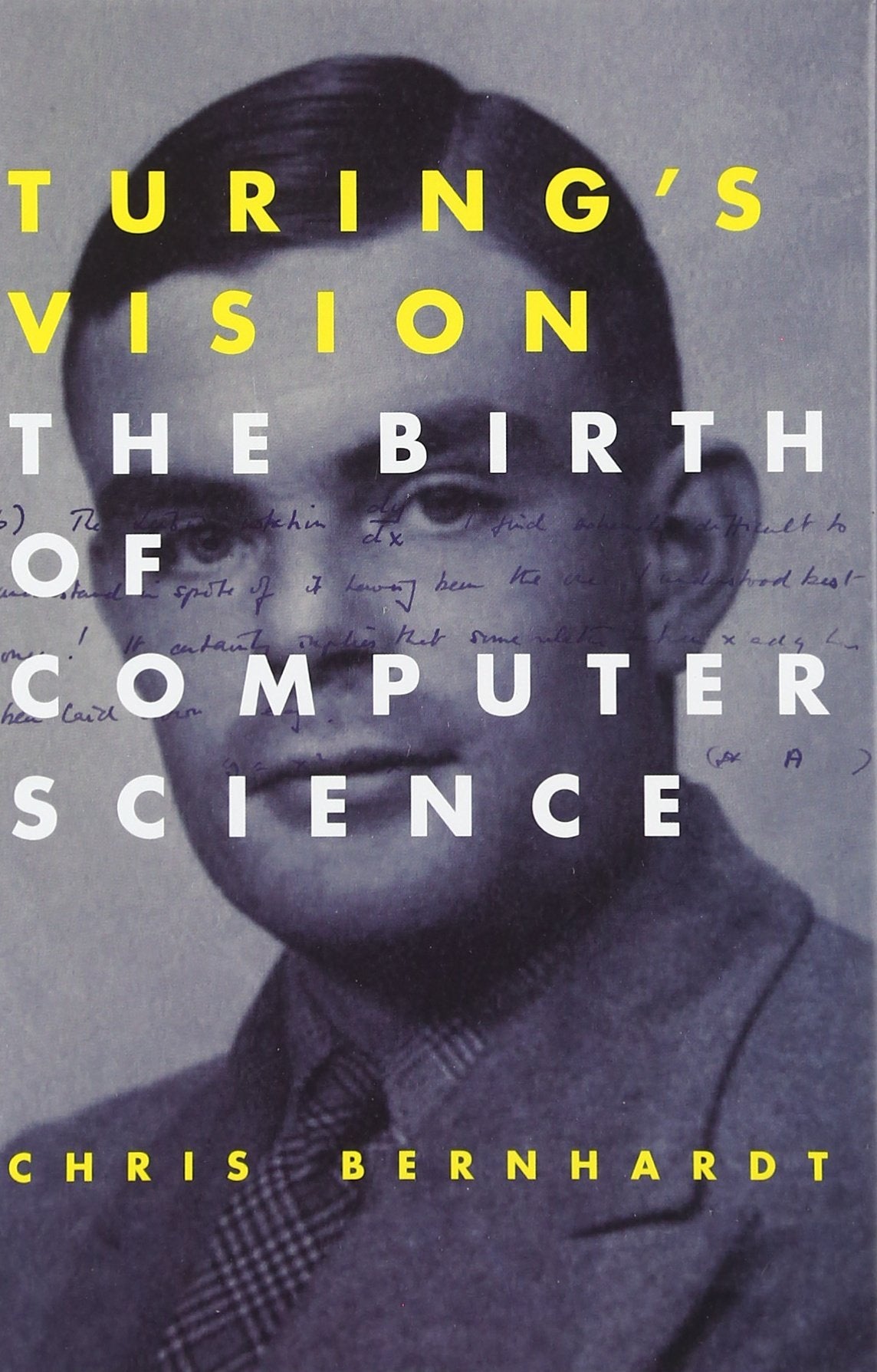
Title
Turing'S Vision: The Birth Of Computer Science
Sold by Ergodebooks, an authorized reseller.
Returns accepted within 30 days | support@ergodebooks.com
Shipping Information
- Free Standard Shipping — United States only
- Processing Time: 3–5 business days
- Estimated Delivery: 6–10 business days after dispatch
- Double-boxed, fully insured & discreetly packaged
- Tracking number sent via email once dispatched
Returns & Refund
Returns accepted within 30 days of delivery.
Damaged or Defective Item
Free return shipping + replacement or full refund
Wrong Item Received
Free return shipping + replacement or full refund
Change of Mind
Return shipping at customer's expense · 25% restocking fee applies
Payment Option

Turing'S Fascinating And Remarkable Theory, Which Now Forms The Basis Of Computer Science, Explained For The General Reader.In 1936, When He Was Just Twentyfour Years Old, Alan Turing Wrote A Remarkable Paper In Which He Outlined The Theory Of Computation, Laying Out The Ideas That Underlie All Modern Computers. This Groundbreaking And Powerful Theory Now Forms The Basis Of Computer Science. In Turing'S Vision, Chris Bernhardt Explains The Theory, Turing'S Most Important Contribution, For The General Reader. Bernhardt Argues That The Strength Of Turing'S Theory Is Its Simplicity, And That, Explained In A Straightforward Manner, It Is Eminently Understandable By The Nonspecialist. As Marvin Minsky Writes, The Sheer Simplicity Of The Theory'S Foundation And Extraordinary Short Path From This Foundation To Its Logical And Surprising Conclusions Give The Theory A Mathematical Beauty That Alone Guarantees It A Permanent Place In Computer Theory. Bernhardt Begins With The Foundation And Systematically Builds To The Surprising Conclusions. He Also Views Turing'S Theory In The Context Of Mathematical History, Other Views Of Computation (Including Those Of Alonzo Church), Turing'S Later Work, And The Birth Of The Modern Computer.In The Paper, On Computable Numbers, With An Application To The Entscheidungsproblem, Turing Thinks Carefully About How Humans Perform Computation, Breaking It Down Into A Sequence Of Steps, And Then Constructs Theoretical Machines Capable Of Performing Each Step. Turing Wanted To Show That There Were Problems That Were Beyond Any Computer'S Ability To Solve; In Particular, He Wanted To Find A Decision Problem That He Could Prove Was Undecidable. To Explain Turing'S Ideas, Bernhardt Examines Three Wellknown Decision Problems To Explore The Concept Of Undecidability; Investigates Theoretical Computing Machines, Including Turing Machines; Explains Universal Machines; And Proves That Certain Problems Are Undecidable, Including Turing'S Problem Concerning Computable Numbers.
⚠️ WARNING (California Proposition 65):
This product may contain chemicals known to the State of California to cause cancer, birth defects, or other reproductive harm.
For more information, please visit www.P65Warnings.ca.gov.
- Q: What is the length, width, and height of the book? A: The book measures six inches in length, one inch in width, and eight and a half inches in height. These dimensions make it a compact and easy-to-handle hardcover edition.
- Q: How many pages does 'Turing's Vision' have? A: The book contains one hundred eighty-nine pages. This length provides a thorough exploration of Alan Turing's theories while remaining accessible to general readers.
- Q: What type of binding does this book have? A: This book is bound in hardcover. The durable binding ensures longevity and makes it suitable for repeated reading and reference.
- Q: What reading level is 'Turing's Vision' suitable for? A: This book is suitable for general readers, including those without a technical background. Chris Bernhardt explains complex theories in an understandable manner.
- Q: How does the author explain Turing's theories? A: Bernhardt systematically builds the concepts from foundational ideas to surprising conclusions. He uses clear language and relatable examples to engage the reader.
- Q: Are there any decision problems discussed in the book? A: Yes, the book examines three well-known decision problems. These discussions help illustrate Turing's concept of undecidability in computation.
- Q: What is the main focus of 'Turing's Vision'? A: The main focus is on Alan Turing's theory of computation and its implications for computer science. The book contextualizes Turing's work within mathematical history.
- Q: Is this book appropriate for someone new to computer science? A: Yes, it's designed for readers new to computer science. The author emphasizes simplicity and clarity, making complex ideas accessible.
- Q: What should I do to maintain the book's condition? A: To maintain the book's condition, store it in a cool, dry place and avoid exposing it to direct sunlight. Handle it carefully to prevent wear.
- Q: Can I find illustrations or diagrams in the book? A: No, the book primarily focuses on text explanations. It is intended to convey Turing's theories through clear narrative rather than visual aids.
- Q: What is the publisher of 'Turing's Vision'? A: The book is published by MIT Press. This reputable publisher is known for its academic and scholarly works in various fields.
- Q: Is there any adult content in 'Turing's Vision'? A: No, there is no adult content in this book. It is appropriate for a wide audience including students and general readers.
- Q: What themes are explored in the book? A: Themes include the foundations of computation, decision problems, and the historical context of Turing's work. The book emphasizes the mathematical beauty of Turing's theories.
- Q: How does the author view Turing's contributions? A: The author views Turing's contributions as foundational and elegantly simple. He argues that the clarity of Turing's theories makes them enduringly relevant.
- Q: What is the ISBN of 'Turing's Vision'? A: The ISBN is not specified in the provided details. However, it can be found through the publisher or major book retailers.
- Q: What makes 'Turing's Vision' unique compared to other computer science books? A: Its unique approach lies in its accessibility for nonspecialists. The author presents complex ideas in an engaging and easy-to-understand manner.