
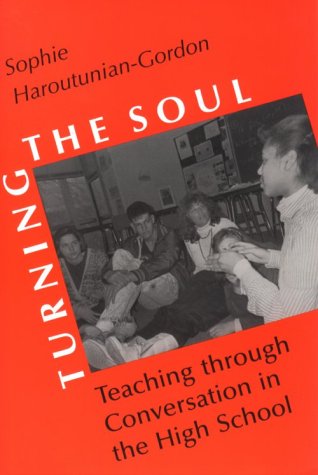
Title
Turning the Soul: Teaching through Conversation in the High School,Used
Sold by Ergodebooks, an authorized reseller.
Returns accepted within 30 days | support@ergodebooks.com
Shipping Information
- Free Standard Shipping — United States only
- Processing Time: 3–5 business days
- Estimated Delivery: 6–10 business days after dispatch
- Double-boxed, fully insured & discreetly packaged
- Tracking number sent via email once dispatched
Returns & Refund
Returns accepted within 30 days of delivery.
Damaged or Defective Item
Free return shipping + replacement or full refund
Wrong Item Received
Free return shipping + replacement or full refund
Change of Mind
Return shipping at customer's expense · 25% restocking fee applies
Payment Option

Is our nation's educational system faltering in part because it strives to teach students predetermined 'right' answers to questions? In Turning the Soul, Sophie HaroutunianGordon offers and alternative to methods advocated by conventional educational practice. By guiding the reader back and forth between two high school classes discussing Shakespeare's Romeo and Juliet, she gracefully introduces the alternative approach to education: interpretive discussion.One class, located in a private, racially integrated urban school, has had many conversations about the meaning of books. The second group, less advantaged students in a largely black urban school, has not. The reader watches as students in each group begin to draw upon experiences in their personal lives to speculate about events in the play. The students assist one another with the interpretation of complex passages, pose queries that help sustain the conversation, and struggle to 'get Shakespeare right.' Though the teachers suffer moments of intense frustration, they are rewarded by seeing their students learn to engage in meaningful exchange.Because Turning the Soul draws on actual classroom conversations, it presents the range of difficulties that one encounters in interpretive discussion. The book describes the assumptions about learning that the use of such discussion in the classroom presupposes, and it offers a theoretical perspective from which to view the changes in both students and teachers.
⚠️ WARNING (California Proposition 65):
This product may contain chemicals known to the State of California to cause cancer, birth defects, or other reproductive harm.
For more information, please visit www.P65Warnings.ca.gov.
- Q: How many pages does this book have? A: This book has two hundred twenty-four pages. It provides an in-depth look at alternative teaching methods in high school education.
- Q: What is the binding type of this book? A: The binding type is paperback. This makes the book lightweight and flexible for easy handling.
- Q: Who is the author of 'Turning the Soul'? A: The author is Sophie Haroutunian-Gordon. She focuses on educational practices and interpretive discussion in her work.
- Q: What educational level is this book suitable for? A: This book is suitable for high school educators and students. It explores methods of engaging students in meaningful discussions.
- Q: What themes does 'Turning the Soul' cover? A: The book covers themes of interpretive discussion and student engagement in literature. It emphasizes the importance of personal experience in learning.
- Q: How does this book approach teaching Shakespeare? A: The book uses interpretive discussion to teach Shakespeare's works. It highlights classroom conversations that help students connect personally with the material.
- Q: What is the main focus of 'Turning the Soul'? A: The main focus is on alternative educational practices. It critiques the conventional approach of teaching predetermined answers to students.
- Q: Is this book based on real classroom experiences? A: Yes, it is based on actual classroom conversations. This provides authentic insights into the challenges and rewards of interpretive discussion.
- Q: Can this book help improve classroom discussions? A: Yes, it offers strategies for enhancing classroom discussions. The insights can help teachers facilitate more meaningful exchanges among students.
- Q: What type of school settings does the book discuss? A: The book discusses both private and urban school settings. It contrasts the experiences of students in racially integrated and less advantaged environments.
- Q: What challenges are presented in the book? A: The book presents challenges faced in interpretive discussions. It details the difficulties teachers encounter while trying to engage students.
- Q: Is this book applicable for teacher training? A: Yes, it is applicable for teacher training programs. The insights can be valuable for educators looking to adopt alternative teaching methods.
- Q: Does the book provide theoretical perspectives on education? A: Yes, it offers theoretical perspectives on educational practices. This helps frame the discussion around teaching and learning in classrooms.
- Q: Is 'Turning the Soul' suitable for self-study? A: Yes, it is suitable for self-study. Educators and students can benefit from the insights provided in the book.
- Q: What educational philosophy is explored in this book? A: The book explores the philosophy of interpretive discussion. This approach encourages students to engage deeply with texts and share personal interpretations.
- Q: How does the author illustrate her points? A: The author illustrates her points through real classroom examples. These examples highlight the practical application of her educational theories.