
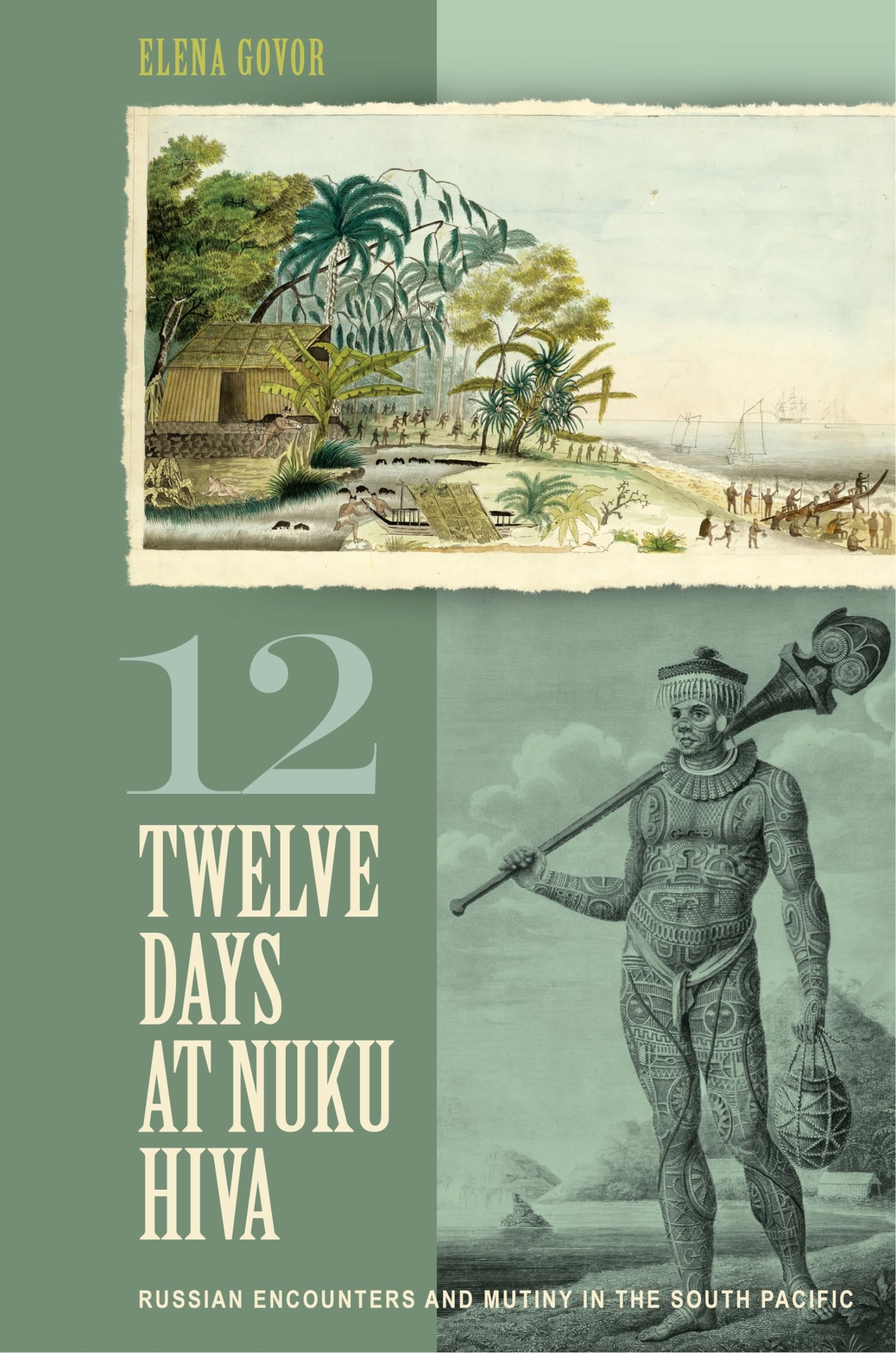
Title
Twelve Days at Nuku Hiva: Russian Encounters and Mutiny in the South Pacific,Used
Sold by Ergodebooks, an authorized reseller.
Returns accepted within 30 days | support@ergodebooks.com
Shipping Information
- Free Standard Shipping — United States only
- Processing Time: 3–5 business days
- Estimated Delivery: 6–10 business days after dispatch
- Double-boxed, fully insured & discreetly packaged
- Tracking number sent via email once dispatched
Returns & Refund
Returns accepted within 30 days of delivery.
Damaged or Defective Item
Free return shipping + replacement or full refund
Wrong Item Received
Free return shipping + replacement or full refund
Change of Mind
Return shipping at customer's expense · 25% restocking fee applies
Payment Option

In August 1803 two Russian ships, the Nadezhda and the Neva, set off on a roundtheworld voyage to carry out scientific exploration and collect artifacts for Alexander Is ethnographic museum in St. Petersburg. Russias strategic concerns in the north Pacific, however, led the Russian government to include as part of the expedition an embassy to Japan, headed by statesman Nikolai Rezanov, who was given authority over the ships commanders without their knowledge. Between them the ships carried an ethnically and socially disparate group of men: Russian educated elite, German naturalists, Siberian merchants, Baltic naval officers, even Japanese passengers. Upon reaching Nuku Hiva in the Marquesas archipelago on May 7, 1804, and for the next twelve days, the naval officers revolted against Rezanovs command while complex crosscultural encounters between Russians and islanders occurred. Elena Govor recounts the voyage, reconstructing and exploring in depth the tumultuous events of the Russians stay in Nuku Hiva; the course of the mutiny, its resolution and aftermath; and the extent and nature of the contact between Nuku Hivans and Russians.Govor draws directly on the writings of the participants themselves, many of whom left accounts of the voyage. Those by the ships captains, Krusenstern and Lisiansky, and the naturalist George Langsdorff are well known, but here for the first time, their writings are juxtaposed with recently discovered textual and visual evidence by various members of the expedition in Russian, German, Japaneseand by the Nuku Hivans themselves. Two sailorbeachcombers, a Frenchman and an Englishman who acted as guides and interpreters, later contributed their own accounts, which feature the words and opinions of islanders. Govor also relies on a myth about the Russian visit recounted by Nuku Hivans to this day.With its unique polyphonic historical approach, Twelve Days at Nuku Hiva presents an innovative crosscultural ethnohistory that uncovers new approaches toand understandings ofwhat took place on Nuku Hiva more than two hundred years ago.
⚠️ WARNING (California Proposition 65):
This product may contain chemicals known to the State of California to cause cancer, birth defects, or other reproductive harm.
For more information, please visit www.P65Warnings.ca.gov.