If you have any questions, you are always welcome to contact us. We'll get back to you as soon as possible, withing 24 hours on weekdays.
Customer service
All questions about your order, return and delivery must be sent to our customer service team by e-mail at yourstore@yourdomain.com
Sale & Press
If you are interested in selling our products, need more information about our brand or wish to make a collaboration, please contact us at press@yourdomain.com
Help
If you have any questions, you are always welcome to contact us. We'll get back to you as soon as possible, withing 24 hours on weekdays.
Customer service
All questions about your order, return and delivery must be sent to our customer service team by e-mail at yourstore@yourdomain.com
Sale & Press
If you are interested in selling our products, need more information about our brand or wish to make a collaboration, please contact us at press@yourdomain.com
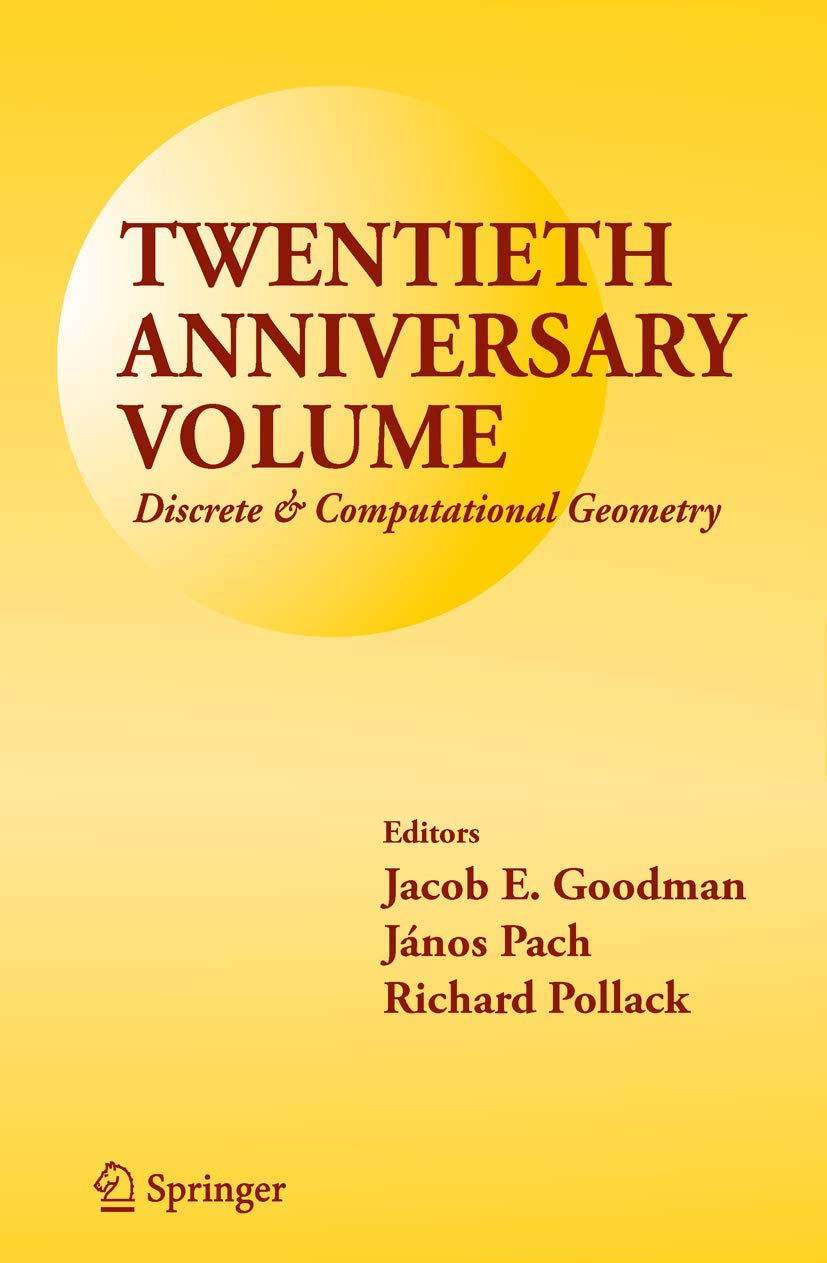
While we were busy putting together the present collection of articles celebrating the twentieth birthday of our journal, Discrete & Computational Geometry, and, in a way, of the ?eld that has become known under the same name, two more years have elapsed. There is no doubt that DCG has crossed the line between childhood and adulthood. By the mid1980s it became evident that the solution of many algorithmic qu tions in the then newly emerging ?eld of computational geometry required classical methodsandresultsfromdiscreteandcombinatorialgeometry. Forinstance,visibility and ray shooting problems arising in computer graphics often reduce to Hellytype questions for line transversals; the complexity (hardness) of a variety of geometric algorithms depends on McMullens upper bound theorem on convex polytopes or on the maximum number of halving lines determined by 2n points in the plane, that is, the number of different ways a set of points can be cut by a straight line into two parts of the same size; proximity questions stemming from several application areas turn out to be intimately related to Erdos ? s classical questions on the distribution of distances determined by n points in the plane or in space. On the other hand, the algorithmic point of view has fertilized several ?elds of c vexity and of discrete geometry which had lain fallow for some years, and has opened new research directions.
⚠️ WARNING (California Proposition 65):
This product may contain chemicals known to the State of California to cause cancer,
birth defects, or other reproductive harm.
For MAP (Minimum Advertised Price) violations and Intellectual Property (IP) or Trademark concerns, please contact:
support@ergodebooks.com
⚠️ California Proposition 65 Warning: Some products sold on this website may expose you to chemicals known to the State of California to cause cancer, birth defects, or other reproductive harm. For more information, visit www.P65Warnings.ca.gov.