
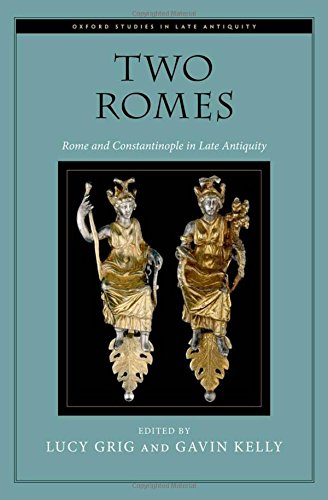
Title
Two Romes: Rome And Constantinople In Late Antiquity (Oxford Studies In Late Antiquity)
Sold by Ergodebooks, an authorized reseller.
Returns accepted within 30 days | support@ergodebooks.com
Shipping Information
- Free Standard Shipping — United States only
- Processing Time: 3–5 business days
- Estimated Delivery: 6–10 business days after dispatch
- Double-boxed, fully insured & discreetly packaged
- Tracking number sent via email once dispatched
Returns & Refund
Returns accepted within 30 days of delivery.
Damaged or Defective Item
Free return shipping + replacement or full refund
Wrong Item Received
Free return shipping + replacement or full refund
Change of Mind
Return shipping at customer's expense · 25% restocking fee applies
Payment Option

The city of Constantinople was named New Rome or Second Rome very soon after its foundation in AD 324; over the next two hundred years it replaced the original Rome as the greatest city of the Mediterranean. In this unified essay collection, prominent international scholars examine the changing roles and perceptions of Rome and Constantinople in Late Antiquity from a range of different disciplines and scholarly perspectives. The seventeen chapters cover both the comparative development and the shifting status of the two cities. Developments in politics and urbanism are considered, along with the cities' changing relationships with imperial power, the church, and each other, and their evolving representations in both texts and images. These studies present important revisionist arguments and new interpretations of significant texts and events. This comparative perspective allows the neglected subject of the relationship between the two Romes to come into focus while avoiding the teleological distortions common in much past scholarship.An introductory section sets the cities, and their comparative development, in context. Part Two looks at topography, and includes the first English translation of the Notitia of Constantinople. The following section deals with politics proper, considering the role of emperors in the two Romes and how rulers interacted with their cities. Part Four then considers the cities through the prism of literature, in particular through the distinctively late antique genre of panegyric. The fifth group of essays considers a crucial aspect shared by the two cities: their role as Christian capitals. Lastly, a provocative epilogue looks at the enduring Roman identity of the postHeraclian Byzantine state. Thus, Two Romes not only illuminates the study of both cities but also enriches our understanding of the late Roman world in its entirety.
⚠️ WARNING (California Proposition 65):
This product may contain chemicals known to the State of California to cause cancer, birth defects, or other reproductive harm.
For more information, please visit www.P65Warnings.ca.gov.