
Title
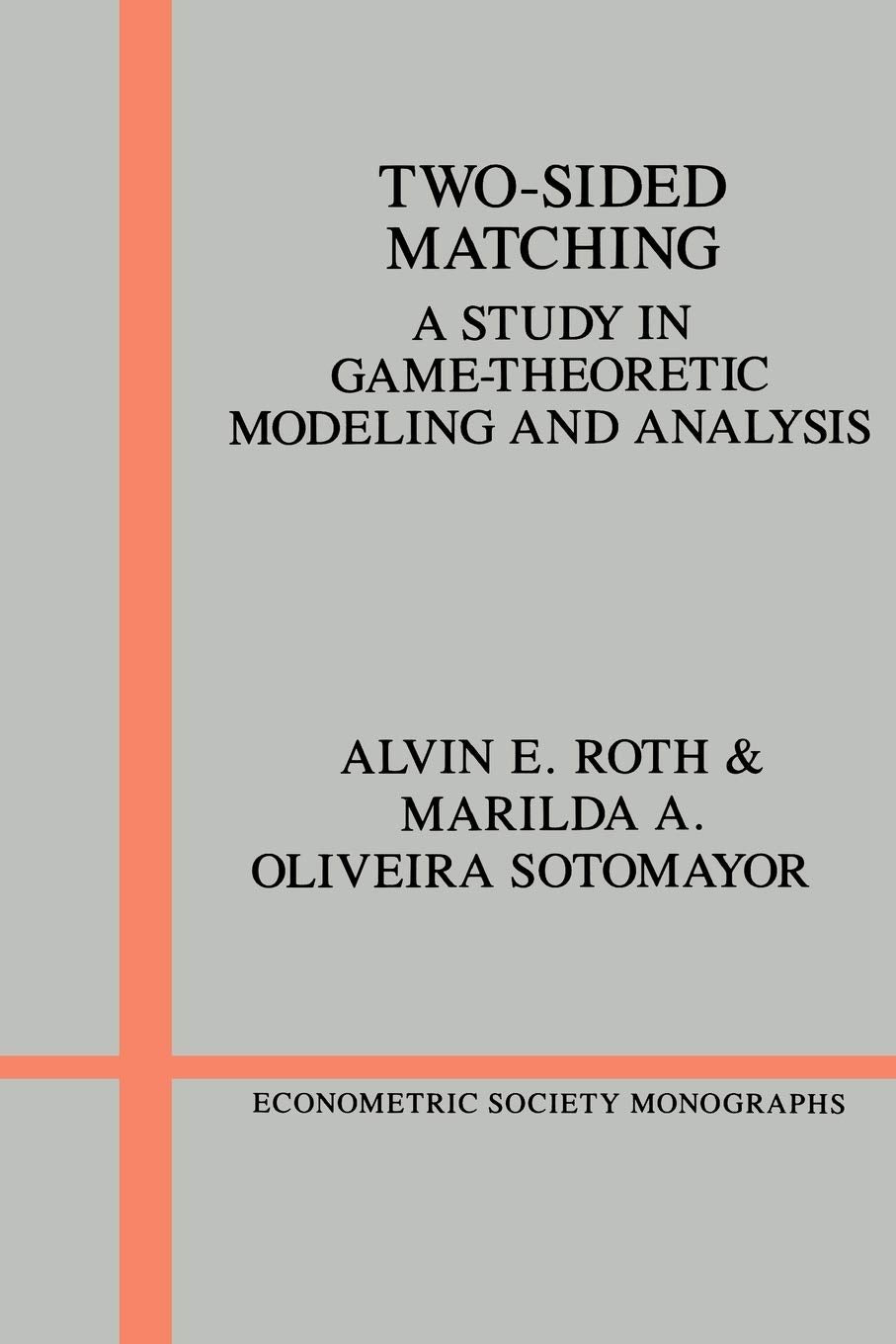
TwoSided Matching: A Study in GameTheoretic Modeling and Analysis (Econometric Society Monographs, Series Number 18),New
Sold by Ergodebooks, an authorized reseller.
Returns accepted within 30 days | support@ergodebooks.com
Shipping Information
- Free Standard Shipping — United States only
- Processing Time: 3–5 business days
- Estimated Delivery: 6–10 business days after dispatch
- Double-boxed, fully insured & discreetly packaged
- Tracking number sent via email once dispatched
Returns & Refund
Returns accepted within 30 days of delivery.
Damaged or Defective Item
Free return shipping + replacement or full refund
Wrong Item Received
Free return shipping + replacement or full refund
Change of Mind
Return shipping at customer's expense · 25% restocking fee applies
Payment Option

Twosided matching provides a model of search processes such as those between firms and workers in labor markets or between buyers and sellers in auctions. This book gives a comprehensive account of recent results concerning the gametheoretic analysis of twosided matching. The focus of the book is on the stability of outcomes, on the incentives that different rules of organization give to agents, and on the constraints that these incentives impose on the ways such markets can be organized. The results for this wide range of related models and matching situations help clarify which conclusions depend on particular modeling assumptions and market conditions, and which are robust over a wide range of conditions.
⚠️ WARNING (California Proposition 65):
This product may contain chemicals known to the State of California to cause cancer, birth defects, or other reproductive harm.
For more information, please visit www.P65Warnings.ca.gov.
- Q: How many pages does this book have? A: The book contains two hundred eighty pages. This length provides a comprehensive exploration of the game-theoretic modeling of two-sided matching.
- Q: What are the dimensions of this book? A: The book measures six inches in length, zero point seventy-one inches in width, and nine point zero two inches in height. This size makes it easy to handle and read.
- Q: What type of binding does this book have? A: This book is paperback bound. Paperback binding is flexible and lightweight, making it convenient for readers.
- Q: Who is the author of this book? A: The author of this book is Alvin E. Roth. He is known for his contributions to game theory and market design.
- Q: What is the main focus of this book? A: The main focus is on the stability of outcomes in two-sided matching markets. It analyzes the incentives that different organizational rules create for agents.
- Q: What is two-sided matching? A: Two-sided matching is a model of search processes between two parties, such as firms and workers. It is applicable in various contexts, including labor markets and auctions.
- Q: Is this book suitable for beginners? A: Yes, this book is suitable for readers with a basic understanding of economics and game theory. It provides a clear explanation of key concepts.
- Q: How can I apply the concepts from this book? A: You can apply the concepts by analyzing real-world matching situations, such as job placements or market transactions. The book offers insights into market organization.
- Q: What are the key themes covered in this book? A: Key themes include stability, organizational rules, and the robustness of conclusions across different market conditions. These themes help clarify critical economic principles.
- Q: How should I care for this book? A: To care for this book, keep it in a dry, cool place and avoid exposure to direct sunlight. This will help preserve its condition over time.
- Q: Is this book a good resource for academic research? A: Yes, this book is an excellent resource for academic research in economics and game theory. It provides extensive analysis and recent results in the field.
- Q: What if the book arrives damaged? A: If the book arrives damaged, you should contact the seller for a return or replacement. Most sellers offer a guarantee for damaged items.
- Q: Can I find similar books on this topic? A: Yes, you can find similar books on econometric modeling and game theory. Look for titles published by Cambridge University Press for related content.
- Q: Does this book offer practical examples? A: Yes, the book includes practical examples of two-sided matching scenarios. These examples help illustrate the theoretical concepts discussed.
- Q: Is this book part of a series? A: Yes, this book is part of the Econometric Society Monographs series. This series focuses on advanced topics in econometrics and statistics.