If you have any questions, you are always welcome to contact us. We'll get back to you as soon as possible, withing 24 hours on weekdays.
Customer service
All questions about your order, return and delivery must be sent to our customer service team by e-mail at yourstore@yourdomain.com
Sale & Press
If you are interested in selling our products, need more information about our brand or wish to make a collaboration, please contact us at press@yourdomain.com
Help
If you have any questions, you are always welcome to contact us. We'll get back to you as soon as possible, withing 24 hours on weekdays.
Customer service
All questions about your order, return and delivery must be sent to our customer service team by e-mail at yourstore@yourdomain.com
Sale & Press
If you are interested in selling our products, need more information about our brand or wish to make a collaboration, please contact us at press@yourdomain.com
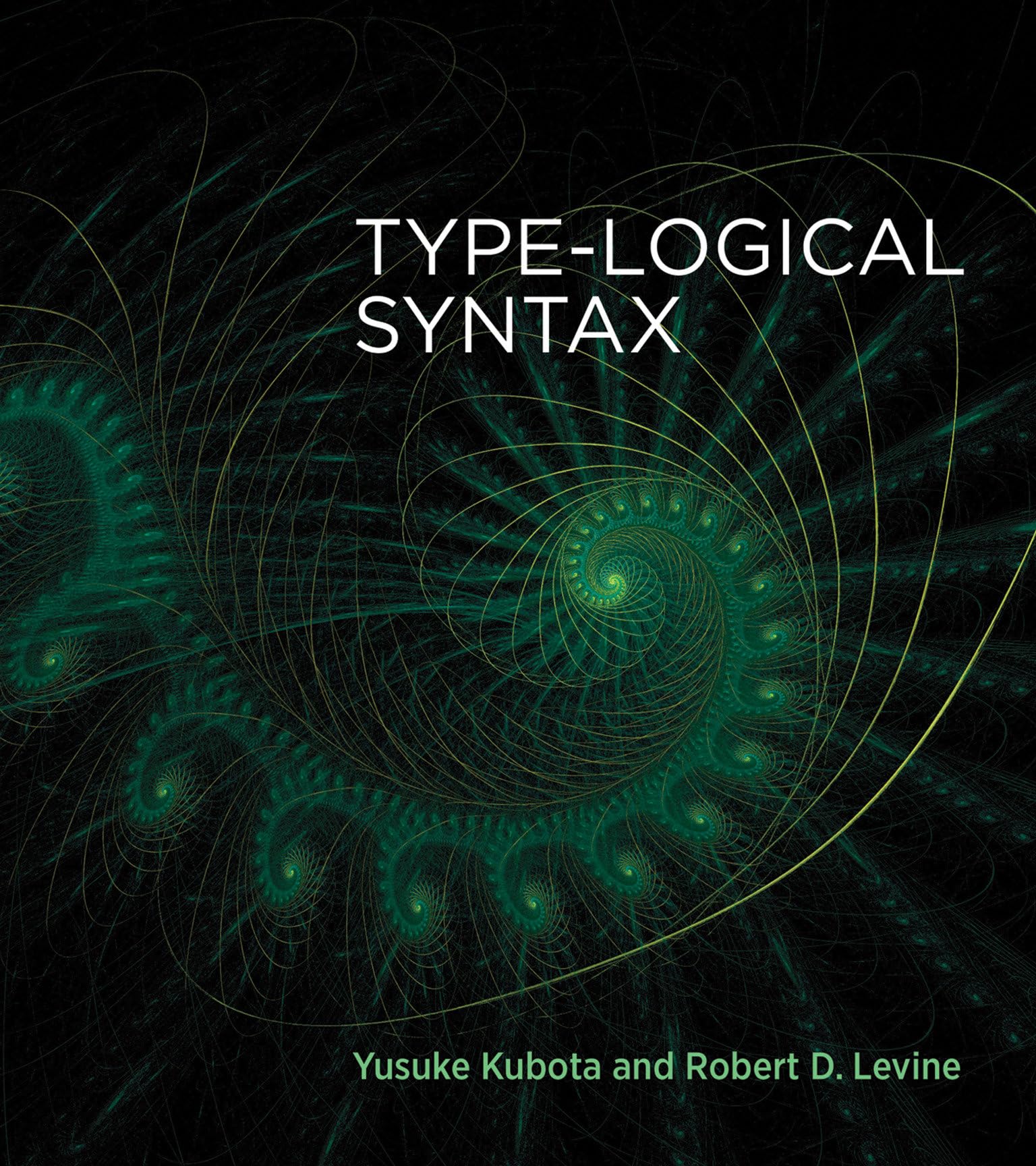
A novel logicbased framework for representing the syntaxsemantics interface of natural language, applicable to a range of phenomena.In this book, Yusuke Kubota and Robert Levine propose a typelogical version of categorial grammar as a viable alternative model of natural language syntax and semantics. They show that this novel logicbased framework is applicable to a range of phenomenaespecially in the domains of coordination and ellipsisthat have proven problematic for traditional approaches.The typelogical syntax the authors propose takes derivations of natural language sentences to be proofs in a particular kind of logic governing the way words and phrases are combined. This logic builds on and unifies two deductive systems from the tradition of categorial grammar; the resulting system, Hybrid TypeLogical Categorial Grammar (Hybrid TLCG) enables comprehensive approaches to coordination (gapping, dependent cluster coordination, and rightnode raising) and ellipsis (VP ellipsis, pseudogapping, and extraction/ellipsis interaction). It captures a number of intricate patterns of interaction between scopal operators and seemingly incomplete constituents that are frequently found in these two empirical domains. Kubota and Levine show that the hybrid calculus underlying their framework incorporates key analytic ideas from competing approaches in the generative syntax literature to offer a unified and systematic treatment of data that have posed considerable difficulties for previous accounts. Their account demonstrates that logic is a powerful tool for analyzing the deeper principles underlying the syntax and semantics of natural language.
⚠️ WARNING (California Proposition 65):
This product may contain chemicals known to the State of California to cause cancer,
birth defects, or other reproductive harm.
For MAP (Minimum Advertised Price) violations and Intellectual Property (IP) or Trademark concerns, please contact:
support@ergodebooks.com
⚠️ California Proposition 65 Warning: Some products sold on this website may expose you to chemicals known to the State of California to cause cancer, birth defects, or other reproductive harm. For more information, visit www.P65Warnings.ca.gov.