If you have any questions, you are always welcome to contact us. We'll get back to you as soon as possible, withing 24 hours on weekdays.
Customer service
All questions about your order, return and delivery must be sent to our customer service team by e-mail at yourstore@yourdomain.com
Sale & Press
If you are interested in selling our products, need more information about our brand or wish to make a collaboration, please contact us at press@yourdomain.com
Help
If you have any questions, you are always welcome to contact us. We'll get back to you as soon as possible, withing 24 hours on weekdays.
Customer service
All questions about your order, return and delivery must be sent to our customer service team by e-mail at yourstore@yourdomain.com
Sale & Press
If you are interested in selling our products, need more information about our brand or wish to make a collaboration, please contact us at press@yourdomain.com
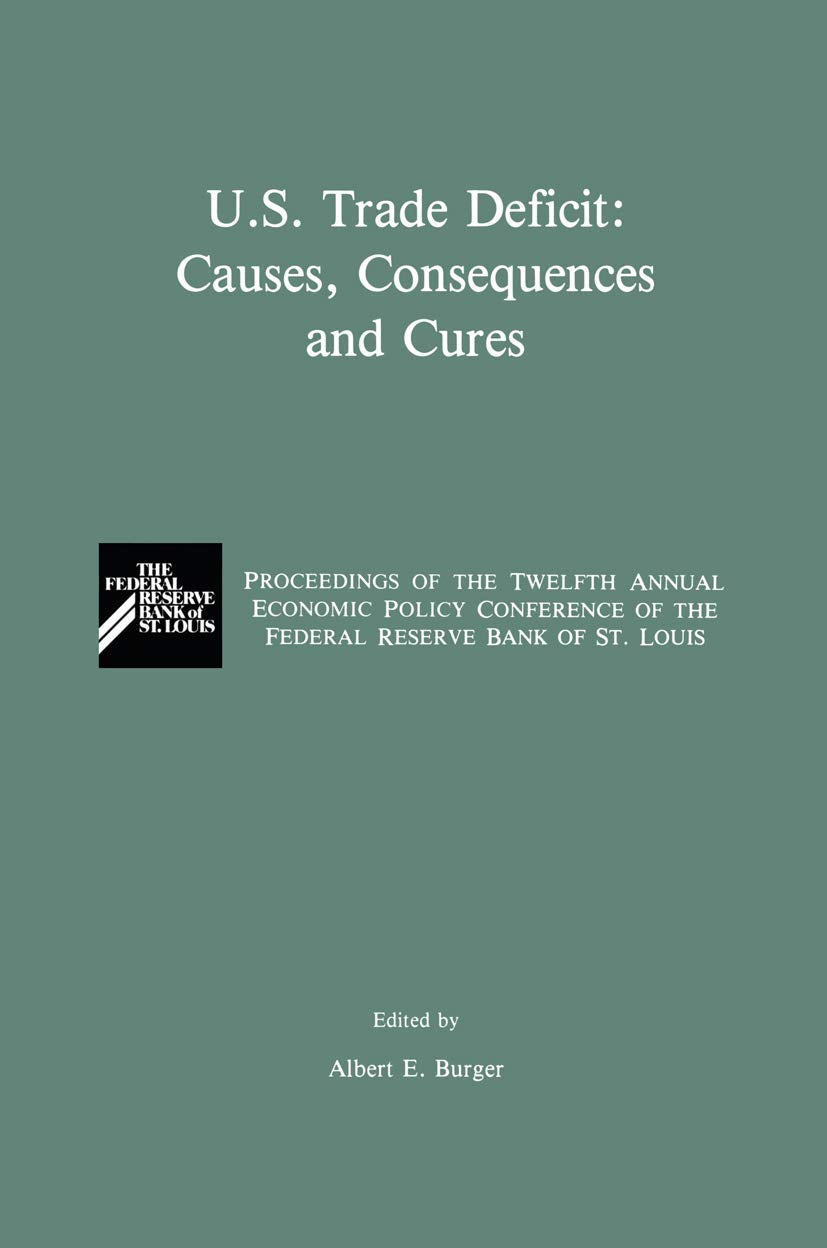
On October 23 and 24, 1987, the Federal Reserve Bank of St. Louis hosted its twelfth annual economic policy conference, 'The U.S. Trade Deficit: Causes, Consequences, and Cures.' This book contains the papers and comments delivered at that conference. A sharp decline in the value of the dollar against major foreign cur rencies began in March 1985 and continued through December 1987. Despite this decline, the U.S. trade deficit experienced considerable growth during this time. Many consider the simultaneous occurrence of these two events over so long a period to be a problem requiring a policy response. The conference addresses this issue. Various papers discuss the cause of the trade deficit, the reason for its size and persistence, its relation ship with other macroeconomic variables, its impact on other industrialized countries, and various policy proposals aimed at reducing the deficit. Session I Peter Hooper and Catherine L. Mann provide an analytical setting for the conference with their 'The U.S. External Deficit: Its Causes and Persistence.' Their observation that the unprecedentedly large U. S. trade imbalance is striking in both its size and its persistence could well be the subtitle of each of the papers presented. The macroeconomic studies, which Hooper and Mann summarize in their review of the existing literature, uniformly conclude that the deficit has not responded to fundamental macroeconomic determinantsrelative U.S. income growth and the dollar's exchange ratein the way that earlier, smaller U.S.
⚠️ WARNING (California Proposition 65):
This product may contain chemicals known to the State of California to cause cancer,
birth defects, or other reproductive harm.
For MAP (Minimum Advertised Price) violations and Intellectual Property (IP) or Trademark concerns, please contact:
support@ergodebooks.com
⚠️ California Proposition 65 Warning: Some products sold on this website may expose you to chemicals known to the State of California to cause cancer, birth defects, or other reproductive harm. For more information, visit www.P65Warnings.ca.gov.