
Title

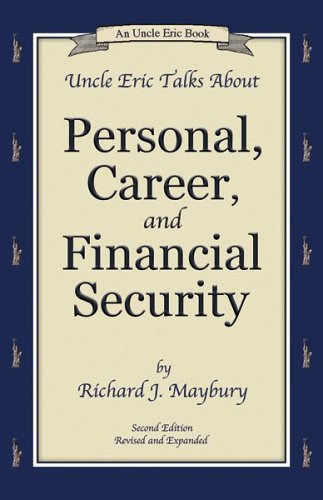
Uncle Eric Talks About Personal, Career, and Financial Security (An Uncle Eric Book),New
Sold by Ergodebooks, an authorized reseller.
Returns accepted within 30 days | support@ergodebooks.com
Shipping Information
- Free Standard Shipping — United States only
- Processing Time: 3–5 business days
- Estimated Delivery: 6–10 business days after dispatch
- Double-boxed, fully insured & discreetly packaged
- Tracking number sent via email once dispatched
Returns & Refund
Returns accepted within 30 days of delivery.
Damaged or Defective Item
Free return shipping + replacement or full refund
Wrong Item Received
Free return shipping + replacement or full refund
Change of Mind
Return shipping at customer's expense · 25% restocking fee applies
Payment Option

In this extensively revised and expanded second edition of 'Uncle Eric Talks About Personal, Career, and Financial Security', Uncle Eric introduces the concept of model. Models (or paradigms) are how people think; they are how we understand our world. Models help us recognize and use the information that is important and bypass that which is not. To achieve success in our careers, investments, and every other part of our lives, we need sound models. In this book, Mr. Maybury introduces the models he has found most useful (Economics and Higher Law). This is the first book in the Uncle Eric series and, while designed to stand alone, provides an excellent foundation for Maybury's other books. To improve the student's learning experience, also purchase the student study guide for 'Uncle Eric Talks About Personal, Career, and Financial Security' titled 'A Bluestocking Guide: Building a Personal Model for Success', which is also available from Amazon.Table of Contents for 'Uncle Eric Talks About Personal, Career, and Financial SecurityUncle Eric's Model of How the World Works'Study Guide AvailbleAuthor's DisclosurePart One: How the Mind Works1. How We Understand Our World2. Building Mental Pictures3. Sorting Data4. Where is the Evidence?5. How to Learn or Teach Models6. Two Highly Important Models7. History Without Models8. A Model for Selecting Models9. Does it Predict?10. A Way to Test a Model You Are Not Qualified to Test11. Beware of Tautology12. How to Control People13. Cognitive Dissonance14. How to Stop Learning15. Automatic Evil16. Models Tend to Merge17. How to Get Started Learning ModelsPart Two: The Best Model for Success18. What is Success?19. A Short History of Models for Success20. Another Mouth to Feed21. A Model Born of Desperation22. Making Your Model Work23. How to Acquire a Business24. What Kind of Millionaire Do You Want to Be?25. Savings and Investments26. Social Security27. Real Estate and Debt28. Investment Advisors29. Negative Real Interest Rates30. How to Keep What You Have Earned31. SummaryAppendixBibliography and Suggested ReadingGlossaryAbout Richard J. MayburyIndexFor more on the Economic model, read 'Whatever Happened to Penny Candy?' The clearest and most interesting explanation of economics around. Explains the Austrian economic model, the most freemarket of all economic models, and the one that is most in agreement with the ethical principles on which America was founded.For more on the Legal model, read 'Whatever Happened to Justice?' Explains the common law model. Underlying common law are two basic rules: 1) do all that you agreed to do and 2) do not encroach on other persons or their property. Maybury says, 'In my opinion, you and your family and friends will avoid a lot of trouble, and find success of every kind easier to achieve, if you adopt these two models, Austrian economics and common law.'
⚠️ WARNING (California Proposition 65):
This product may contain chemicals known to the State of California to cause cancer, birth defects, or other reproductive harm.
For more information, please visit www.P65Warnings.ca.gov.