If you have any questions, you are always welcome to contact us. We'll get back to you as soon as possible, withing 24 hours on weekdays.
Customer service
All questions about your order, return and delivery must be sent to our customer service team by e-mail at yourstore@yourdomain.com
Sale & Press
If you are interested in selling our products, need more information about our brand or wish to make a collaboration, please contact us at press@yourdomain.com
Help
If you have any questions, you are always welcome to contact us. We'll get back to you as soon as possible, withing 24 hours on weekdays.
Customer service
All questions about your order, return and delivery must be sent to our customer service team by e-mail at yourstore@yourdomain.com
Sale & Press
If you are interested in selling our products, need more information about our brand or wish to make a collaboration, please contact us at press@yourdomain.com
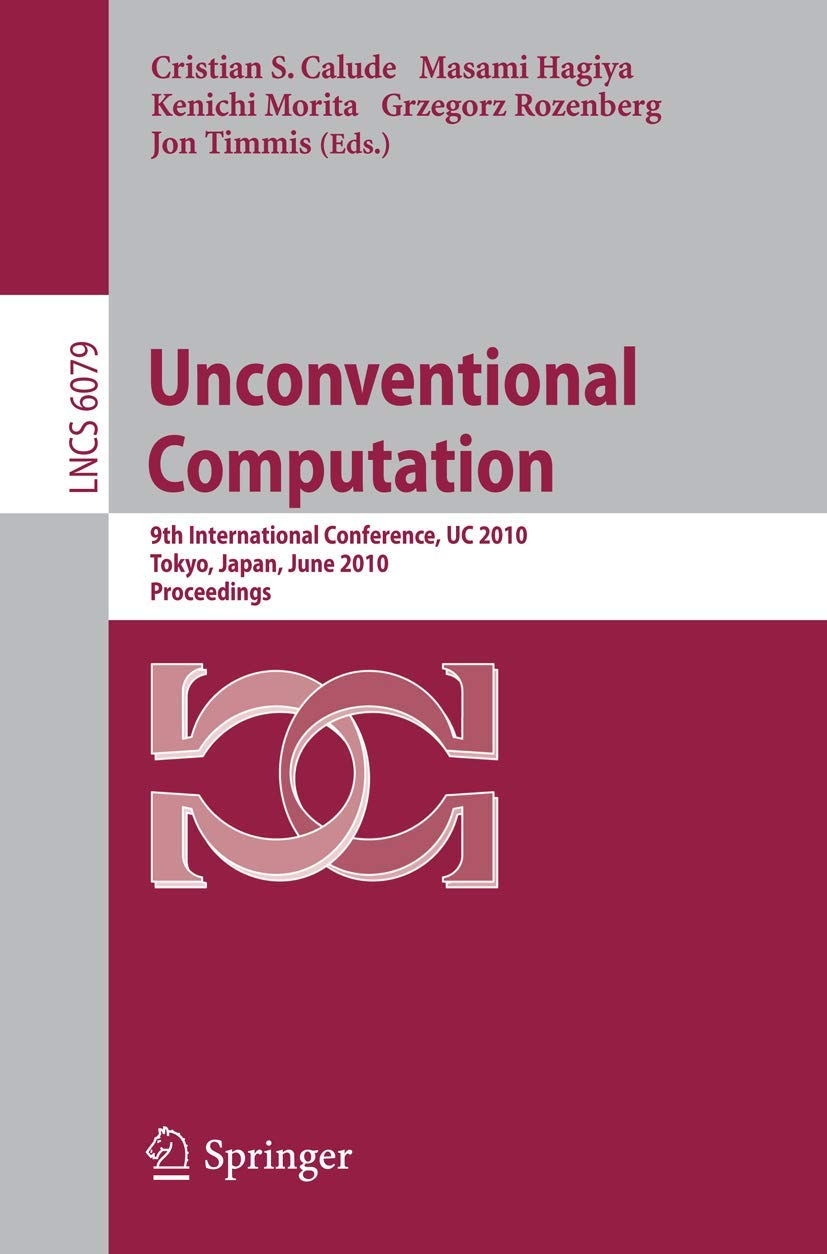
The 9th International Conference on Unconventional Computation, UC 2010, was organized under the auspices of EATCS and Academia Europaea, by the University of Tokyo (Tokyo, Japan), and the Center for Discrete Mathematics and Theoretical Computer Science (Auckland, New Zealand). It was held in Tokyoduring June 2125,2010(seehttp://arn.local.frs.riken.jp/UC10/). The venue was the Sanjo (Hilltop) Conference Hall at Hongo Campus of the University of Tokyo. Hongo Campus was formerly the residence of the Maeda family, one of the richest feudal lords in the Edo period of Japan. The Japanese garden in the residence is partially preserved, including the pond and the hill on which the conference hall is located. Within walking distance from Hongo Campus are Ueno park with many museums, the Akihabara area, which is now the center of Japanesepop culture, and the Korakuenamusement park/baseball stadium. The International Conference on Unconventional Computation (UC) series (seehttp://www.cs.auckland.ac.nz/CDMTCS/conferences/uc/)isdevotedto all aspects of unconventional computation theory as well as experiments and applications. Typical, but not exclusive, topics are: natural computing including quantum, cellular, molecular, membrane, neural, and evolutionary computing, as well as chaos and dynamical systembased computing, and various proposals for computational mechanisms that go beyond the Turing model.
⚠️ WARNING (California Proposition 65):
This product may contain chemicals known to the State of California to cause cancer,
birth defects, or other reproductive harm.
For MAP (Minimum Advertised Price) violations and Intellectual Property (IP) or Trademark concerns, please contact:
support@ergodebooks.com
⚠️ California Proposition 65 Warning: Some products sold on this website may expose you to chemicals known to the State of California to cause cancer, birth defects, or other reproductive harm. For more information, visit www.P65Warnings.ca.gov.