
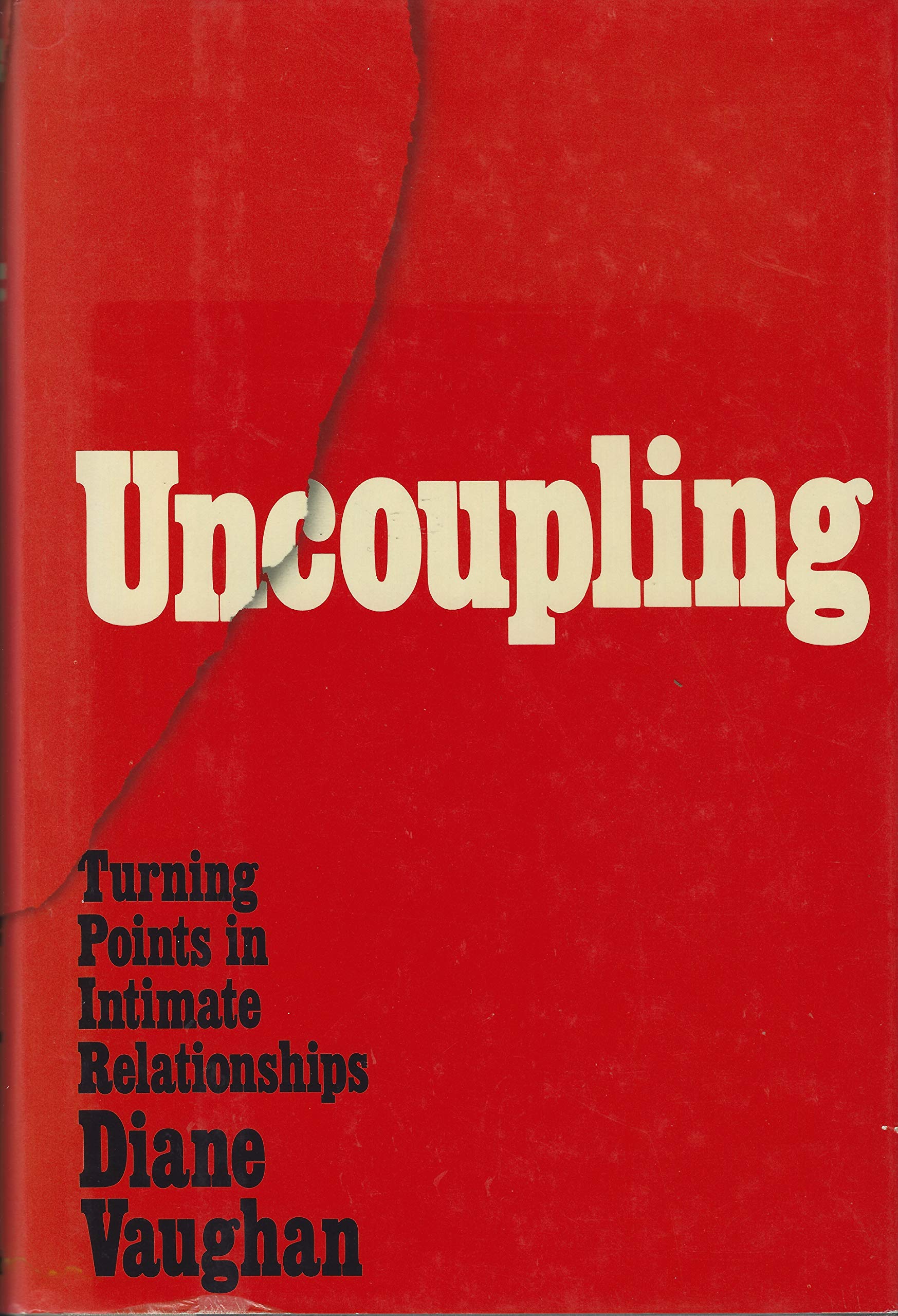
Title
Uncoupling: Turning Points In Intimate Relationships
Sold by Ergodebooks, an authorized reseller.
Returns accepted within 30 days | support@ergodebooks.com
Shipping Information
- Free Standard Shipping — United States only
- Processing Time: 3–5 business days
- Estimated Delivery: 6–10 business days after dispatch
- Double-boxed, fully insured & discreetly packaged
- Tracking number sent via email once dispatched
Returns & Refund
Returns accepted within 30 days of delivery.
Damaged or Defective Item
Free return shipping + replacement or full refund
Wrong Item Received
Free return shipping + replacement or full refund
Change of Mind
Return shipping at customer's expense · 25% restocking fee applies
Payment Option

Many Books Explain Why Relationships End, But Never Before Has A Book Shown In Riveting Stepbystep Detail Precisely How They End. Through Extensive Interviews And Original Research, Diane Vaughan Reveals The Underlying Pattern Beneath Every Disintegrating Relationship. This Is Agroundbreaking Book That Will Help Anyone Who Has Ever Left A Relationshipor Been Leftto Understand What Happened. Perhaps Even More Important, It Will Help Some People Who Don'T Even Know Their Relationship Is In Trouble To See What Is Happening. Armed With A New Awareness Of What Is Usuallyan Unconscious Processuntil It'S Too Latethe Partners Acquire The Ability To Either Live With It, Control It, Or Change It. Vaughan Shows That No Matter What The Characteristics Of The Couple Involved, Rich Or Poor, Straight Or Gay, Married Or Not, And Whether They'Ve Been Together 18 Months Or18 Years, The Dynamics Of The Uncoupling Process Are Essentially The Same. The Key To Understanding How Two People Separate, According To Vaughan, Is The Role They Assume In The Leavetaking. Most Often, One Partnerthe Initiatorwants Out Of A Relationship While The Other Wants The Relationshipto Continue. Although Both People Must Go Through The Same Steps In Altering Their Perceptions Of Each Other And Themselves, They Do So At Different Times. By The Time The Stillloving Partner Realizes The Relationship Is In Serious Trouble, The Initiator Is Already Gone In A Number Of Ways.Uncoupling Begins With The Initiator'S First Secret Awareness Of Discomfort, Depicts His Or Her Search For A Confidant (Who Is Selected Is A Telling Factor), And Reveals The Subtle, Often Barely Perceptible Signalling Of His Discontent To The Partner. Vaughan Traces The Initiator'S Groping For Andtesting Of A New Single Identity And Depicts The Initiator'S Confrontation With The Partner. She Shows How Two People Try And Why Trying Often Fails. Finally, She Explains How The Partner Makes His Or Her Own Transition Out Of The Relationship. Replete With Case Histories, Many Poignant, The Bookprovides Answers To Many Puzzling Questions: Why One Person Can Sometimes Take The End Of A Longterm Relationship So Calmly...Why Counseling So Often Fails...Why One Member Of A Couple Can Be So Much Better Prepared For A Single Life Than The Other...Why Some People Never Psychologicallyseparate...And Much More.
⚠️ WARNING (California Proposition 65):
This product may contain chemicals known to the State of California to cause cancer, birth defects, or other reproductive harm.
For more information, please visit www.P65Warnings.ca.gov.
- Q: What is the main focus of the book 'Uncoupling: Turning Points in Intimate Relationships'? A: The book focuses on the process of how relationships end, providing a detailed analysis of the uncoupling process through interviews and research.
- Q: Who is the author of 'Uncoupling' and what expertise do they bring? A: The author is Diane Vaughan, a sociologist known for her extensive research on relationships and the dynamics involved in their dissolution.
- Q: What unique perspective does 'Uncoupling' offer compared to other relationship books? A: Unlike many books that discuss why relationships fail, 'Uncoupling' offers a step-by-step exploration of how relationships actually end, highlighting the experiences of both partners.
- Q: Is 'Uncoupling' suitable for individuals currently in a relationship? A: Yes, the book provides insights that can help individuals recognize early signs of trouble in their relationships, potentially helping them to address issues before they escalate.
- Q: How does Diane Vaughan describe the roles of partners during the uncoupling process? A: Vaughan identifies two roles: the initiator, who desires to end the relationship, and the still-loving partner, who often struggles to understand the changes occurring.
- Q: What type of research is included in 'Uncoupling'? A: The book includes extensive interviews and original research, providing case studies that illustrate various aspects of the uncoupling process.
- Q: What are some common themes explored in 'Uncoupling'? A: Common themes include the dynamics of separation, the psychological impact on both partners, and the reasons why some individuals find it harder to move on than others.
- Q: What practical insights can readers gain from 'Uncoupling'? A: Readers can gain awareness of the unconscious processes involved in relationship dissolution and strategies for coping with the emotional challenges of uncoupling.
- Q: What is the page count and binding type of 'Uncoupling'? A: The book has 259 pages and is available in hardcover.
- Q: When was 'Uncoupling' first published? A: The book was first published on October 16, 1986.