
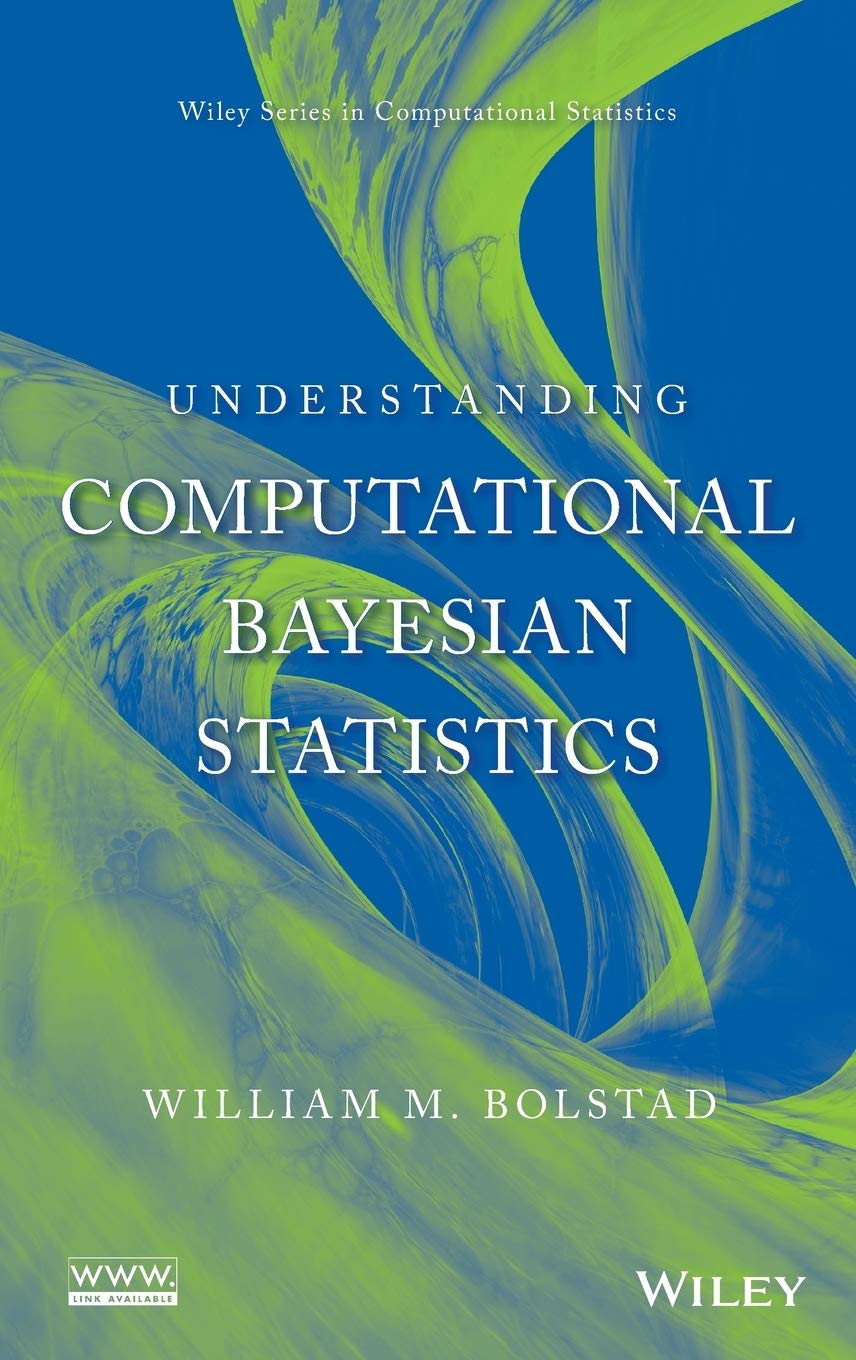
Title
Understanding Computational Bayesian Statistics,Used
Sold by Ergodebooks, an authorized reseller.
Returns accepted within 30 days | support@ergodebooks.com
Shipping Information
- Free Standard Shipping — United States only
- Processing Time: 3–5 business days
- Estimated Delivery: 6–10 business days after dispatch
- Double-boxed, fully insured & discreetly packaged
- Tracking number sent via email once dispatched
Returns & Refund
Returns accepted within 30 days of delivery.
Damaged or Defective Item
Free return shipping + replacement or full refund
Wrong Item Received
Free return shipping + replacement or full refund
Change of Mind
Return shipping at customer's expense · 25% restocking fee applies
Payment Option

A handson introduction to computational statistics from a Bayesian point of viewProviding a solid grounding in statistics while uniquely covering the topics from a Bayesian perspective, Understanding Computational Bayesian Statistics successfully guides readers through this new, cuttingedge approach. With its handson treatment of the topic, the book shows how samples can be drawn from the posterior distribution when the formula giving its shape is all that is known, and how Bayesian inferences can be based on these samples from the posterior. These ideas are illustrated on common statistical models, including the multiple linear regression model, the hierarchical mean model, the logistic regression model, and the proportional hazards model.The book begins with an outline of the similarities and differences between Bayesian and the likelihood approaches to statistics. Subsequent chapters present key techniques for using computer software to draw Monte Carlo samples from the incompletely known posterior distribution and performing the Bayesian inference calculated from these samples. Topics of coverage include: Direct ways to draw a random sample from the posterior by reshaping a random sample drawn from an easily sampled starting distribution The distributions from the onedimensional exponential family Markov chains and their longrun behavior The MetropolisHastings algorithm Gibbs sampling algorithm and methods for speeding up convergence Markov chain Monte Carlo samplingUsing numerous graphs and diagrams, the author emphasizes a stepbystep approach to computational Bayesian statistics. At each step, important aspects of application are detailed, such as how to choose a prior for logistic regression model, the Poisson regression model, and the proportional hazards model. A related Web site houses R functions and Minitab macros for Bayesian analysis and Monte Carlo simulations, and detailed appendices in the book guide readers through the use of these software packages.Understanding Computational Bayesian Statistics is an excellent book for courses on computational statistics at the upperlevel undergraduate and graduate levels. It is also a valuable reference for researchers and practitioners who use computer programs to conduct statistical analyses of data and solve problems in their everyday work.
⚠️ WARNING (California Proposition 65):
This product may contain chemicals known to the State of California to cause cancer, birth defects, or other reproductive harm.
For more information, please visit www.P65Warnings.ca.gov.