If you have any questions, you are always welcome to contact us. We'll get back to you as soon as possible, withing 24 hours on weekdays.
Customer service
All questions about your order, return and delivery must be sent to our customer service team by e-mail at yourstore@yourdomain.com
Sale & Press
If you are interested in selling our products, need more information about our brand or wish to make a collaboration, please contact us at press@yourdomain.com
Help
If you have any questions, you are always welcome to contact us. We'll get back to you as soon as possible, withing 24 hours on weekdays.
Customer service
All questions about your order, return and delivery must be sent to our customer service team by e-mail at yourstore@yourdomain.com
Sale & Press
If you are interested in selling our products, need more information about our brand or wish to make a collaboration, please contact us at press@yourdomain.com
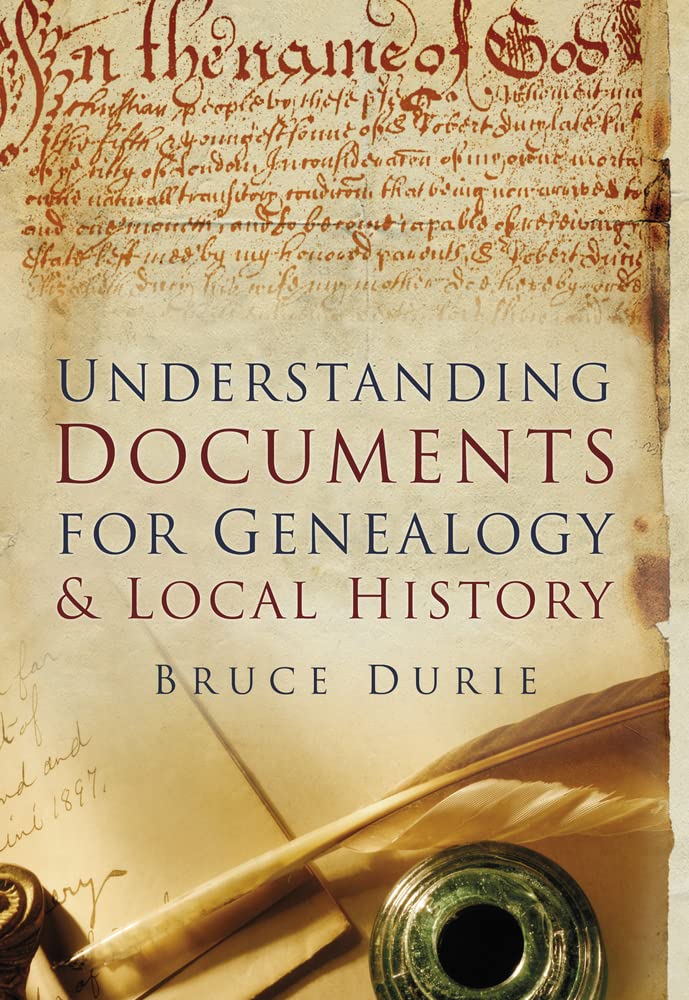
Genealogists and local historians have probably seen every birth, marriage, death and census record available, and are adept at using the internet for research. However, once they have learnt everything they can from them, the next step is reading and understanding older documents. These can be hard to find (not many are online), are often written in challenging handwriting and use legal and other unfamiliar terms. Some will be in Latin, antiquated English or Scots. Readers need to be able to understand the nature and intent of a range of documents as well as the palaeography (the handwriting) and orthography (the shape of the contents). In Understanding Documents for Genealogy and Local History, Dr Bruce Durie, the celebrated author of Scottish Genealogy, details how to find and comprehend documents from 1560 to the 1860s wills, testaments, contracts, indentures and charters, land records (retours, sasines and manorial custumals), personal letters, official records, Church papers, trust dispositions, deeds and others. Also covered are the complexities of dates, numbers, calendars, measurements and money, abbreviations, transcription conventions, letterforms and glossaries. A Latin primer completes the tool kit the genealogist and family historian will need to further their research.
⚠️ WARNING (California Proposition 65):
This product may contain chemicals known to the State of California to cause cancer,
birth defects, or other reproductive harm.
For MAP (Minimum Advertised Price) violations and Intellectual Property (IP) or Trademark concerns, please contact:
support@ergodebooks.com
⚠️ California Proposition 65 Warning: Some products sold on this website may expose you to chemicals known to the State of California to cause cancer, birth defects, or other reproductive harm. For more information, visit www.P65Warnings.ca.gov.