If you have any questions, you are always welcome to contact us. We'll get back to you as soon as possible, withing 24 hours on weekdays.
Customer service
All questions about your order, return and delivery must be sent to our customer service team by e-mail at yourstore@yourdomain.com
Sale & Press
If you are interested in selling our products, need more information about our brand or wish to make a collaboration, please contact us at press@yourdomain.com
Help
If you have any questions, you are always welcome to contact us. We'll get back to you as soon as possible, withing 24 hours on weekdays.
Customer service
All questions about your order, return and delivery must be sent to our customer service team by e-mail at yourstore@yourdomain.com
Sale & Press
If you are interested in selling our products, need more information about our brand or wish to make a collaboration, please contact us at press@yourdomain.com
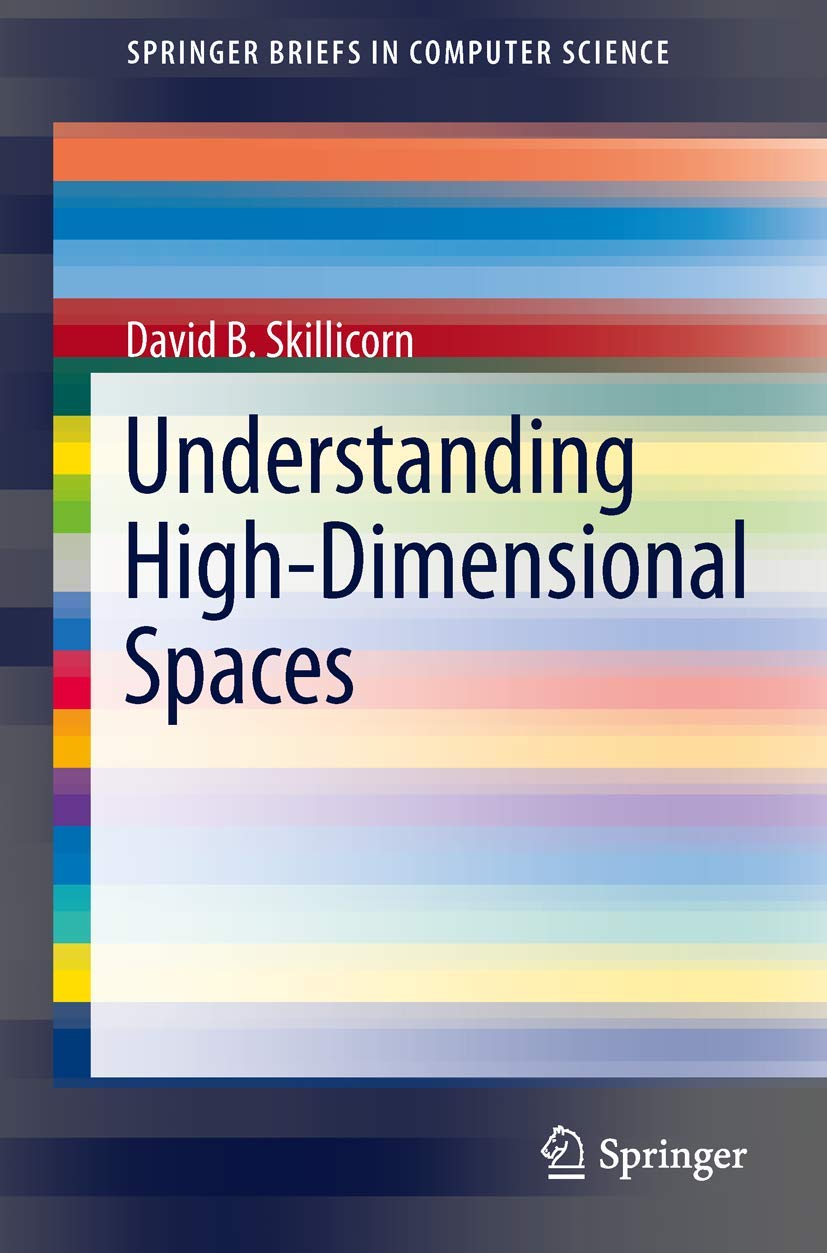
Highdimensional spaces arise as a way of modelling datasets with many attributes. Such a dataset can be directly represented in a space spanned by its attributes, with each record represented as a point in the space with its position depending on its attribute values. Such spaces are not easy to work with because of their high dimensionality: our intuition about space is not reliable, and measures such as distance do not provide as clear information as we might expect.There are three main areas where complex high dimensionality and large datasets arise naturally: data collected by online retailers, preference sites, and social media sites, and customer relationship databases, where there are large but sparse records available for each individual; data derived from text and speech, where the attributes are words and so the corresponding datasets are wide, and sparse; and data collected for security, defense, law enforcement, and intelligence purposes, where the datasets are large and wide. Such datasets are usually understood either by finding the set of clusters they contain or by looking for the outliers, but these strategies conceal subtleties that are often ignored. In this book the author suggests new ways of thinking about highdimensional spaces using two models: a skeleton that relates the clusters to one another; and boundaries in the empty space between clusters that provide new perspectives on outliers and on outlying regions.The book will be of value to practitioners, graduate students and researchers.
⚠️ WARNING (California Proposition 65):
This product may contain chemicals known to the State of California to cause cancer,
birth defects, or other reproductive harm.
For MAP (Minimum Advertised Price) violations and Intellectual Property (IP) or Trademark concerns, please contact:
support@ergodebooks.com
⚠️ California Proposition 65 Warning: Some products sold on this website may expose you to chemicals known to the State of California to cause cancer, birth defects, or other reproductive harm. For more information, visit www.P65Warnings.ca.gov.