If you have any questions, you are always welcome to contact us. We'll get back to you as soon as possible, withing 24 hours on weekdays.
Customer service
All questions about your order, return and delivery must be sent to our customer service team by e-mail at yourstore@yourdomain.com
Sale & Press
If you are interested in selling our products, need more information about our brand or wish to make a collaboration, please contact us at press@yourdomain.com
Help
If you have any questions, you are always welcome to contact us. We'll get back to you as soon as possible, withing 24 hours on weekdays.
Customer service
All questions about your order, return and delivery must be sent to our customer service team by e-mail at yourstore@yourdomain.com
Sale & Press
If you are interested in selling our products, need more information about our brand or wish to make a collaboration, please contact us at press@yourdomain.com
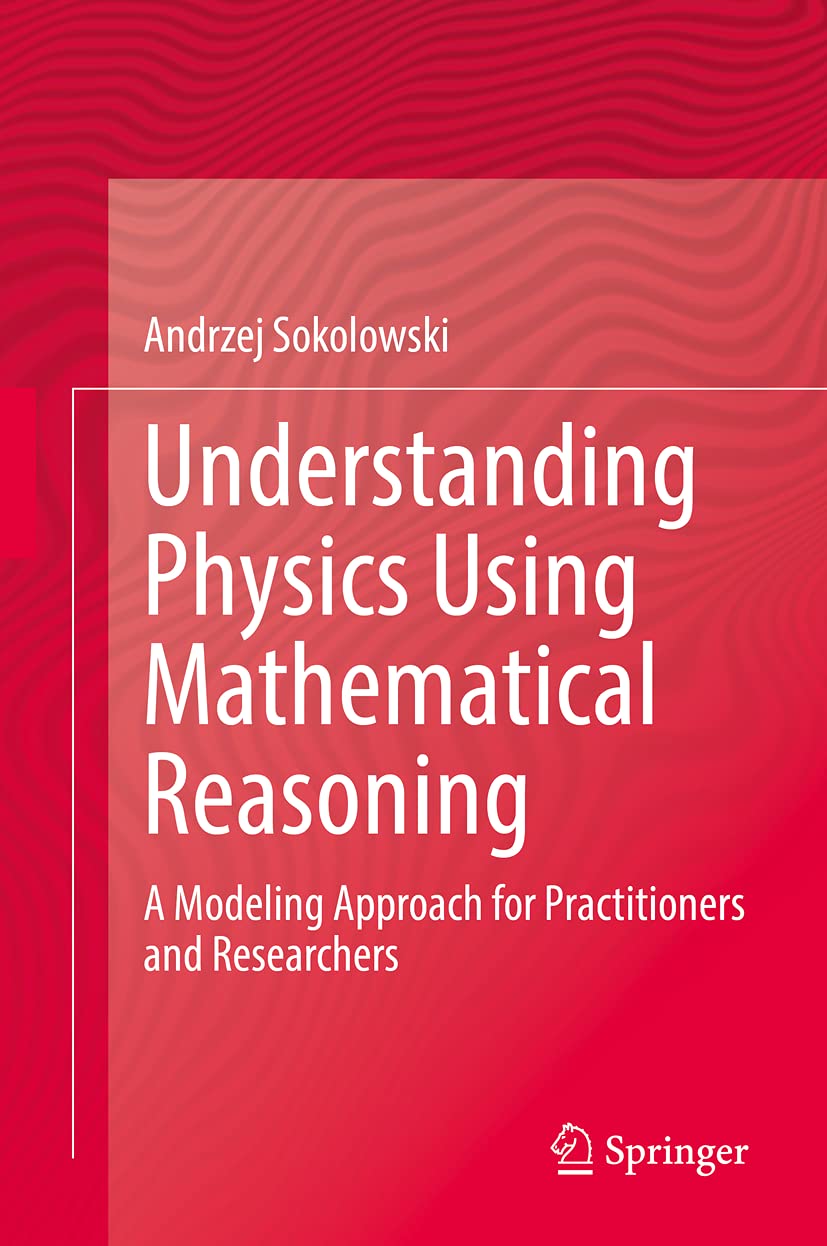
This book speaks about physics discoveries that intertwine mathematical reasoning, modeling, and scientific inquiry. It offers ways of bringing together the structural domain of mathematics and the content of physics in one coherent inquiry. Teaching and learning physics is challenging because students lack the skills to merge these learning paradigms. The purpose of this book is not only to improve access to the understanding of natural phenomena but also to inspire new ways of delivering and understanding the complex concepts of physics. To sustain physics education in college classrooms, authentic training that would help develop high school students skills of transcending function modeling techniques to reason scientifically is needed and this book aspires to offer such training The book draws on current research in developing students mathematical reasoning. It identifies areas for advancements and proposes a conceptual framework that is tested in several case studies designed using that framework. Modeling Newtons laws using limited case analysis, Modeling projectile motion using parametric equations and Enabling covariational reasoning in Einstein formula for the photoelectric effect represent some of these case studies. A wealth of conclusions that accompany these case studies, drawn from the realities of classroom teaching, is to help physics teachers and researchers adopt these ideas in practice.
⚠️ WARNING (California Proposition 65):
This product may contain chemicals known to the State of California to cause cancer,
birth defects, or other reproductive harm.
For MAP (Minimum Advertised Price) violations and Intellectual Property (IP) or Trademark concerns, please contact:
support@ergodebooks.com
⚠️ California Proposition 65 Warning: Some products sold on this website may expose you to chemicals known to the State of California to cause cancer, birth defects, or other reproductive harm. For more information, visit www.P65Warnings.ca.gov.