
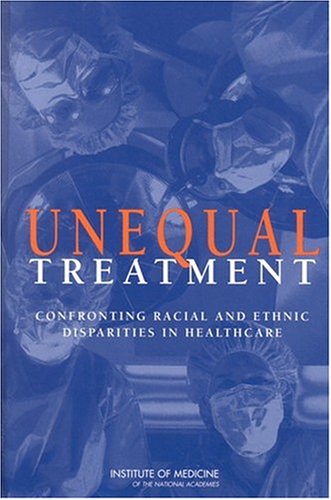
Title
Unequal Treatment: Confronting Racial and Ethnic Disparities in Health Care,New
Processing time: 1-3 days
US Orders Ships in: 3-5 days
International Orders Ships in: 8-12 days
Return Policy: 15-days return on defective items
Payment Option

Racial and ethnic disparities in health care are known to reflect access to care and other issues that arise from differing socioeconomic conditions. There is, however, increasing evidence that even after such differences are accounted for, race and ethnicity remain significant predictors of the quality of health care received.In Unequal Treatment, a panel of experts documents this evidence and explores how persons of color experience the health care environment. The book examines how disparities in treatment may arise in health care systems and looks at aspects of the clinical encounter that may contribute to such disparities. Patients' and providers' attitudes, expectations, and behavior are analyzed.How to intervene? Unequal Treatment offers recommendations for improvements in medical care financing, allocation of care, availability of language translation, communitybased care, and other arenas. The committee highlights the potential of crosscultural education to improve providerpatient communication and offers a detailed look at how to integrate crosscultural learning within the health professions. The book concludes with recommendations for data collection and research initiatives. Unequal Treatment will be vitally important to health care policymakers, administrators, providers, educators, and students as well as advocates for people of color.
⚠️ WARNING (California Proposition 65):
This product may contain chemicals known to the State of California to cause cancer, birth defects, or other reproductive harm.
For more information, please visit www.P65Warnings.ca.gov.
- Q: What is the main focus of the book 'Unequal Treatment'? A: The book focuses on racial and ethnic disparities in health care, detailing how these disparities persist even after accounting for socioeconomic factors.
- Q: Who authored 'Unequal Treatment'? A: The book is authored by the Institute of Medicine, which comprises a panel of experts in the field.
- Q: What are the key topics covered in 'Unequal Treatment'? A: Key topics include the quality of health care received by persons of color, the clinical encounters contributing to disparities, and recommendations for improving health care access and quality.
- Q: How long is the book 'Unequal Treatment'? A: The book contains 780 pages.
- Q: What type of binding does 'Unequal Treatment' have? A: The book is available in hardcover binding.
- Q: When was 'Unequal Treatment' published? A: The book was published on February 6, 2009.
- Q: What recommendations does 'Unequal Treatment' offer? A: The book offers recommendations for improving medical care financing, availability of language translation, and enhancing cross-cultural education for better provider-patient communication.
- Q: Is 'Unequal Treatment' suitable for health care policymakers? A: Yes, the book is designed to be important for health care policymakers, administrators, providers, educators, students, and advocates for people of color.
- Q: Does 'Unequal Treatment' include data collection recommendations? A: Yes, the book concludes with recommendations for data collection and research initiatives to address health care disparities.
- Q: What issues do the authors explore regarding health care experiences? A: The authors explore how race and ethnicity influence the quality of health care received and the factors that contribute to disparities in treatment.