If you have any questions, you are always welcome to contact us. We'll get back to you as soon as possible, withing 24 hours on weekdays.
Customer service
All questions about your order, return and delivery must be sent to our customer service team by e-mail at yourstore@yourdomain.com
Sale & Press
If you are interested in selling our products, need more information about our brand or wish to make a collaboration, please contact us at press@yourdomain.com
Help
If you have any questions, you are always welcome to contact us. We'll get back to you as soon as possible, withing 24 hours on weekdays.
Customer service
All questions about your order, return and delivery must be sent to our customer service team by e-mail at yourstore@yourdomain.com
Sale & Press
If you are interested in selling our products, need more information about our brand or wish to make a collaboration, please contact us at press@yourdomain.com
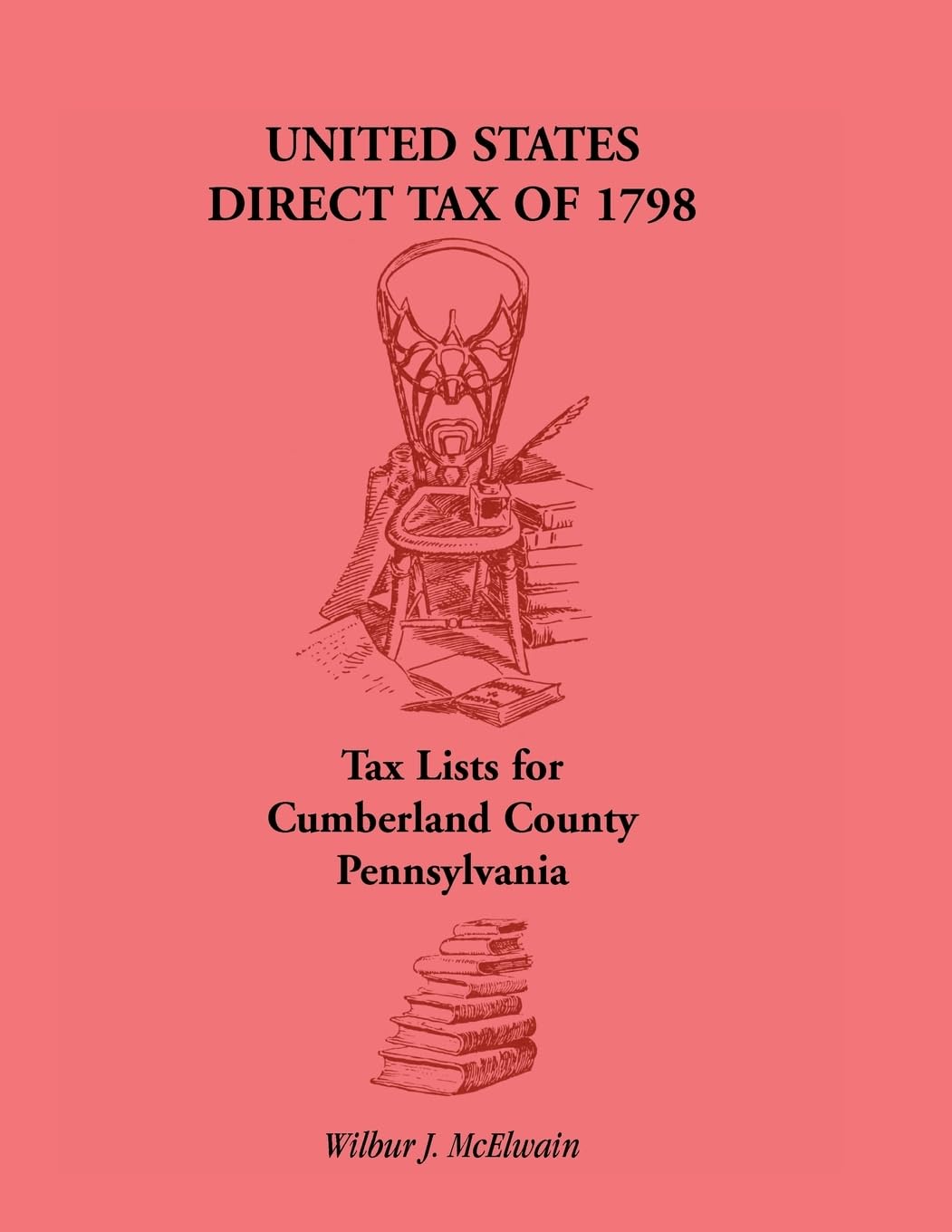
The direct tax of 1798 was imposed by the United States government on dwellings, lands and slaves. To carry out the taxation program, every structure, lot, and tract in the country had to be accounted for in tax listings, in which each was described and given an assessed value. The result was a housing inventory so complete that it has not been surpassed to this day. This book is a compilation of these tax lists for the area of presentday Cumberland County, Pennsylvania. Over 2,000 county properties are listed herein, and approximately 5,000 separate structures are described in these records. An appendix includes reproductions of original tax list forms and related documents, and separate indexes are provided for property owners and for occupants other than owners. Information in the tax lists includes the type of structure, its dimensions, construction material, number of stories, number of windows and window panes, lot size, farm acreage, location, names of adjoining owners and value. Occasionally additional information on the fertility of the land, the state of repair of structures, and other matters appears in comments by the assessors. The nature of the structures (milk house, wheelwright shop, grist mill, still house, and so forth) can provide information on the occupations of avocations of their owners, and it is also sometimes possible to reconstruct a neighborhood by comparing the names of adjoining owners. A treasuretrove of information lies within the data in this extraordinary picture of eighteenthcentury society.
⚠️ WARNING (California Proposition 65):
This product may contain chemicals known to the State of California to cause cancer,
birth defects, or other reproductive harm.
For MAP (Minimum Advertised Price) violations and Intellectual Property (IP) or Trademark concerns, please contact:
support@ergodebooks.com
⚠️ California Proposition 65 Warning: Some products sold on this website may expose you to chemicals known to the State of California to cause cancer, birth defects, or other reproductive harm. For more information, visit www.P65Warnings.ca.gov.