
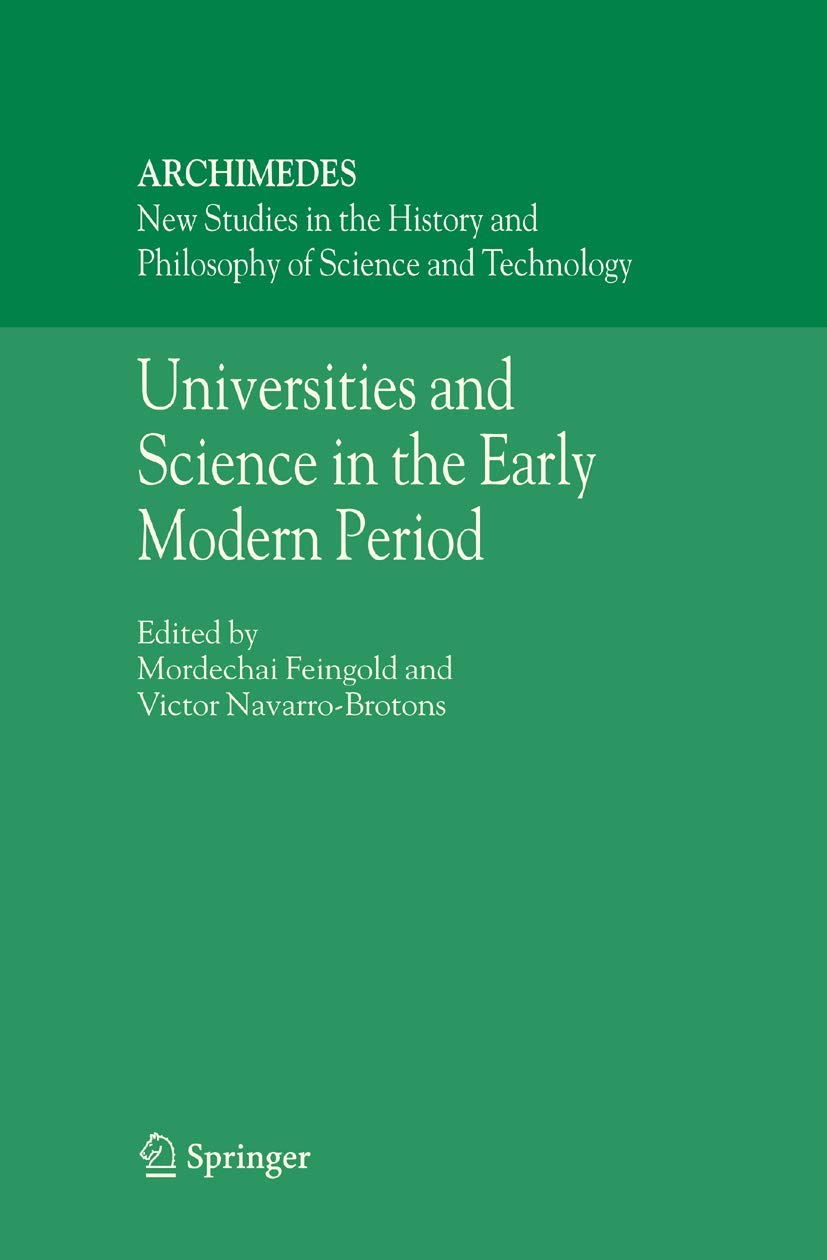
Title
Universities and Science in the Early Modern Period (Archimedes, 12),Used
Sold by Ergodebooks, an authorized reseller.
Returns accepted within 30 days | support@ergodebooks.com
Shipping Information
- Free Standard Shipping — United States only
- Processing Time: 3–5 business days
- Estimated Delivery: 6–10 business days after dispatch
- Double-boxed, fully insured & discreetly packaged
- Tracking number sent via email once dispatched
Returns & Refund
Returns accepted within 30 days of delivery.
Damaged or Defective Item
Free return shipping + replacement or full refund
Wrong Item Received
Free return shipping + replacement or full refund
Change of Mind
Return shipping at customer's expense · 25% restocking fee applies
Payment Option

This book includes most of the contributions presented at a conference on Univ sities and Science in the Early Modern Period held in 1999 in Valencia, Spain. The conference was part of the Five Centuries of the Life of the University of Valencia (Cinc Segles) celebrations, and from the outset we had the generous support of the Patronato (Foundation) overseeing the events. In recent decades, as a result of a renewed attention to the institutional, political, social, and cultural context of scienti?c activity, we have witnessed a reappraisal of the role of the universities in the construction and development of early modern science. In essence, the following conclusions have been reached: (1) the attitudes regarding scienti?c progress or novelty differed from country to country and follow differenttrajectoriesinthecourseoftheearlymodernperiod;(2)institutionsofhigher learning were the main centers of education for most scientists; (3) although the universities were sometimes slow to assimilate new scienti?c knowledge, when they didsoithelpednotonlytoremovethesuspicionthatthenewsciencewasintellectually subversivebutalsotomakesciencearespectableandevenprestigiousactivity;(4)the universities gave the scienti?c movement considerable material support in the form of research facilities such as anatomical theaters, botanical gardens, and expensive instruments; (5) the universities provided professional employment and a means of support to many scientists; and (6) although the relations among the universities and the academies or scienti?c societies were sometimes antagonistic, the two types of institutionsoftenworkedtogetherinharmony,performingcomplementaryratherthan competing functions; moreover, individuals moved from one institution to another, as did knowledge, methods, and scienti?c practices.
⚠️ WARNING (California Proposition 65):
This product may contain chemicals known to the State of California to cause cancer, birth defects, or other reproductive harm.
For more information, please visit www.P65Warnings.ca.gov.