
Title
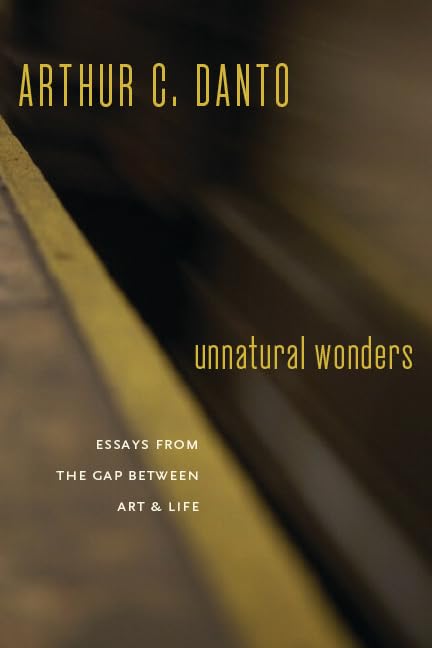
Unnatural Wonders: Essays from the Gap Between Art and Life,New
Sold by Ergodebooks, an authorized reseller.
Returns accepted within 30 days | support@ergodebooks.com
Shipping Information
- Free Standard Shipping — United States only
- Processing Time: 3–5 business days
- Estimated Delivery: 6–10 business days after dispatch
- Double-boxed, fully insured & discreetly packaged
- Tracking number sent via email once dispatched
Returns & Refund
Returns accepted within 30 days of delivery.
Damaged or Defective Item
Free return shipping + replacement or full refund
Wrong Item Received
Free return shipping + replacement or full refund
Change of Mind
Return shipping at customer's expense · 25% restocking fee applies
Payment Option

Arthur C. Danto's essays not only critique bodies of work but reflect upon art's conceptual evolution as well, drawing for the reader a kind of 'philosophical map' indicating how art and the criteria for judging it has changed over the twentieth century. In Unnatural Wonders the renowned critic finds himself at a point when contemporary art has become wholly pluralistic, even chaoticwith one medium as good as anotherand when the moment for the 'next thing' has already passed. So the theorist goes in search of contemporary art's most exhilarating achievements, work that bridges the gap between art and life, which, he argues, is now the definitive art of our time.Danto considers the work of such young artists as John Currin and Renee Cox and older living masters including Gerhard Richter and Sol LeWitt. He discusses artists of the New York School, like Philip Guston and Joan Mitchell, and international talents, such as the South African William Kentridge. Danto conducts a frank analysis of Matthew Barney's The Cremaster Cycle, Damien Hirst's skeletons and anatomical models, and Barbara Kruger's tchotchkeready slogans; finds the ghost of Henry James in the work of Barnett Newman; and muses on recent Whitney Biennials and art influenced by 9/11. He argues that aesthetic considerations no longer play a central role in the experience and critique of art. Instead art addresses us in our humanity, as men and women who seek meaning in the 'unnatural wonders' of art, a meaning that philosophy and religion are unable to provide.
⚠️ WARNING (California Proposition 65):
This product may contain chemicals known to the State of California to cause cancer, birth defects, or other reproductive harm.
For more information, please visit www.P65Warnings.ca.gov.