
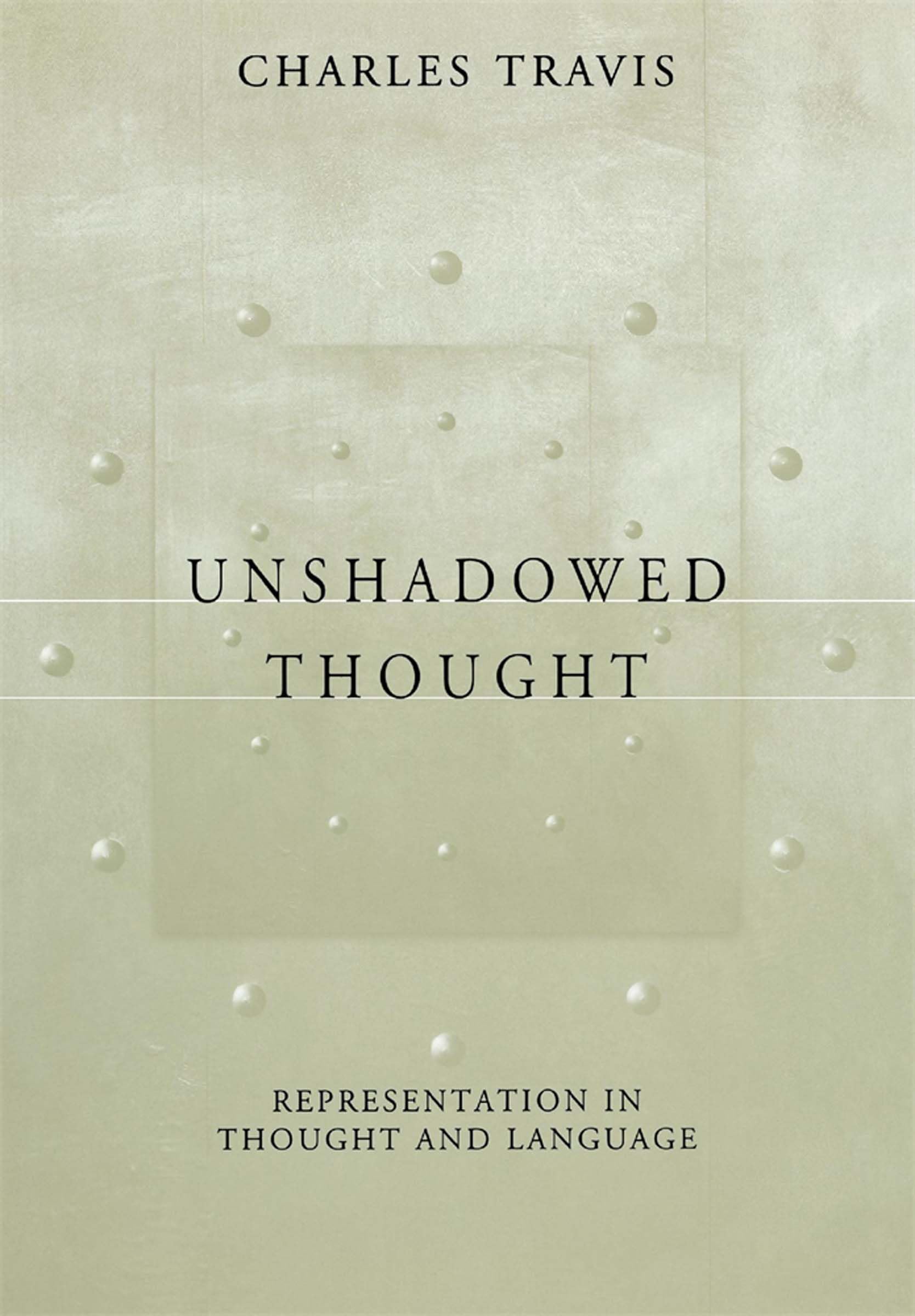
Title
Unshadowed Thought: Representation in Thought and Language,New
Sold by Ergodebooks, an authorized reseller.
Returns accepted within 30 days | support@ergodebooks.com
Shipping Information
- Free Standard Shipping — United States only
- Processing Time: 3–5 business days
- Estimated Delivery: 6–10 business days after dispatch
- Double-boxed, fully insured & discreetly packaged
- Tracking number sent via email once dispatched
Returns & Refund
Returns accepted within 30 days of delivery.
Damaged or Defective Item
Free return shipping + replacement or full refund
Wrong Item Received
Free return shipping + replacement or full refund
Change of Mind
Return shipping at customer's expense · 25% restocking fee applies
Payment Option

This book mounts a sustained attack on ideas that are dear to many practitioners of analytic philosophy. Charles Travis targets the seductive illusion thatin Wittgensteins termsif anyone utters a sentence and means or understands it, he is operating a calculus according to definite rules. This book rejects the idea that thoughts are essentially representational items whose content is independent of context. In doing so, it undermines the foundations of much contemporary philosophy of mind.Traviss main argument in Unshadowed Thought is that linguistic expressions and forms are occasionsensitive; they cannot be abstracted out of a concrete context. With compelling examples and a thoroughgoing scrutiny of opposing positions, his book systematically works out the implications of the work of J. L. Austin, Hilary Putnam, and John McDowell. Eloquently insisting that there is no particular way one must structure what one relates to, no one way one must represent it, Unshadowed Thought identifies and resists a certain strain of semantic Platonism that permeates current philosophya strain that has had profoundly troubling consequences for our ideas about attitudes and beliefs and for our views about what language might be.
⚠️ WARNING (California Proposition 65):
This product may contain chemicals known to the State of California to cause cancer, birth defects, or other reproductive harm.
For more information, please visit www.P65Warnings.ca.gov.
- Q: What is the main theme of 'Unshadowed Thought' by Charles Travis? A: 'Unshadowed Thought' critiques the prevalent belief in analytic philosophy that thoughts are purely representational. Charles Travis argues that linguistic expressions are context-dependent, challenging the idea that thoughts can be understood independently of their context.
- Q: What are the key arguments presented in the book? A: The book presents the argument that linguistic expressions are occasion-sensitive and cannot be divorced from the specific contexts in which they arise. Travis discusses the implications of this view on contemporary philosophy of mind, particularly in relation to semantic Platonism.
- Q: Who is the author of 'Unshadowed Thought'? A: The author of 'Unshadowed Thought' is Charles Travis, a philosopher known for his work in the philosophy of language and mind.
- Q: What is the publication date of 'Unshadowed Thought'? A: 'Unshadowed Thought' was published on January 29, 2001.
- Q: What is the format and binding of the book? A: The book is available in hardcover format.
- Q: How many pages does 'Unshadowed Thought' have? A: 'Unshadowed Thought' consists of 288 pages.
- Q: What condition is the book in? A: The book is in new condition.
- Q: What category does this book fall under? A: 'Unshadowed Thought' falls under the category of Linguistics.
- Q: Is this book suitable for beginners in philosophy? A: While 'Unshadowed Thought' presents complex ideas, it may be challenging for complete beginners due to its critical stance on established philosophical concepts. Readers with some background in philosophy may find it more accessible.
- Q: What unique perspective does 'Unshadowed Thought' offer on language and thought? A: The book offers a unique perspective by arguing against the notion that there is a singular, universal way to represent thoughts and language, emphasizing the importance of context in understanding meaning.