If you have any questions, you are always welcome to contact us. We'll get back to you as soon as possible, withing 24 hours on weekdays.
Customer service
All questions about your order, return and delivery must be sent to our customer service team by e-mail at yourstore@yourdomain.com
Sale & Press
If you are interested in selling our products, need more information about our brand or wish to make a collaboration, please contact us at press@yourdomain.com
Help
If you have any questions, you are always welcome to contact us. We'll get back to you as soon as possible, withing 24 hours on weekdays.
Customer service
All questions about your order, return and delivery must be sent to our customer service team by e-mail at yourstore@yourdomain.com
Sale & Press
If you are interested in selling our products, need more information about our brand or wish to make a collaboration, please contact us at press@yourdomain.com
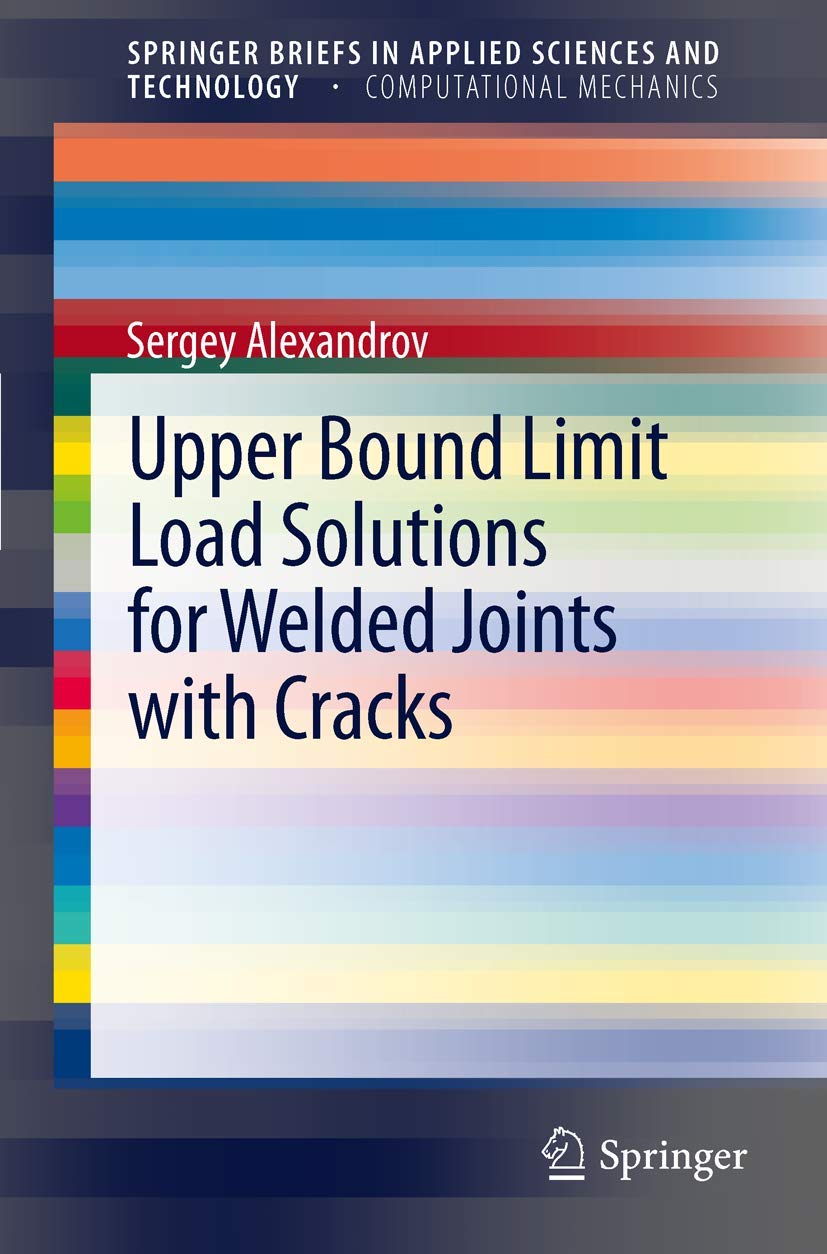
The present short monograph concerns analytic and semianalytic techniques for finding an approximate value of the limit load. The limit load is an essential input parameter of flaw assessment procedures. In most cases, finding the limit load involves some numerical calculations of different levels of complexity, including numerical minimization of functions of one or several arguments, the slipline technique and the finite element method. This book shows in particular how to use singular behavior of the real velocity field in the vicinity of bimaterial interfaces in kinematically admissible velocity fields to increase the accuracy of upper bound solutions. An approach to recalculate the limit load for a class of structures with defects with the use of its value for the corresponding structure with no defect is discussed. The upper bound technique is applied to evaluate the limit load of overmatched and undermatched welded joints with cracks subject to various loading conditions of practical importance in conjunction with the aforementioned special techniques.
⚠️ WARNING (California Proposition 65):
This product may contain chemicals known to the State of California to cause cancer,
birth defects, or other reproductive harm.
For MAP (Minimum Advertised Price) violations and Intellectual Property (IP) or Trademark concerns, please contact:
support@ergodebooks.com
⚠️ California Proposition 65 Warning: Some products sold on this website may expose you to chemicals known to the State of California to cause cancer, birth defects, or other reproductive harm. For more information, visit www.P65Warnings.ca.gov.