
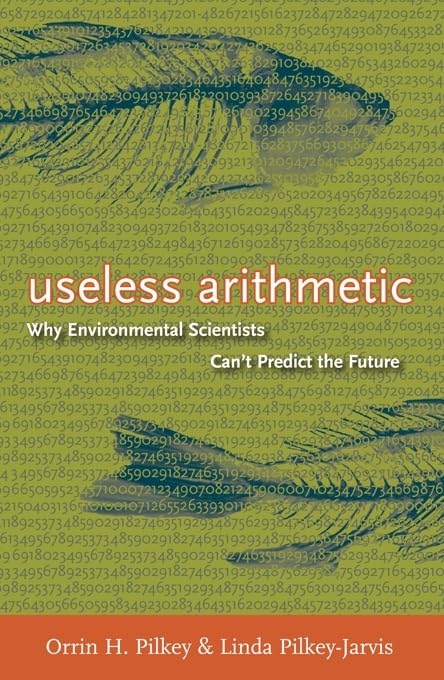
Title
Useless Arithmetic: Why Environmental Scientists Can't Predict the Future,New
Sold by Ergodebooks, an authorized reseller.
Returns accepted within 30 days | support@ergodebooks.com
Shipping Information
- Free Standard Shipping — United States only
- Processing Time: 3–5 business days
- Estimated Delivery: 6–10 business days after dispatch
- Double-boxed, fully insured & discreetly packaged
- Tracking number sent via email once dispatched
Returns & Refund
Returns accepted within 30 days of delivery.
Damaged or Defective Item
Free return shipping + replacement or full refund
Wrong Item Received
Free return shipping + replacement or full refund
Change of Mind
Return shipping at customer's expense · 25% restocking fee applies
Payment Option

Noted coastal geologist Orrin Pilkey and environmental scientist Linda PilkeyJarvis show that the quantitative mathematical models policy makers and government administrators use to form environmental policies are seriously flawed. Based on unrealistic and sometimes false assumptions, these models often yield answers that support unwise policies.Writing for the general, nonmathematician reader and using examples from throughout the environmental sciences, Pilkey and PilkeyJarvis show how unquestioned faith in mathematical models can blind us to the hard data and sound judgment of experienced scientific fieldwork. They begin with a riveting account of the extinction of the North Atlantic cod on the Grand Banks of Canada. Next they engage in a general discussion of the limitations of many models across a broad array of crucial environmental subjects.The book offers fascinating case studies depicting how the seductiveness of quantitative models has led to unmanageable nuclear waste disposal practices, poisoned mining sites, unjustifiable faith in predicted sea level rise rates, bad predictions of future shoreline erosion rates, overoptimistic cost estimates of artificial beaches, and a host of other thorny problems. The authors demonstrate how many modelers have been reckless, employing fudge factors to assure 'correct' answers and caring little if their models actually worked.A timely and urgent book written in an engaging style, Useless Arithmetic evaluates the assumptions behind models, the nature of the field data, and the dialogue between modelers and their 'customers.'
⚠️ WARNING (California Proposition 65):
This product may contain chemicals known to the State of California to cause cancer, birth defects, or other reproductive harm.
For more information, please visit www.P65Warnings.ca.gov.
- Q: How many pages does the book have? A: This book contains two hundred forty-eight pages. It provides a comprehensive examination of environmental models and their flaws.
- Q: What is the binding type of this book? A: The binding type of this book is paperback. This makes it lightweight and easy to handle.
- Q: What are the dimensions of the book? A: The book measures five point six inches in length, zero point six inches in width, and eight point six inches in height. These dimensions make it portable for reading.
- Q: Who is the author of this book? A: The author of this book is Orrin H. Pilkey. He is a noted coastal geologist with expertise in environmental science.
- Q: What genre does this book belong to? A: This book belongs to the Ecology genre. It discusses environmental policies and the limitations of mathematical models.
- Q: Is this book suitable for non-mathematicians? A: Yes, this book is written for the general, non-mathematician reader. It uses accessible language and examples from environmental sciences.
- Q: What themes are explored in this book? A: The book explores themes such as the flaws in quantitative models and the importance of field data in environmental science. It critiques how models can mislead policy decisions.
- Q: Can this book be used for educational purposes? A: Yes, this book can be used for educational purposes. It provides case studies and discussions that are valuable for understanding environmental science.
- Q: Is this book appropriate for younger audiences? A: While not specifically aimed at children, the book may be suitable for older teens interested in environmental issues. It addresses complex topics that may require prior knowledge.
- Q: How should I care for this book? A: To care for this book, keep it in a cool, dry place and avoid exposing it to direct sunlight. This will help preserve its condition.
- Q: What if the book arrives damaged? A: If the book arrives damaged, you should contact customer support for a return or replacement. Ensure you have your order details handy.
- Q: Is there a warranty on this book? A: No, books typically do not come with a warranty. However, most retailers have return policies for damaged or defective products.
- Q: How do I store this book? A: Store this book upright on a shelf or in a bookcase. This prevents warping and keeps it in good condition for future reading.
- Q: What are the key case studies mentioned in the book? A: The book discusses key case studies including the extinction of the North Atlantic cod and issues surrounding nuclear waste disposal. These examples illustrate the dangers of flawed models.
- Q: Is the content of this book based on real-world examples? A: Yes, the content is based on real-world examples from environmental science. It emphasizes the importance of field data over flawed mathematical models.
- Q: What makes this book timely and urgent? A: This book is considered timely and urgent because it addresses serious flaws in environmental policy-making that can lead to harmful decisions. The authors advocate for better scientific practices.